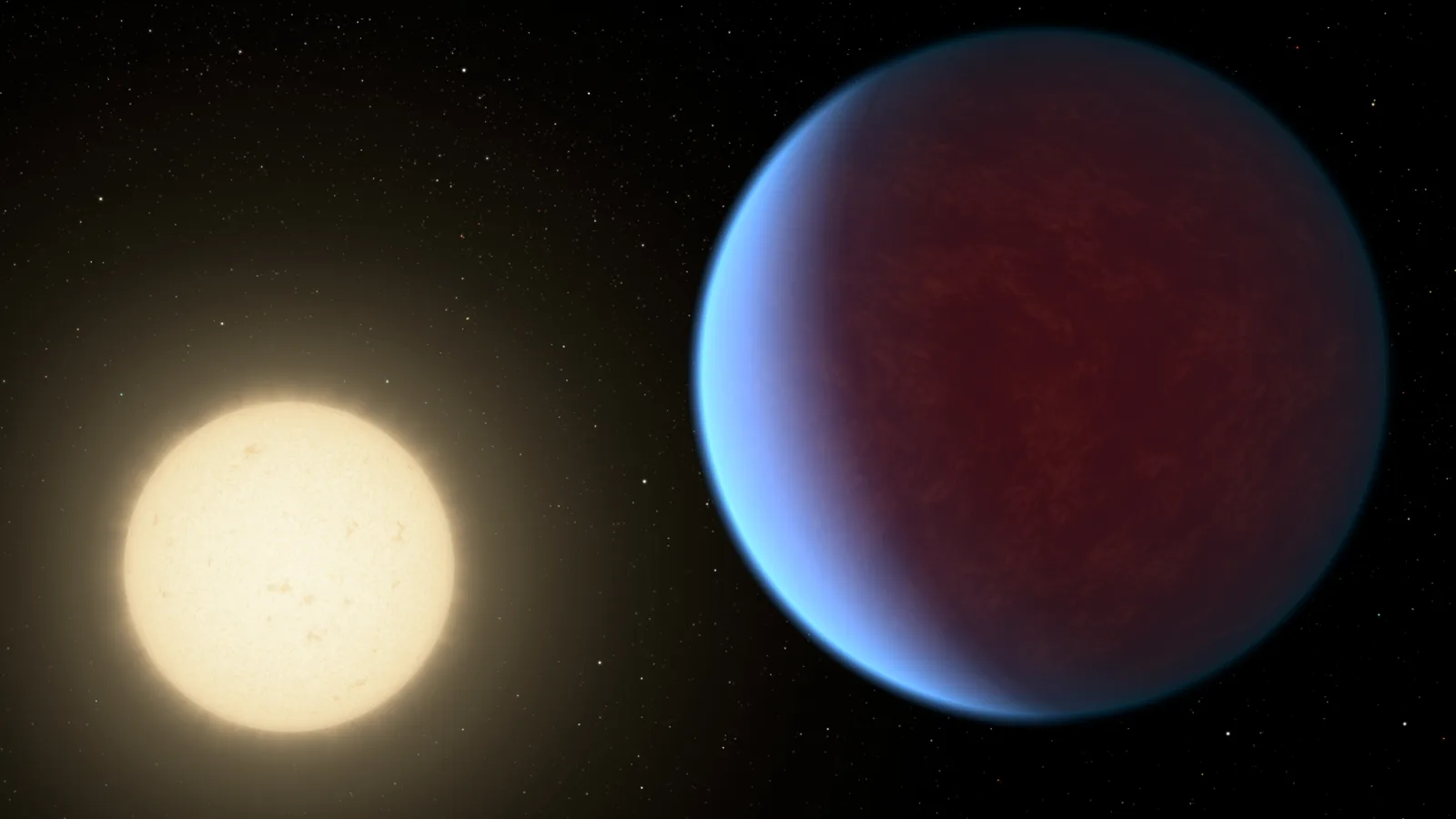
There is a planet thirty-five light-years away where you could not stand, land, or even find a surface to crash into. Its outermost shell is not rock but molten rock, an ocean of magma with no shore, and from that ocean rises a thin, restless atmosphere threaded with sulfur. Nothing in our solar system looks like it. Until recently, nothing in the exoplanet catalogs did either.
The planet is called L 98-59 d, and in March 2026 a team led by Harrison Nicholls and Tim Lichtenberg reported in Nature Astronomy that it may be the first known example of a new class of world: a molten super-Earth whose atmosphere is fed, and kept alive, by a magma ocean that never freezes over. The finding did not come from a photograph. It came from the faint chemical signature of a planet that no telescope can see as anything more than a shadow.
A super-Earth around a small red star
L 98-59 d is one of several planets orbiting L 98-59, a red dwarf star about a third the mass of the Sun, lying roughly 35 light-years from Earth in the southern constellation Volans. The system was first found by NASA's Transiting Exoplanet Survey Satellite, TESS, which catches planets by the tiny, repeating dips in starlight they cause as they cross the face of their star. L 98-59 turned out to be crowded, with a family of small worlds packed close to the star.
The planet d is a super-Earth, about 1.6 times the radius of our own. It sits near enough to its star that its dayside is scorching, hot enough, the models say, to keep rock liquid at the surface. That alone was not shocking. What drew attention was the atmosphere. Small planets around red dwarfs were widely expected to be bare rocks, their air long since stripped away by the flares and stellar wind that these turbulent stars throw off. L 98-59 d appeared to have an atmosphere anyway, and a strange one.
How JWST reads an air it cannot see
The James Webb Space Telescope does not image these atmospheres. It weighs them by their color. When a planet passes in front of its star, a sliver of starlight filters through the ring of atmosphere at its edge. Different gases absorb different wavelengths, so the filtered light arrives carrying a barcode of missing colors, each gap the fingerprint of a specific molecule. This technique, transmission spectroscopy, is how astronomers inventory the air of a world trillions of kilometers away.
Applied to L 98-59 d in 2024, JWST's instruments returned a barcode dominated by sulfur. The data pointed to sulfur dioxide, the same acrid gas that pours from volcanoes on Earth, along with signs of hydrogen sulfide, the molecule that smells of rotten eggs. A sulfur-rich sky is not something the standard recipes for rocky-planet atmospheres readily produce. It demanded an explanation for where all that sulfur was coming from, and why it had not simply been lost to space.
The planet is not venting sulfur as a dying gasp. It is exhaling it, continuously, from an interior that has never gone cold.
The ocean of fire beneath the sky
The answer Nicholls, Lichtenberg and their colleagues arrived at is a permanent magma ocean. In their model, L 98-59 d has spent its history slowly cooling and shrinking, bleeding off the lightest gases into space. But the surface never solidified. A global layer of molten rock remained, and molten rock is chemically generous: as it churns, it releases dissolved volatiles, sulfur among them, in a process planetary scientists call outgassing. The magma ocean acts as a reservoir, continuously resupplying the atmosphere with sulfur that would otherwise thin out and vanish.
Once that sulfur reaches the upper atmosphere, the star's ultraviolet light goes to work on it. Photochemistry, the rearranging of molecules by starlight, converts the outgassed sulfur into the sulfur dioxide that JWST detects. The sky, in other words, is a chemistry set powered from below by magma and from above by radiation. The two together explain a signal that neither a dead rock nor a conventional atmosphere could account for.
This is why the discovery matters beyond one planet. An atmosphere sustained by a magma ocean is direct evidence of an active, molten interior, a world still geologically alive rather than a cooled cinder. It also offers a rare window into what these hot, close-in planets are made of, because the gases in the air are, quite literally, samples of the melt beneath.
Why sulfur, and why it is a signpost
Sulfur turns out to be an unusually useful tracer. It is abundant, it dissolves readily in magma, and it produces gases that leave clear marks in the infrared where JWST is most sensitive. A thin, hydrogen-poor atmosphere loaded with sulfur compounds, the team argues, is a signpost, a tell-tale sign that a tidally heated, terrestrial planet is outgassing from a magma ocean rather than holding onto a primordial envelope of hydrogen it was born with.
That distinction is central to one of the biggest questions in exoplanet science: do rocky planets around red dwarfs keep any atmosphere at all? Red dwarfs are the most common stars in the galaxy, and most of the potentially Earth-like worlds we can study orbit them. If their planets are routinely stripped bare, the search for habitable ground narrows sharply. L 98-59 d shows that at least some of these worlds hold onto an atmosphere, even if it is an atmosphere of fire and brimstone rather than one that could ever be breathed.
The first of a new class
The researchers are careful to frame L 98-59 d not as a curiosity but as a prototype. They suggest it may be the first recognized member of a broader population: gas-rich, sulfurous planets sustaining long-lived magma oceans, a category that simply did not exist in the textbooks a few years ago. If so, the sulfur signature becomes a search tool. Point JWST at other hot super-Earths around small stars, look for the same acrid barcode, and you may be able to pick out molten worlds one spectrum at a time.
It is a reminder of how quickly the exoplanet field is still discovering entirely new kinds of object. We have found worlds of iron, worlds of water, worlds cloaked in hydrogen. Now, from thirty-five light-years away and without a single direct image, we have found a world whose defining feature is an ocean that burns and a sky that reeks of sulfur, and whose air is a message, decoded from stolen starlight, about the fire that never went out beneath it.
No telescope has seen its surface, and none may ever need to. The planet tells us what it is made of every time it exhales.
Frequently Asked Questions
What is L 98-59 d?
L 98-59 d is a super-Earth exoplanet about 1.6 times the radius of Earth, orbiting a red dwarf star roughly 35 light-years away. In 2026, astronomers concluded it likely has a permanent magma ocean that feeds a thin, sulfur-rich atmosphere, making it a candidate for a newly proposed class of molten planet.
Why does L 98-59 d have a sulfur atmosphere?
Its surface is thought to be a global ocean of molten rock. As the magma churns, it releases dissolved sulfur into the air, a process called outgassing. Ultraviolet light from the star then converts that sulfur into sulfur dioxide, the gas the James Webb Space Telescope detected.
How did astronomers detect the atmosphere?
They used transmission spectroscopy with JWST. As the planet crosses in front of its star, starlight filters through its atmosphere, and gases absorb specific wavelengths. The pattern of missing colors revealed sulfur dioxide and other sulfur compounds high in the planet's air.
Could L 98-59 d support life?
No. With a molten surface and an atmosphere of sulfur compounds, its dayside is hot enough to keep rock liquid. The planet is scientifically valuable not as a habitat but as a window into the interiors of rocky worlds and into whether planets around red dwarfs keep atmospheres at all.
Why is this discovery important?
Most potentially Earth-like planets we can study orbit red dwarfs, and it was unclear whether such planets keep any atmosphere. L 98-59 d shows that at least some do, and it may be the first known member of a broader population of sulfurous, magma-ocean worlds that astronomers can now search for by their chemistry.
Continue Exploring
- The Coldest World We Have Ever PhotographedAlmost every planet we have imaged directly is a young, glowing furnace. Then JWST captured a mature, frigid...
Sources
- Nicholls, Lichtenberg, Chatterjee, Guimond, Postolec & Pierrehumbert (2026). "Volatile-rich evolution of molten super-Earth L 98-59 d." Nature Astronomy. link.
- University of Groningen (2026). "Scientists discover a new type of molten sulphur world." research summary.
- NASA Exoplanet Archive. L 98-59 system overview (TESS discovery). link.