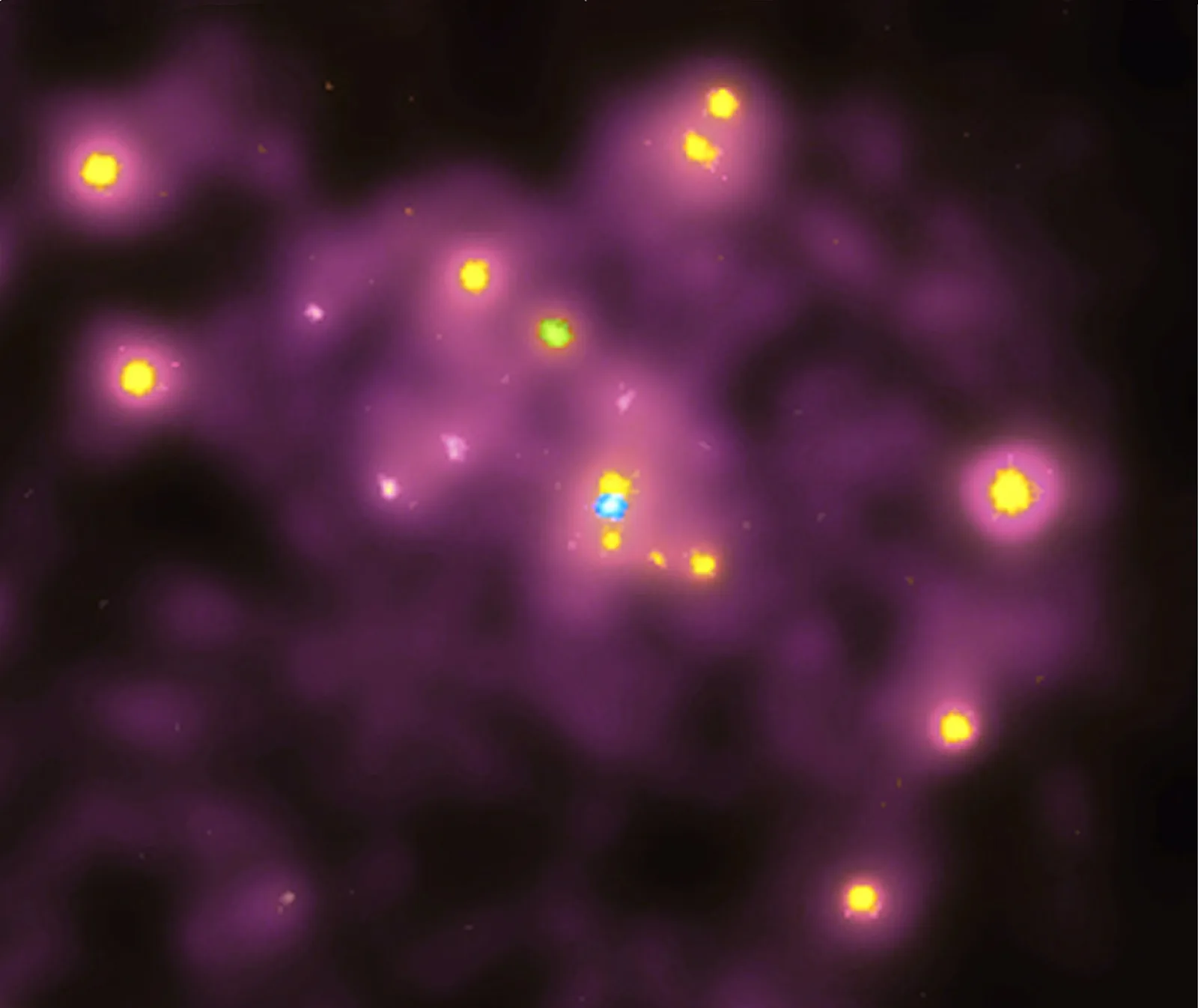
For most of the last fifteen years, the end of the Milky Way had a date on it. In roughly four and a half billion years, the textbooks said, our galaxy would meet Andromeda, the great spiral drifting toward us out of the constellation of the same name. The two would swing past each other, fall back, and over a few hundred million years braid into a single elliptical galaxy. Astronomers even gave the offspring a name: Milkomeda. It was one of the rare cosmic forecasts specific enough to feel like a promise. New measurements have quietly dissolved that promise into a question.
How the date got set
The prediction did not come from a guess. It came from one of the hardest measurements in observational astronomy: the sideways motion of an entire galaxy. Knowing that Andromeda is approaching us is easy, the light from its stars is blueshifted, compressed toward shorter wavelengths, and has been since Vesto Slipher first noticed it in 1912. But approach speed alone cannot tell you whether two objects collide or merely pass close. For that you need the transverse velocity, the component of motion across the sky, and Andromeda's is so small that for a century it was simply unmeasurable.
In 2012, a team led by Roeland van der Marel at the Space Telescope Science Institute changed that. Using the Hubble Space Telescope, Sangmo Tony Sohn and colleagues tracked tiny shifts in the positions of stars in three fields of Andromeda over baselines of five to seven years. The motion they were chasing was on the order of a hundred-thousandth of an arcsecond per year, the angular width of a coin seen from thousands of kilometers away. The answer that fell out was startling in its smallness: a tangential velocity of about 17 kilometers per second, with an uncertainty just as large.
To appreciate why that measurement mattered, it helps to remember the geometry of the problem. Andromeda is closing on us at roughly 110 kilometers per second along the line of sight. If its sideways motion were also large, the two galaxies would swing past each other like sprinters in adjacent lanes and never touch. A transverse velocity near zero, by contrast, means Andromeda is dropping toward us almost straight down the gravitational well between the two galaxies. The radial speed was easy and had been known for a century. The transverse speed was the missing piece, and it was the piece that decided everything. When it came in small, the head-on collision followed almost as a matter of bookkeeping.
A galaxy moving almost straight at us is a galaxy on a collision course. Feeding that nearly radial orbit into simulations, van der Marel's group projected that the Milky Way and Andromeda would reach their first close passage in about 3.9 billion years and fully merge at 5.86 billion years, give or take a billion and a half. The Sun, they noted, would likely be flung to a new orbit far out in the merged galaxy's halo, though it would survive the event intact. That paper, published in The Astrophysical Journal, became the source of the confident headlines.
A galaxy moving almost straight at us is a galaxy on a collision course. The trouble is that "almost" was carrying the entire prediction.
What the new data changed
The 2012 measurement was a triumph, but it rested on a velocity that was statistically consistent with zero. The error bar was as wide as the value itself. In the years since, two things improved. The European Space Agency's Gaia mission has been charting the motions of more than a billion stars with precision no previous instrument approached, and astronomers have used those motions to refine not only Andromeda's path but the masses and trajectories of the smaller galaxies that share the Local Group with us. Hubble has continued to extend its own time baselines. The picture that emerged was not a smaller error bar around the old answer. It was a different answer.
In June 2025, a team led by Till Sawala at the University of Helsinki published a reanalysis in Nature Astronomy under a title that left little to interpretation: "No certainty of a Milky Way-Andromeda collision." Rather than running a handful of orbits, the group ran thousands of simulations, drawing the positions, velocities, and masses of the relevant galaxies at random from the full range allowed by current data. The question they asked was not "when do we merge?" but "how often do we merge at all?"
The result reframed everything. Over the next ten billion years, the simulations produced a merger only about half the time. A head-on collision in the next five billion years, the scenario behind the familiar four-and-a-half-billion-year figure, turned up in fewer than one run in fifty, a probability below two percent. As Sawala put it, the chance of a Milky Way-Andromeda merger went from near-certainty to a coin flip.
The shift is worth dwelling on, because it is not the usual story of a measurement being overturned by a contradictory one. The 2012 orbit is not wrong. It sits comfortably inside the range of outcomes the new simulations explore. What changed is the recognition of how wide that range really is. When a prediction depends sensitively on a quantity known only to within its own size, a single best-fit orbit can be deeply misleading. Running the calculation thousands of times, with every input allowed to wander across its uncertainty, reveals that the head-on merger is one possibility among many rather than the destiny it had been presented as.
The galaxy nobody was counting
The single largest reason for the change is a galaxy that the original forecasts left out: the Large Magellanic Cloud. The LMC is the brightest of the Milky Way's satellites, a smudge of light visible from the southern hemisphere, and for a long time it was treated as a minor companion along for the ride. Recent mass estimates have made it harder to ignore. The cloud carries something like fifteen percent of the Milky Way's own mass, enough that its gravity does not just respond to our galaxy, it tugs back.
What matters is the direction of that tug. The Large Magellanic Cloud is falling toward the Milky Way on a path roughly perpendicular to the line connecting us to Andromeda. As it pulls on our galaxy, it nudges the Milky Way sideways, off the head-on track that the 2012 orbit assumed. A small sideways shove, applied over billions of years and millions of light-years, is enough to turn a direct hit into a near miss. When Sawala's team included the LMC, the merger probability dropped. When they left it out, the old near-certainty crept back.
A small sideways shove, applied over billions of years and millions of light-years, is enough to turn a direct hit into a near miss.
The Triangulum Galaxy, M33, pushes the other way. As Andromeda's largest satellite, M33 adds mass to the Andromeda side of the equation and, in the simulations, tends to increase the odds of a merger. The two influences do not cancel neatly. The honest outcome, with the Milky Way, Andromeda, M33, and the LMC all included, is the coin flip: close to a fifty percent chance of merging within ten billion years, and no clean date attached even to the cases that do.
Why a near miss might still end in a merger
It would be a mistake to read this as a clean acquittal. Even when the two galaxies avoid a direct collision, gravity has a long memory. In most of the simulated cases that do end in a merger, the galaxies first sail past one another. That flyby is not free. Tidal forces and a process called dynamical friction bleed orbital energy out of the system, like a satellite skimming the top of an atmosphere. Having lost momentum, the galaxies fall back toward each other and, on a later pass, finally combine.
Whether that happens hinges on a single uncertain number: how close the two come on their first passage. Sawala's team found that if the galaxies clear each other by more than roughly five hundred thousand light-years, they may keep enough energy to escape and never return. Come closer than that, and the slow spiral toward a merger begins. The trouble is that the width of that first passage is exactly the quantity that current data cannot pin down. Andromeda's sideways velocity, the same elusive number van der Marel's team first wrestled into view, still carries enough uncertainty to put the encounter on either side of the line.
Dynamical friction is the quiet engine behind all of this. As one galaxy plows through the diffuse halo of dark matter and stars surrounding the other, it stirs up a wake of material behind it, and the gravitational drag of that wake saps its forward motion. The effect is gentle on human timescales and relentless on cosmic ones. It is the same mechanism that will, with near certainty, pull the Large Magellanic Cloud into the Milky Way. Whether it does the same to Andromeda depends on whether the two galaxies pass close enough for their halos to overlap substantially in the first place. A grazing encounter generates little friction and the galaxies coast apart. A deep one generates a great deal, and the outcome is sealed.
If a merger does occur, the result would not be either spiral preserved but a new galaxy with little of the structure we recognize today. Simulations of such events, including van der Marel's own, show the ordered disks of both galaxies disrupted and their stars scattered into the puffed, featureless form of an elliptical galaxy. Star formation would flare briefly as gas clouds collided and compressed, then fade as the combined galaxy exhausted or expelled its raw material. The two central supermassive black holes would spiral toward each other over additional hundreds of millions of years and eventually merge in their own right. Milkomeda, if it forms, would be a quieter and redder object than either of its parents.
The collision that is already certain
While the fate of the great spiral merger has softened into probability, a smaller and far nearer collision has come into sharp focus. The Large Magellanic Cloud, the same galaxy now credited with possibly saving us from Andromeda, is itself doomed. Sawala's simulations find that the Milky Way will almost certainly swallow the LMC, and on a timescale that makes the Andromeda question look distant: within about two billion years.
It is a quietly poetic arrangement. The companion that may steer us clear of one merger is being consumed in another, and far sooner. The Local Group is not a static diorama with two giants destined to clash on schedule. It is a swarm of dozens of galaxies, each pulling on every other, and the largest among them are close enough in mass that no single pair can be modeled in isolation. The old prediction failed not because the physics was wrong but because the system was treated as simpler than it is.
That complexity is not a flaw in the modeling so much as a feature of where we live. The Local Group is a gravitationally bound island of galaxies, decoupled from the general expansion of the universe, and bound systems tend toward eventual consolidation. On timescales of tens of billions of years, the dwarf galaxies will be absorbed one by one, and the giants will likely find their way together. The 2025 result does not promise the Milky Way an eternity of solitude. It says that the timing and even the certainty of the great merger were claimed too soon, and that the smaller mergers reshaping our galaxy will arrive first. The endpoint may still be a single galaxy. The road to it is longer and less straight than the textbooks drew.
The Local Group is not a diorama with two giants destined to clash on schedule. It is a swarm, and every member is pulling on every other.
An honest kind of forecast
None of this means the merger is cancelled. That word, like the certainty it replaces, claims more than the data allow. The careful statement is that the Milky Way and Andromeda may merge, or may sail past one another and remain distinct galaxies for far longer than anyone expected, and that with today's measurements the two outcomes are roughly equally likely. The future of the Local Group has been returned to its proper state, which is uncertain.
The instrument that will resolve it is already at work. Each additional year of Gaia and Hubble observations narrows the error bars on Andromeda's transverse motion and on the masses of the galaxies steering the encounter. A few more years of data may push the coin flip decisively toward a merger, or decisively toward escape. Until then, the most accurate thing astronomy can say about the end of our galaxy is that it does not yet know the ending. That is not a failure of the science. It is the science working as it should, refusing to round a hard measurement up to a tidy story.
The collision once had a date. Now it has only a probability, and the most honest thing astronomy can say about the end of our galaxy is that it does not yet know the ending.
Frequently Asked Questions
Will the Milky Way and Andromeda definitely collide?
No. A 2025 study in Nature Astronomy, using improved Gaia and Hubble data, found roughly a 50 percent chance the two galaxies merge within the next ten billion years. A head-on collision in the next five billion years, the scenario behind the popular four-and-a-half-billion-year figure, has less than a two percent probability.
Why did astronomers previously think the collision was certain?
A 2012 study led by Roeland van der Marel used Hubble to measure Andromeda's sideways motion for the first time and found it moving almost directly toward us. That nearly radial orbit pointed to a near-certain merger around 5.86 billion years from now. The measurement was sound, but its uncertainty was large and it left out the gravity of other Local Group galaxies.
What changed the prediction?
Two things. Gaia and Hubble produced more precise data on the motions and masses of galaxies in the Local Group, and the new analysis ran thousands of simulations that included the Large Magellanic Cloud and the Triangulum Galaxy, which earlier forecasts had largely ignored.
How does the Large Magellanic Cloud reduce the chance of a merger?
The Large Magellanic Cloud holds roughly fifteen percent of the Milky Way's mass and is falling toward us along a path nearly perpendicular to the line to Andromeda. Its gravity nudges the Milky Way sideways, off the head-on track, enough over billions of years to turn a likely collision into a possible near miss.
What happens to the Solar System and the Sun?
Even in the merger scenarios, individual stars almost never collide, because the space between them is vast. The Sun would most likely be moved to a new orbit, possibly far out in the merged galaxy's halo, but would not be destroyed. By that era, in any case, the aging Sun will have changed dramatically on its own.
Is any galaxy collision certain for the Milky Way?
Yes. The same 2025 study finds the Milky Way will almost certainly absorb the Large Magellanic Cloud within about two billion years, long before the Andromeda question is settled.
Continue Exploring
- The Ghost Particles Passing Through YouRight now, trillions of them are streaming through your body every second, and almost none will touch a single atom....
- The Fastest Particles in the UniverseEvery second, particles from deep space slam into the atmosphere at nearly the speed of light. The most extreme carry...
Sources
- Sawala et al. (2025). "No certainty of a Milky Way-Andromeda collision (Nature Astronomy)." link.
- Sawala et al. (2024). "Apocalypse When? No Certainty of a Milky Way-Andromeda Collision (arXiv preprint)." link.
- van der Marel et al. (2012). "The M31 Velocity Vector. III. Future Milky Way-M31-M33 Orbital Evolution (ApJ 753, 9)." link.
- Sohn, Anderson & van der Marel (2012). "The M31 Velocity Vector. I. Hubble Space Telescope Proper-Motion Measurements (ApJ 753, 7)." link.
- ESA. "Gaia mission overview." link.