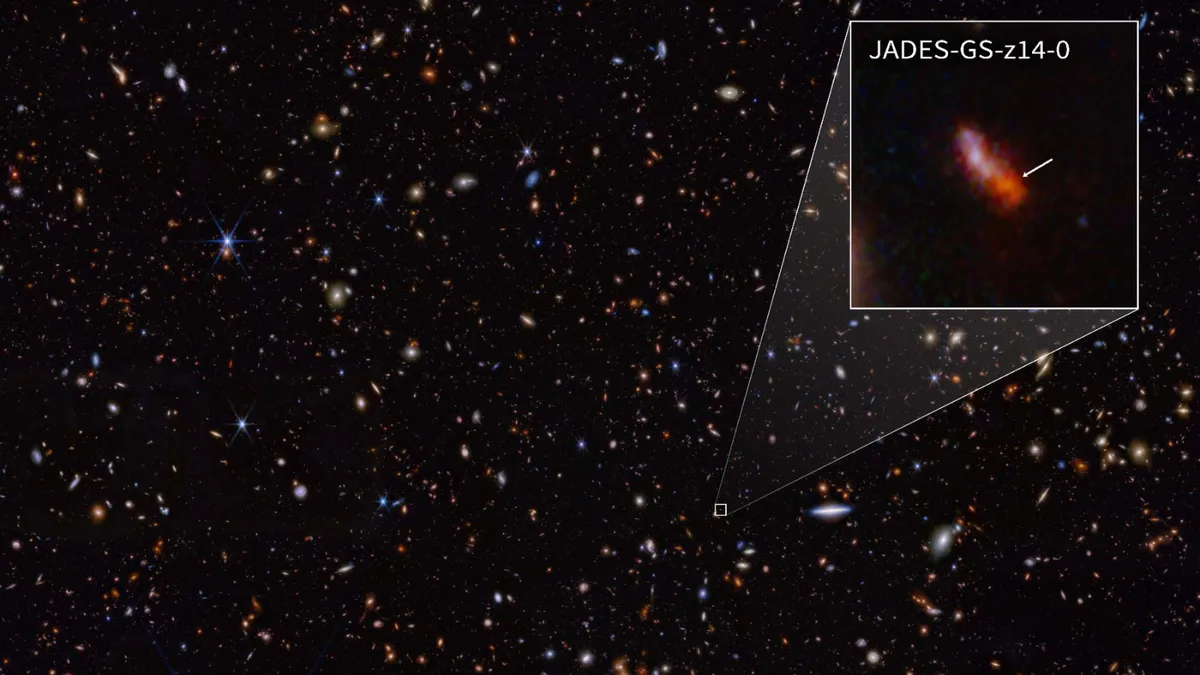
It is a single red point of light, fainter than almost anything else in the frame, and it has been traveling toward us for nearly the entire history of the universe. When the photons now striking the James Webb Space Telescope left their source, there was no Sun, no Earth, no Milky Way as we know it. The cosmos was 280 million years old, a fraction of one percent of its present age. And yet the object that emitted that light was already a galaxy: compact, blazing, and chemically enriched in a way that, by every reasonable expectation, it had no business being.
Astronomers call it MoM-z14. Its redshift, the most precise distance measurement in cosmology, is 14.44. That number makes it the most distant object ever confirmed by humanity, the new edge of the observable past. But the record is not the most interesting thing about it. The most interesting thing is that the team who found it, led by Rohan Naidu of the MIT Kavli Institute for Astrophysics and Space Research, looked at what they had caught and admitted, in effect, that the textbooks were wrong.
"With Webb, we are able to see farther than humans ever have before," Naidu said, "and it looks nothing like what we predicted."
What a redshift of 14.44 actually means
Redshift is the universe keeping time. As space itself expands, the light traveling through it gets stretched, its wavelengths dragged toward the red end of the spectrum. The more the universe has expanded since a photon was emitted, the more stretched that photon arrives. A redshift of 14.44, written as z = 14.44, means the universe has expanded so much that the light's wavelength is now more than fifteen times longer than when it set out.
Translate that into time and the numbers become almost unreal. MoM-z14's light has been in transit for roughly 13.5 billion years, out of a universe that is about 13.8 billion years old. The galaxy we see is not a galaxy as it exists now. It is a galaxy as it existed when the cosmos was 280 million years old, an epoch astronomers call cosmic dawn, when the first stars and galaxies were only beginning to switch on and burn away the neutral hydrogen fog that filled all of space.
We are not looking at a distant object. We are looking at a young universe, caught in the act of building its first structures.
This is the strange power of deep-field astronomy. Distance and time are the same axis. To photograph something 13.5 billion light-years away is to photograph the universe as it was 13.5 billion years ago. JWST, with its 6.5-meter gold-coated mirror tuned to the infrared, was built precisely to catch this ancient, stretched light, the faint embers of the first galaxies, redshifted out of the visible spectrum entirely and into the near-infrared where the telescope's instruments live.
How the discovery was confirmed
Finding a candidate for the most distant galaxy is one thing. Proving it is another. The history of high-redshift astronomy is littered with promising candidates that dissolved on closer inspection, dusty nearby galaxies masquerading as distant ones, their colors mimicking the signature of extreme redshift. Astronomers call this the "mirage" problem, and it is why MoM-z14 carries the name it does. The survey that found it, covering about 350 square arcminutes of sky, is called Mirage or Miracle. Each candidate is either an illusion or a genuinely impossible-seeming object. MoM-z14 turned out to be the latter.
The galaxy was first spotted in May 2025 by JWST's NIRCam, the Near-Infrared Camera, which images the sky and lets astronomers estimate distances from an object's colors alone. A color-based estimate is called a photometric redshift, and it is only a probability, not a measurement. To turn a candidate into a confirmed record, you need a spectrum.
That is the job of NIRSpec, the Near-Infrared Spectrograph. It splits the galaxy's light into its component wavelengths, revealing the fingerprints of specific physical processes. For MoM-z14, NIRSpec captured two decisive features. The first is a sharp drop in brightness at a particular wavelength, the Lyman-alpha break, caused by neutral hydrogen between us and the galaxy absorbing all the light above a certain energy. The position of that break pins down the redshift. The second is a set of five faint emission lines in the rest-frame ultraviolet, produced by ionized gas inside the galaxy itself. Together, the break and the lines locked the redshift at z = 14.44, with an uncertainty of just plus or minus 0.02.
It was no longer a mirage. It was a measurement.
The record it broke, and by how little
Until MoM-z14, the title of most distant confirmed galaxy belonged to JADES-GS-z14-0, found by a different JWST program in 2024 and described by Stefano Carniani of the Scuola Normale Superiore in Pisa in a paper for Astronomy & Astrophysics. Its redshift was initially measured at 14.32 and later refined to about 14.18 after the ALMA radio observatory in Chile detected oxygen in its gas and nailed the distance to a precision of 0.005 percent.
The margin between the old record and the new one is slim. In raw redshift, MoM-z14's 14.44 edges past JADES-GS-z14-0 by a small step. But that step corresponds to roughly ten million years of additional cosmic history, pushing the frontier from about 290 million years after the Big Bang back to 280 million. In a universe where the first stars are thought to have formed only a little earlier, ten million years is not trivial. It is a meaningful fraction of the entire window in which galaxies could have assembled at all.
This is the most distant object known to humanity. JWST was not expected to find any galaxies this early.
"This is the most distant object known to humanity," said Pieter van Dokkum of Yale University, a member of the team. "The broader story here is that JWST was not expected to find any galaxies this early." That last sentence is the entire problem in miniature. The telescope keeps finding things at the edge of cosmic dawn that the pre-launch models said should not be there, or should be far too faint to detect. Each new record does not just extend the frontier. It deepens the puzzle.
Why it shouldn't be this bright
The puzzle has a name among cosmologists: the problem of the impossibly early galaxies. The standard model of cosmology, known as Lambda Cold Dark Matter, describes with remarkable success how matter clumped together under gravity after the Big Bang, how dark matter halos grew, and how ordinary gas fell into those halos to form stars. The model makes a firm prediction about the early universe: galaxies at this epoch should be small, faint, and few. There simply has not been enough time for big, bright ones to assemble.
MoM-z14 defies that expectation. It has an ultraviolet brightness, measured as an absolute magnitude of about minus 20.2, that places it among a population of early galaxies JWST has found to be roughly a hundred times more luminous than pre-launch theoretical studies anticipated. To shine that brightly so soon, a galaxy must convert its gas into stars with extraordinary efficiency, in some interpretations approaching the physical ceiling where nearly every available atom of gas collapses into a star. Real galaxies in the nearby universe are nowhere near that efficient. Feedback from supernovae and radiation normally blows gas out and throttles star formation long before it runs to completion.
MoM-z14 is also tiny. Its light is concentrated within an effective radius of about 74 parsecs, roughly 240 light-years, which makes it something like fifty times smaller than the Milky Way across. All of that brightness is packed into a point. And the team found evidence that its star formation is not steady but surging: the rate at which it is forming stars appears to have jumped nearly tenfold in the last five million years before the moment we observe it. We are catching the galaxy mid-burst, in a violent episode of growth.
None of this, on its own, overturns Lambda Cold Dark Matter. The model has proven resilient. But it forces astronomers to rethink the messy astrophysics of how the first galaxies actually built themselves, perhaps through bursts of unusually efficient star formation, perhaps through a population of brighter, hotter stars than any that form today.
The nitrogen that arrived too soon
The brightness is a problem of timing. The chemistry is a deeper one. When NIRSpec dispersed MoM-z14's light, it found emission lines from nitrogen, carbon, helium, and oxygen. The presence of those elements at all is significant, because the Big Bang produced essentially only hydrogen and helium. Every atom of nitrogen, carbon, and oxygen in the universe was forged later, inside stars, and scattered into space when those stars died. To see them in a galaxy 280 million years after the Big Bang means that at least one generation of stars has already lived and died, enriching the gas, before the light we are seeing was emitted.
But it is the specific balance of elements that startled the researchers. MoM-z14 shows a ratio of nitrogen to carbon greater than one, a value described as highly super-solar, meaning far richer in nitrogen relative to carbon than our own Sun. That pattern is rare. In the present-day universe, it shows up mainly in the ancient, densely packed stellar swarms called globular clusters, and in a handful of other extreme early galaxies JWST has uncovered. It hints at an exotic origin: perhaps supermassive stars, hundreds or thousands of times the mass of the Sun, burning and dying in the crowded conditions of the early cosmos and seeding their surroundings with nitrogen in a way no ordinary star can.
The echo of a similar finding in JADES-GS-z14-0, where ALMA detected ten times more heavy elements than expected for that epoch, is hard to ignore. "It is like finding an adolescent where you would only expect babies," said Sander Schouws of Leiden Observatory, who led one of the oxygen studies. The early universe, it turns out, did not ease into maturity. By cosmic dawn, some of its galaxies had already grown up fast.
What the frontier looks like now
For decades, the deepest reaches of cosmic time were a theorist's playground, sketched in models and simulations because no telescope could see them. JWST has changed that. In just a few years it has pushed the confirmed frontier from redshifts around 11 to beyond 14, and at each step the galaxies it finds are brighter, more compact, and more chemically evolved than the models said they should be. MoM-z14 is not an anomaly standing alone. It is the most extreme member of a growing class of objects that, collectively, are telling astronomers that the first chapter of galaxy formation unfolded faster and more violently than anyone wrote down.
Whether MoM-z14 holds its record is anyone's guess. The history of this field is a history of records that last a year or less. Somewhere in JWST's data, or in observations not yet taken, there may be a galaxy at redshift 15 or 16, light from a universe even younger, even closer to the very first stars. The telescope was built to find exactly that. And if the pattern holds, whatever it finds will once again look nothing like what we predicted.
A single red point of light, traveling for almost the entire age of the universe, arrives to tell us that the cosmos grew up faster than we ever imagined. The record will fall. The puzzle it leaves behind will not.
Frequently Asked Questions
What is the most distant galaxy ever discovered?
As of 2026, the most distant confirmed galaxy is MoM-z14, with a spectroscopically measured redshift of z = 14.44. Its light left the galaxy about 280 million years after the Big Bang, making it the farthest and earliest object ever confirmed by humanity. It was found by a JWST survey led by Rohan Naidu of MIT and published in the Open Journal of Astrophysics.
How far away is MoM-z14?
MoM-z14's light has traveled for roughly 13.5 billion years to reach us, out of a universe that is about 13.8 billion years old. Because the universe has expanded enormously during that time, the galaxy is now far more distant than 13.5 billion light-years in present-day terms, but the lookback time, how long the light has been traveling, is what astronomers most often quote.
How do astronomers know it is really that far away?
The redshift was confirmed spectroscopically using JWST's NIRSpec instrument, which split the galaxy's light into a spectrum. Astronomers identified a sharp Lyman-alpha break, where hydrogen absorbs light above a certain energy, plus five faint ultraviolet emission lines. Together these features pinned the redshift to z = 14.44 with an uncertainty of just 0.02, far more reliable than a color-based photometric estimate.
Why do early galaxies like this challenge our models?
The standard Lambda Cold Dark Matter model predicts that galaxies so soon after the Big Bang should be small and faint, because there has not been enough time to build large ones. MoM-z14 is instead very bright, about a hundred times more luminous than pre-launch predictions for its epoch, and chemically enriched. It implies star formation far more efficient and rapid than models expected.
What does the nitrogen in MoM-z14 tell us?
Nitrogen, carbon, and oxygen are forged inside stars, not in the Big Bang, so their presence means at least one generation of stars had already lived and died. MoM-z14's unusually high nitrogen-to-carbon ratio resembles that of ancient globular clusters and hints at an exotic source, possibly supermassive stars enriching the galaxy in the dense conditions of the early universe.
Will telescopes find galaxies even farther away?
Very likely. In a few years JWST has pushed the frontier from redshift 11 to beyond 14, and each record has tended to last a year or less. Astronomers expect to find galaxies at redshift 15 or higher, closer still to the era of the first stars. Future facilities and continued JWST surveys are designed to keep extending this frontier.
Continue Exploring
- The Oldest Light in the UniverseEverywhere you point a radio dish, a faint glow answers back: the cooled afterglow of the Big Bang, released when the...
- The Fraction of a Second That Made EverythingCosmic inflation says the universe expanded faster than light in its first instant, smoothing space and seeding every...
- The Collision That Left Its Own Gravity BehindWhen two galaxy clusters smashed through each other, the visible matter slowed and the gravity kept going. The gap...
- The Hunt for a Star Made of Nothing but the Big BangThe first stars formed from pure hydrogen and helium, with no heavier element to cool the gas, so theory says they grew...
Sources
- Naidu et al. (2025). "A Cosmic Miracle: A Remarkably Luminous Galaxy at z_spec = 14.44 Confirmed with JWST (Open Journal of Astrophysics)." link.
- Naidu et al. (2025). "A Remarkably Luminous Galaxy at z_spec = 14.44 (arXiv preprint 2505.11263)." link.
- NASA / STScI (2026). "NASA's Webb Pushes Boundaries of Observable Universe Closer to Big Bang." link.
- Carniani et al. (2024). "A shining cosmic dawn: spectroscopic confirmation of JADES-GS-z14-0 (NASA Webb blog)." link.
- ESO (2025). "Oxygen discovered in most distant known galaxy (ESO press release eso2507)." link.
- Boylan-Kolchin (2023). "Stress testing Lambda-CDM with high-redshift galaxy candidates (Nature Astronomy / arXiv 2208.01611)." link.