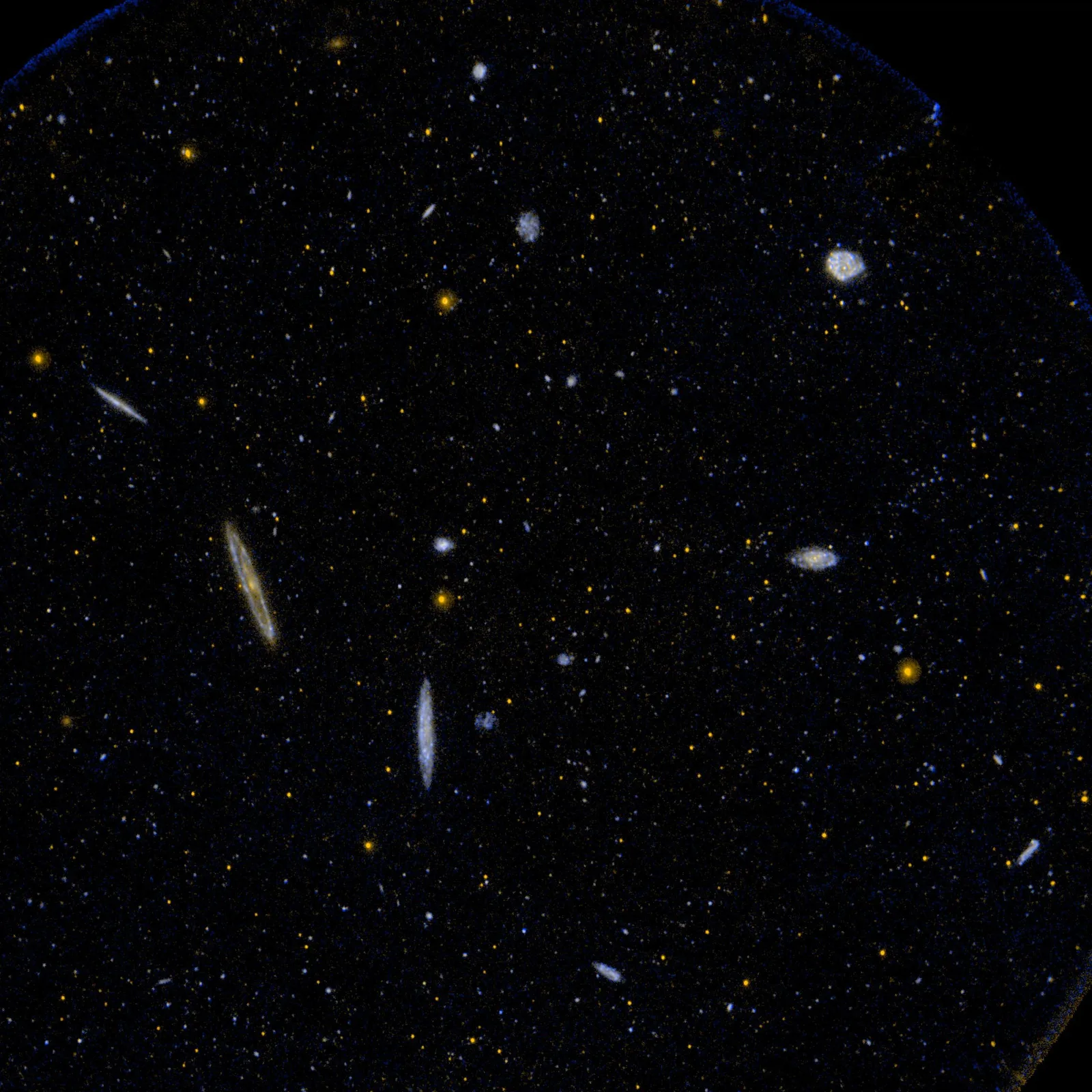
Right now, without any sensation of speed, you are moving. The Sun carries the Earth around the galaxy. The galaxy drifts through its local crowd. And the entire crowd, the Milky Way and its neighbors together, is falling at roughly 631 kilometers per second toward a patch of sky we can barely see. The thing doing the pulling has a name that sounds like a confession of ignorance, because in 1986 it was exactly that. Astronomers called it the Great Attractor.
A direction in the sky, and a problem
The story begins not with a discovery but with a discrepancy. In the cosmic microwave background, the faint afterglow of the Big Bang that fills the entire sky, one side is very slightly warmer than the other. This lopsidedness, the dipole, is not a feature of the early universe. It is a Doppler signature. It tells us that our whole Local Group of galaxies is in motion relative to the background radiation, and it gives both the speed and the direction of that motion.
The speed is large. Measured against the cosmic microwave background, the Local Group moves at 631 kilometers per second, a figure refined over decades and reported with an uncertainty of about 20 kilometers per second by Yehuda Hoffman and colleagues in 2017. That is more than two million kilometers per hour. The expansion of the universe does not explain it. Expansion carries galaxies apart smoothly; it does not single out one direction and shove an entire population of galaxies toward it. Something gravitational, something with mass, had to be responsible. The only question was what, and where.
In the late 1980s a group of seven astronomers set out to answer it. Alan Dressler, Sandra Faber, David Burstein, Roberto Terlevich, Donald Lynden-Bell, Roger Davies, and Gary Wegner measured the distances and motions of nearly 400 elliptical galaxies. The trick was that a galaxy's distance can be estimated independently of its redshift. For elliptical galaxies, the team used a relationship between a galaxy's size and the internal speeds of its stars, a method that yields a distance without reference to how fast the galaxy appears to be receding. Compare that distance with the redshift and the difference is the galaxy's peculiar velocity, its motion on top of the universal expansion.
The team, who came to be known half-jokingly as the Seven Samurai, found that galaxies across a huge swath of sky were not drifting at random. They were streaming, coherently, in the same direction the dipole pointed. In their 1988 paper in The Astrophysical Journal, they reported that the Local Group and its surroundings were sliding at roughly 600 kilometers per second toward a region in Hydra-Centaurus that contained no single dominant object large enough to obviously account for the flow. They proposed that the pull came from a great, partly hidden concentration of mass farther out, and gave it the placeholder name that stuck. The Great Attractor was, at first, a hypothesis built entirely out of motion.
The galaxies were not scattered like dust in still air. They were a river, and every measurement pointed downstream toward the same hidden basin.
The thing we cannot look at
The direction the river flowed was, cosmically speaking, cruel. It pointed almost exactly through the plane of the Milky Way, toward the southern constellations of Norma and Triangulum Australe. That plane is where our own galaxy's stars, gas, and dust are densest. Looking through it is like trying to read a distant billboard through a snowstorm lit from inside. Astronomers call this band of obscured sky the Zone of Avoidance, because it is the region surveys have historically had to avoid. Roughly a fifth of the extragalactic sky is hidden behind it.
The Great Attractor sits squarely inside that zone. Estimates place its center somewhere between 150 and 250 million light-years away, or 47 to 79 megaparsecs. For years that was nearly all anyone could say about it: a direction, a rough distance, and a mass large enough, on the order of ten thousand trillion solar masses in early estimates, to organize the motion of everything around us. The object itself was a smudge behind the curtain.
The obscuration is not total. Dust dims optical light severely but lets longer wavelengths through, so the curtain thins as you move from visible light to the infrared and then to radio. Neutral hydrogen gas, which fills spiral galaxies, glows at a radio wavelength of 21 centimeters that passes almost unimpeded through the galactic plane. By tuning surveys to that line and to penetrating infrared bands, astronomers could detect galaxies that no optical photograph would ever show, recovering structure in the very part of the sky where the Great Attractor was thought to lie.
Renee Kraan-Korteweg and her collaborators spent years pulling that curtain aside. Working at optical, infrared, and radio wavelengths that penetrate dust to different degrees, they conducted deep surveys behind the southern Milky Way. What emerged was a massive, previously underappreciated galaxy cluster: ACO 3627, the Norma Cluster, sitting about 230 million light-years away, close to the heart of the Great Attractor. Norma is one of the most massive clusters in the local universe, with a mass on the order of a million billion suns, and it had been hiding in plain sight, dimmed by our own galaxy's dust. It was the densest visible knot in the structure pulling us, though as the next two decades would reveal, it was not the whole story.
Mapping a basin instead of a point
For a long time the Great Attractor was treated as a destination, a place we were falling toward, as if it were a single great mass at the bottom of a hill. In 2014 a team led by R. Brent Tully at the University of Hawaii changed the question. Instead of asking where we are falling, they asked which galaxies fall the same way we do.
Their tool was the same one the Seven Samurai had pioneered, peculiar velocities, but applied to far more galaxies with far better data, a catalog called Cosmicflows. With thousands of measured galaxy motions, Tully and his colleagues, Helene Courtois, Yehuda Hoffman, and Daniel Pomarede, built a flow field, a map of which way every galaxy is drifting once the universal expansion is subtracted out. Then they drew the watershed. On Earth, a watershed is the boundary that separates rain flowing to one ocean from rain flowing to another. In their map, the boundary separated galaxies flowing toward our local gravitational basin from galaxies flowing toward someone else's.
Everything inside our basin, the authors argued, deserves to be called a single structure. They named it Laniakea, a Hawaiian phrase meaning immense heaven, in honor of the Polynesian navigators who read the sky to cross the Pacific. The result, published in Nature in September 2014, redrew our cosmic address.
A supercluster, they proposed, is not a pile of galaxies but a region of agreement, every galaxy inside it sliding toward the same distant floor.
Our address: Laniakea
Laniakea is enormous. It spans roughly 520 million light-years, about 160 megaparsecs, and contains on the order of 100,000 large galaxies. Its total mass is staggering, around 100 million billion times the mass of the Sun, or about 10 to the 17th power solar masses. The Milky Way does not sit at its center. We live out near one edge, in a thin filament, and the whole filament is sliding inward.
The floor of the basin, the point toward which the internal flows converge, is the Great Attractor. So the anomaly the Seven Samurai chased in the 1980s turns out to be the gravitational focus of the supercluster we live in. The Norma Cluster marks roughly where that focus lies. The pull is real, it is local in cosmic terms, and we are inside its watershed.
But Laniakea is not the end of the slope. Beyond the Great Attractor, in the same direction, lies something larger still.
The Shapley Concentration behind the curtain
Some 650 million light-years away sits the Shapley Concentration, the most massive single agglomeration of galaxies in the nearby universe. First noticed by Harlow Shapley in 1930 as an unusual density of galaxies, it is now understood to be a supercluster of superclusters, around twenty rich galaxy clusters packed into one region, the largest concentration of mass within about a billion light-years of us.
Shapley lies roughly in the same direction as the Great Attractor, only farther. This led to a long-running picture in which the Great Attractor was a nearer waypoint and Shapley the deeper, more massive influence beyond it, both tugging us in broadly the same direction. The two were not rivals so much as a near pull and a far pull along one line of sight. By the 2010s, careful accounting identified the Shapley Concentration as the dominant attractor in the local flow, the single largest gravitational pull on Laniakea. Its mass, spread across some twenty rich clusters, runs into the tens of thousands of trillions of solar masses, enough to bend the trajectories of galaxies hundreds of millions of light-years away.
And yet, even Shapley plus everything between us and it did not fully account for our speed. The sum of the pulls came up short. The Local Group was moving faster than the visible attractors could explain. Something was missing from the bookkeeping, and the missing piece was not an attractor at all.
The void that pushes
In 2017, Hoffman, Pomarede, Tully, and Courtois proposed a resolution that inverted the intuition. Motion in the universe is not only about being pulled toward mass. It is equally about being pushed away from its absence. An underdense region, a cosmic void, exerts a relative push on everything around it, because matter elsewhere pulls harder than the empty region does. The void acts, in effect, like a hill you are rolling away from.
Mapping the full three-dimensional flow field, the team found exactly such a region on the opposite side of the sky from Shapley. They called it the Dipole Repeller, a vast underdensity sitting at a distance of about 16,000 kilometers per second in redshift units, roughly 700 million light-years away. We are being pushed away from it at the same time we are pulled toward Shapley, and the two effects point the same way. Together they explain the dipole. The attractor and the repeller, the team found, contribute in roughly equal measure to our 631 kilometers per second.
We are not simply falling toward something. We are being squeezed, pulled forward by a distant concentration of galaxies and pressed from behind by an emptiness almost as influential as the mass.
This is the part that reframes the whole picture. For thirty years the question was what we were falling toward. The answer turned out to require also asking what we were falling away from. The Great Attractor is real, but it is a milepost on a longer journey, and half the force driving that journey comes from a place where there is almost nothing at all.
What it does not mean
It is tempting to imagine the Great Attractor as a cosmic drain that will one day swallow us, but the universe has a countermove. On the scales we are discussing, dark energy is accelerating the expansion of space. Over billions of years that acceleration is expected to win against the gravitational basin, stretching the distances within Laniakea faster than the inward flow can close them. The supercluster, current models suggest, is not destined to collapse into a single point. Its galaxies are sliding toward a floor that is, very slowly, falling out from under them.
So we are caught in a brief and beautiful moment. The Local Group will never reach the Great Attractor. The flow we measure is the fading momentum of a structure that the expanding universe is already beginning to pull apart. We are reading the motion of a river that is quietly running dry.
What remains astonishing is how we know any of this. No telescope ever resolved the Great Attractor as a glowing object the way it resolves a galaxy or a star. The structure that organizes the motion of a hundred thousand galaxies was inferred almost entirely from how things move, from the slight disagreement between where galaxies are and where their redshifts say they should be. We mapped something hidden behind our own galaxy by watching the universe lean toward it.
You felt nothing as you read this, and yet you traveled hundreds of thousands of kilometers, carried toward a structure no one has ever clearly seen, pushed by an emptiness on the far horizon. The universe leans, and so do we.
Frequently Asked Questions
What is the Great Attractor?
The Great Attractor is a concentration of mass about 150 to 250 million light-years away, in the direction of the constellations Norma and Triangulum Australe, that pulls the Milky Way and thousands of nearby galaxies toward it. It marks the gravitational focus of our home supercluster, Laniakea, with the Norma Cluster (ACO 3627) at roughly 230 million light-years near its core.
How fast is the Milky Way moving toward it?
Our Local Group of galaxies moves at about 631 kilometers per second relative to the cosmic microwave background, a figure measured with an uncertainty of roughly 20 kilometers per second. That motion is the combined result of being pulled toward the Shapley Concentration and pushed away from a void called the Dipole Repeller, both contributing in roughly equal measure.
Why can't we see the Great Attractor directly?
It lies in the Zone of Avoidance, the band of sky blocked by the dense dust, gas, and stars of our own Milky Way's disk. About a fifth of the extragalactic sky is hidden this way. Surveys using infrared and radio wavelengths, which penetrate dust, have revealed clusters like Norma that optical telescopes could not see clearly.
What is the Laniakea Supercluster?
Laniakea is the supercluster that contains the Milky Way, defined in 2014 by R. Brent Tully and colleagues as the full region of galaxies whose motions converge toward the same gravitational basin. It spans roughly 520 million light-years, holds about 100,000 large galaxies, and has a mass near 100 million billion suns. The name means immense heaven in Hawaiian.
What is the Dipole Repeller?
The Dipole Repeller is a vast underdense region, a cosmic void, located about 700 million light-years away on the opposite side of the sky from the Shapley Concentration. Because it contains less matter than its surroundings, it effectively pushes galaxies away from it. Identified by Hoffman and colleagues in 2017, it accounts for roughly half of the Local Group's motion, with Shapley's pull accounting for the rest.
Will the Great Attractor eventually pull the Milky Way into it?
No. On these scales the accelerating expansion of the universe, driven by dark energy, is expected to overcome the inward flow. Rather than collapsing onto the Great Attractor, the galaxies of Laniakea are gradually being carried apart by expanding space. The Local Group will never arrive at its destination.
Continue Exploring
- The Great Nothing: A Hole in the Universe 330 Million Light-Years WideIn 1981, a redshift survey turned up an emptiness so vast that if the Milky Way sat at its center, we might not have...
Sources
- Lynden-Bell et al. (1988). "Spectroscopy and Photometry of Elliptical Galaxies. V. Galaxy Streaming toward the New Supergalactic Center." link.
- Tully et al. (2014). "The Laniakea supercluster of galaxies, Nature 513, 71-73." link.
- Hoffman et al. (2017). "The Dipole Repeller, Nature Astronomy 1, 0036." link.
- Hoffman et al. (2017). "The Dipole Repeller (preprint), arXiv:1702.02483." link.
- Woudt, Kraan-Korteweg et al. (2008). "The Norma cluster (ACO 3627) I: A dynamical analysis of the most massive cluster in the Great Attractor, MNRAS 383, 445-457." link.