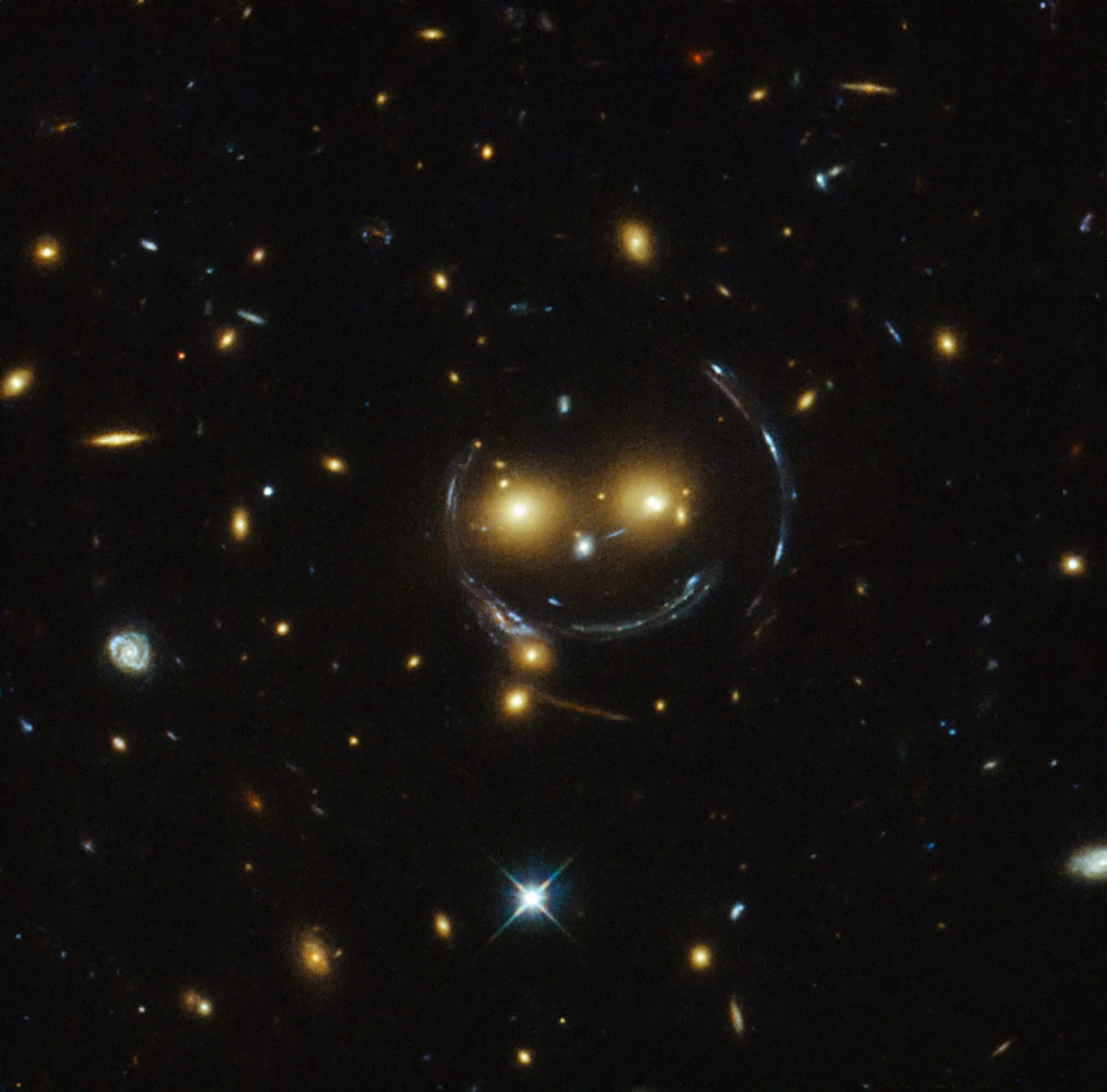
Look through the bottom of a wine glass at a candle flame and it splits, stretches, and warps. The glass bends the light on its way to your eye. The universe does the same thing, on an unimaginable scale, with no glass at all. A galaxy in the foreground, or a cluster of them, can bend the light of a more distant galaxy behind it, smearing it into arcs, splitting it into multiple copies, and in the most symmetric cases, wrapping it into a complete ring of light. Nothing is touching the light. Gravity alone is doing the bending.
This is gravitational lensing, and it is one of the most direct and beautiful confirmations of Einstein's theory of gravity. It has also become a tool: by measuring how much a foreground mass distorts the light behind it, astronomers can weigh that mass, including the vast amounts of it they cannot see.
Mass tells light where to go
In Einstein's general relativity, mass and energy curve the fabric of spacetime, and light always travels along the straightest available path through that curved geometry. Near a massive object, the straightest path is bent. So starlight grazing a heavy body is deflected, not because a force tugs on it, but because the space it moves through is warped. The more mass, the sharper the bend.
Einstein worked out the effect and, in a 1936 paper, described how a foreground star could split a background star into a ring of light, though he doubted such alignments would ever be seen. He was thinking too small. On the scale of galaxies and galaxy clusters, with their enormous masses and the vast distances involved, the alignments are common enough that telescopes now find them by the thousands.
No lens, no glass, no force reaches out to grab the light. The mass simply bends the space, and the light has no choice but to follow.
The eclipse that proved Einstein right
The first test came in 1919. Einstein's theory predicted that the Sun's gravity should deflect the light of stars passing near its edge by a specific, tiny amount, twice what Newton's older theory allowed. The only way to see stars next to the Sun was during a total solar eclipse. Arthur Eddington led expeditions to observe one, measured the shifted positions of stars near the eclipsed Sun, and found the deflection Einstein predicted. The result made headlines around the world and turned Einstein into a global figure overnight. Gravity bending light had gone from equation to observation.
Rings, arcs, and multiple images
When a distant galaxy sits almost exactly behind a foreground mass, its light bends around all sides equally and forms an Einstein ring, a luminous circle framing the lens. Perfect alignments are rare, so more often the background galaxy appears as bright curved arcs or as several separated images of the same object, two, four, or more copies of a single galaxy scattered around the lens. Astronomers can recognize these copies because they share the same color and spectrum, fingerprints of a single source seen multiple times.
Lensing comes in two strengths. Strong lensing produces the dramatic rings and multiple images near very massive, well-aligned lenses. Weak lensing is subtler: across large patches of sky, the shapes of countless distant galaxies are stretched by a fraction of a percent, a faint distortion detectable only by averaging over thousands of them. Both carry information, and both are now central to cosmology.
Weighing the invisible universe
The most powerful use of lensing is weighing dark matter. Because lensing responds to all mass, seen or unseen, the amount of bending a cluster produces reveals its total mass, which turns out to be far greater than the visible stars and gas can account for. The excess is dark matter, and lensing lets astronomers map where it sits. The famous Bullet Cluster, where the dark matter and visible gas were seen to separate after a collision, was mapped precisely this way.
Lensing also acts as a natural telescope. A massive cluster in the foreground magnifies the faint galaxies behind it, letting instruments like the James Webb Space Telescope see objects that would otherwise be too dim and distant to detect. Some of the earliest galaxies ever found were caught only because a cluster's gravity magnified their light. The bent sky, once a curiosity that proved a theory, is now one of the sharpest instruments we have for seeing both the invisible and the impossibly far.
The same warp that turns a galaxy into a ring also weighs the dark matter around it and magnifies the dawn of the cosmos. Gravity is the lens.
Frequently Asked Questions
What is gravitational lensing?
Gravitational lensing is the bending of light by gravity. When a massive object like a galaxy or galaxy cluster lies between us and a more distant light source, its gravity warps spacetime and bends the light around it, distorting the background object into arcs, multiple images, or a ring.
What is an Einstein ring?
An Einstein ring forms when a distant galaxy sits almost exactly behind a foreground mass. The background light is bent equally around all sides of the lens and appears as a luminous circle. Einstein described the effect in 1936 but thought such perfect alignments would never be observed.
How did gravitational lensing prove Einstein right?
In 1919, Arthur Eddington observed a total solar eclipse and measured how much the Sun's gravity shifted the apparent positions of nearby stars. The deflection matched Einstein's general relativity, twice the value Newton's theory allowed, confirming that gravity bends light.
How does lensing reveal dark matter?
Lensing responds to all mass, whether it emits light or not. The amount a galaxy cluster bends background light reveals its total mass, which far exceeds the visible stars and gas. The unseen excess is dark matter, and lensing lets astronomers map where it lies.
What is the difference between strong and weak lensing?
Strong lensing produces dramatic rings, arcs, and multiple images near very massive, well-aligned lenses. Weak lensing is a subtle stretching of the shapes of many distant galaxies by a fraction of a percent, detectable only by averaging over thousands of them across the sky.
Continue Exploring
- The Telescope Mapping the Dark UniverseOrdinary matter, everything we can see, is a rounding error in the cosmos. The rest is dark matter and dark energy. A...
- The Exploding Stars That Measure the UniverseA certain kind of stellar explosion always detonates at nearly the same brightness. That reliability turned dying white...
Sources
- Einstein, A. (1936). "Lens-Like Action of a Star by the Deviation of Light in the Gravitational Field." Science. link.
- Dyson, Eddington & Davidson (1920). Results of the 1919 eclipse expedition. Philosophical Transactions of the Royal Society. link.
- NASA/ESA. Hubble and JWST gravitational lensing science. link.