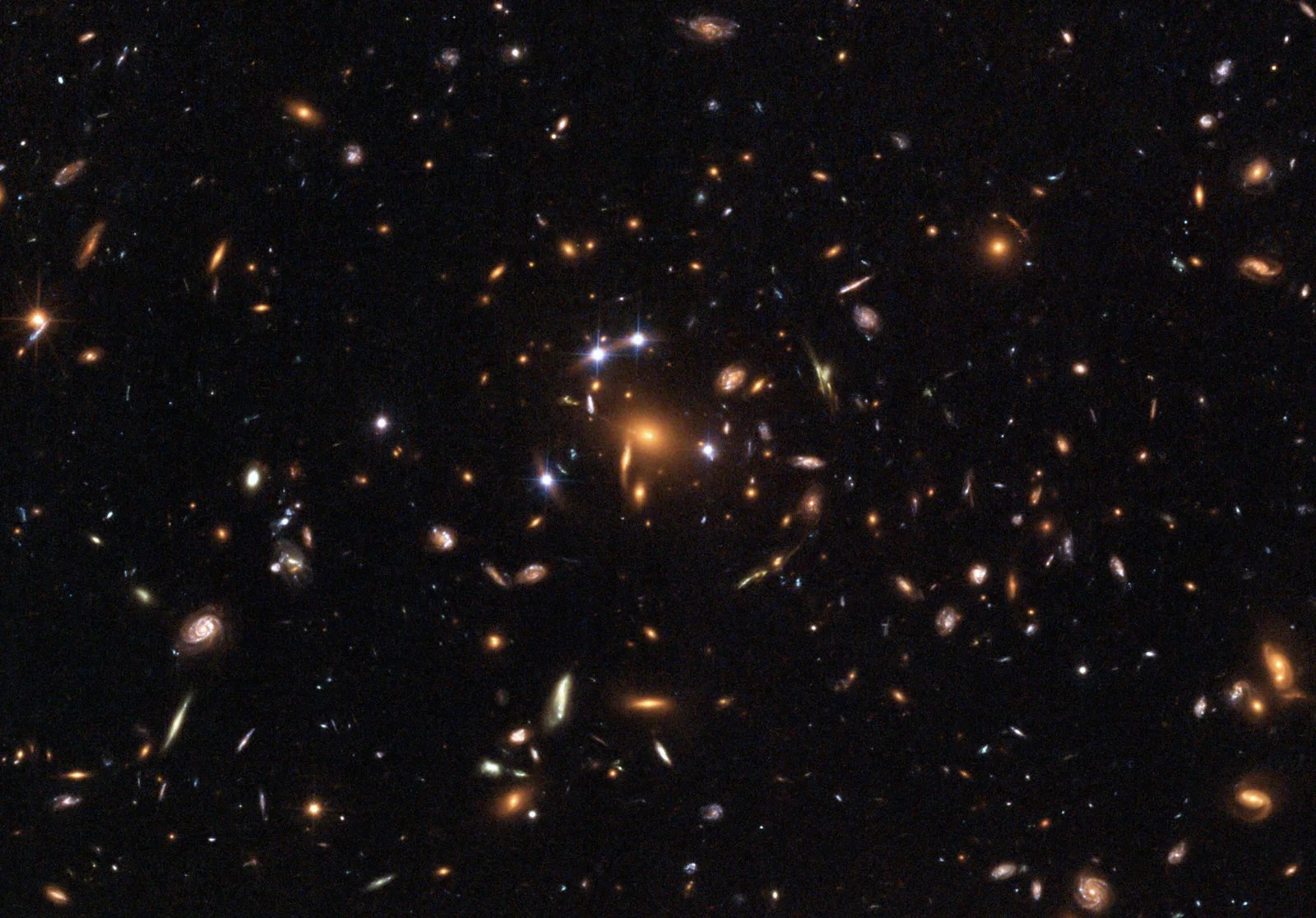
Roughly 3.8 billion light years from Earth, in the southern constellation Carina, two galaxy clusters did something violent and slow. They fell toward each other for an age, then passed straight through one another at thousands of kilometers per second. The galaxies barely noticed. The gas screamed. And when the dust settled, the gravity was no longer where the matter was. That last fact, plainly stated, is the reason a single object known as the Bullet Cluster has become the most cited piece of evidence that dark matter is real.
A cluster is mostly the stuff you cannot see in starlight
To understand why the collision matters, you have to abandon a comfortable intuition about what a galaxy cluster is made of. A cluster looks, in an optical photograph, like a swarm of galaxies. Those galaxies, with their hundreds of billions of stars each, feel like the substance of the thing. They are not. By mass, the stars are a rounding error.
Most of the ordinary matter in a massive cluster is not in stars at all. It sits between the galaxies as a thin, ferociously hot plasma, heated to tens of millions of degrees by the cluster's own gravity. That gas is invisible to the eye but blazes in X-rays, which is why an X-ray telescope is the right instrument to weigh the normal matter. In the Bullet Cluster, the X-ray gas outmasses all the stars in all the galaxies by a wide margin. It is the dominant baryonic component, the bulk of the matter we know how to detect by the light it emits.
Then there is the third ingredient, the one that does not emit light at any wavelength. Decades of measurements, from the rotation of galaxies to the temperature ripples in the cosmic microwave background, point to far more gravitating mass in the universe than the luminous matter can account for. The standard name for the missing mass is dark matter. The standard objection is that you can never see it, only infer it, and an inference is not a sighting.
That objection has real force. Almost every argument for dark matter is an argument from absence. A galaxy rotates too fast for the stars it contains, so we posit extra mass to hold it together. A cluster moves too quickly to stay bound by its visible matter, so we posit extra mass to bind it. In each case the dark matter is added precisely where it is needed, by hand, to balance the books. A skeptic can reasonably reply that you have not discovered a substance, you have only named a discrepancy. The power of the Bullet Cluster is that it breaks this pattern. It does not ask you to balance a budget. It shows you two things that should sit together, the visible matter and the gravity, sitting in different places.
The Bullet Cluster is the experiment that turns the inference into something closer to a sighting.
What happens when you fire one cluster through another
The object's formal designation is 1E 0657-56, discovered in 1995 in X-ray data. Its nickname comes from a compact, bullet-shaped cloud of gas tearing away from the smaller of the two clusters. Both clusters sit at a redshift of about 0.296, the distance light covers in roughly 3.8 billion years.
Here is the mechanics of the collision, and the mechanics are the whole story. When two clusters merge, their three components behave in three different ways, governed by what each component is willing to collide with.
The galaxies behave almost like ghosts. Stars are tiny compared with the distances between them, so when two clusters interpenetrate, the galaxies of one sail through the galaxies of the other without anything actually hitting. They are slowed only by gravity, gently, and they keep moving in the direction they were already going.
The hot gas behaves like a fluid, because it is one. The plasma of one cluster cannot pass through the plasma of the other untouched. It rams, compresses, shocks, and stalls. In the Bullet Cluster, Chandra X-ray Observatory data revealed exactly this, a textbook bow shock plowing ahead of the bullet cloud. Maxim Markevitch and colleagues measured the shock and found the bullet moving at a Mach number of roughly 2 to 3, on the order of 3,000 to 4,000 kilometers per second relative to the main cluster, with the cores having swept through each other only about 0.1 to 0.2 billion years ago. The gas, in short, got left in the middle, lagging behind the galaxies that flew on past it.
The galaxies sailed through like ghosts. The gas slammed to a halt. The question was where the gravity went.
So after the collision you have a peculiar arrangement. The galaxies of each cluster are out in front, separated by a large gap. The gas, which is most of the visible matter, is stranded in the center between them. If the visible matter were all the matter there is, then the gravity of the system should follow the gas, because the gas is where the mass is.
Weighing a collision with light that never reaches the gas
The second instrument in this story does not measure light from the cluster at all. It measures light from far behind it.
Mass bends spacetime, and spacetime bends the paths of light rays passing through it. A massive foreground object therefore acts as a lens, subtly distorting the apparent shapes of the distant galaxies behind it. The effect on any single background galaxy is too small to notice, but across thousands of faint galaxies it produces a coherent statistical stretching. Reverse the distortion mathematically and you recover a map of where the gravitating mass actually sits, regardless of whether that mass shines. This technique is called weak gravitational lensing, and it is the only way to weigh a system using gravity alone.
Douglas Clowe and his collaborators built that lensing map of the Bullet Cluster using observations including the European Southern Observatory's Wide Field Imager and the Magellan and Hubble telescopes. The technique is demanding. Each background galaxy is intrinsically some random shape, and the lensing distortion is a faint percent-level shear laid on top of that randomness. Only by averaging over many thousands of galaxies does the coherent signal of the foreground mass emerge from the noise. The work had been building for years. An earlier reconstruction by Clowe, Anthony Gonzalez, and Maxim Markevitch in 2004 had already flagged the offset between the main cluster's mass peak and its X-ray gas at the level of several sigma, and the 2006 result tightened and extended it. The map answers one question. Where is the gravity?
It is not on the gas. The two peaks of gravitational mass sit out in front, aligned with the two clouds of galaxies, well separated from the X-ray gas trapped in the middle. The mass went one way; the bulk of the visible matter went the other.
Why the offset is the entire argument
That separation is the result, and it is worth being precise about why it is so hard to argue with. In a normal, undisturbed cluster, the gas, the galaxies, and the gravity all pile up in the same place. You cannot tell them apart, and so you cannot prove that any extra mass exists. The collision is what pulls them apart. By ram-pressure stripping the gas out of the galaxies, the merger performs a kind of separation that nature almost never offers, sorting the matter by how it responds to a crash.
The dominant visible matter, the gas, is in the middle. The dominant gravitating mass is on the outside. The only way to put most of the gravity where the galaxies are, rather than where most of the ordinary matter is, is to have a great deal of additional mass that travelled with the galaxies. That mass must be something that, like the galaxies, passed through the collision almost without interacting. Something collisionless. Something that does not feel the ram pressure that stranded the gas. Dark matter is precisely such a substance.
Clowe and colleagues published the result in 2006 in The Astrophysical Journal Letters under a title that left no room for hedging, "A Direct Empirical Proof of the Existence of Dark Matter." They measured the offset between the gravitational mass center and the baryonic mass center at the 8-sigma level, a statistical confidence far beyond the threshold physicists normally treat as a discovery. Their conclusion was that the offset cannot be produced by changing the law of gravity, and therefore the majority of the matter in the system is unseen.
In a quiet cluster, gravity and matter sit in the same place, so neither can prove anything. The collision is what tells them apart.
The challenge to modified gravity, stated fairly
The reason the Bullet Cluster carries so much weight is that it speaks directly to the main alternative to dark matter. For decades, a minority of physicists have argued that the missing mass is an illusion produced by using the wrong equations. Perhaps gravity simply behaves differently at the low accelerations found in the outskirts of galaxies. The original version of this idea, Modified Newtonian Dynamics, or MOND, proposed by Mordehai Milgrom, is strikingly successful at predicting how individual galaxies rotate, often more economically than dark matter does.
The Bullet Cluster is hard for that program, and it is important to say why rather than to score a point. In a pure modified-gravity picture, gravity is sourced by the matter you can see. The strongest lensing signal should therefore sit on the X-ray gas, which is where most of the visible matter is. Instead it sits on the galaxies, offset from the gas. A theory in which gravity tracks visible mass has to explain how the gravity ended up somewhere the visible mass is not.
This is where the honest version of the debate gets interesting. Analyses of the Bullet Cluster's convergence map by Garry Angus, Benoit Famaey, and HongSheng Zhao concluded that MOND, on its own, fails to fit the lensing data of this cluster without some additional unseen mass. The candidate that modified-gravity theorists have most often reached for is a population of massive neutrinos, with an electron-neutrino mass on the order of 2 electron volts, enough to supply the offset gravity that plain MOND cannot. Critics note, fairly, that this is its own form of invisible matter. Other workers, such as John Moffat and Joel Brownstein, have argued that a different theory of modified gravity, MOG, can fit the lensing using only the baryons plus altered gravitational physics. The argument is not settled by decree, it is fought over in fits to data.
There is a separate and genuine wrinkle that fairness demands acknowledging. The collision velocity inferred from the bow shock, in the region of several thousand kilometers per second, is high. Some studies have argued that such a fast head-on encounter at this redshift is itself uncomfortable for the standard cold dark matter model, since the simulations rarely produce collisions that violent. Joel Kraljic and Subir Sarkar found the system to be in tension with cold dark matter expectations once the survey that discovered it is properly accounted for, though later hydrodynamic simulations that allow a somewhat lower infall velocity and an off-center impact have eased the discomfort. The Bullet Cluster is excellent at separating gravity from gas. It is a messier witness on the precise statistics of how often such crashes should happen.
One object, and why one is not enough
No single cluster, however clean, settles a question this large, and the field has not treated the Bullet Cluster as the final word. It has treated it as the first clear case in a growing class. Other merging systems show the same signature, the same offset between the lensing mass and the X-ray gas, sometimes in more complicated geometries that test the idea further. The pattern repeats. Where collisions strip the gas away from the galaxies, the gravity follows the galaxies, not the gas.
What makes the Bullet Cluster endure is not that it is unanswerable, but that it reframed the question. Before it, dark matter was an inference drawn from many indirect measurements, each individually deniable. The collision converted that inference into a spatial fact you can point at on an image, two pink clumps of gas in the middle, two blue peaks of mass out front, separated by a visible gap. That gap is the argument. Any theory of gravity and matter, dark matter or modified gravity, has to put something there to hold up the lensing, and the simplest something that does the job is a great deal of collisionless, invisible mass.
Two clusters fell through each other, and the gravity kept going while the matter stayed behind. The space between them is the closest thing we have to a photograph of the dark.
Frequently Asked Questions
What is the Bullet Cluster?
The Bullet Cluster, formally 1E 0657-56, is a pair of galaxy clusters about 3.8 billion light years from Earth that recently collided and passed through each other. Its nickname comes from a bullet-shaped cloud of hot gas blasting out of the smaller cluster.
Why is the Bullet Cluster considered proof of dark matter?
During the collision, the hot X-ray gas, which is most of the ordinary matter, slowed and stalled in the center, while the galaxies sailed on ahead. Gravitational lensing shows most of the gravitating mass moved with the galaxies, not the gas. That offset is difficult to explain unless most of the mass is invisible, collisionless dark matter that passed through the crash unimpeded.
How did astronomers map the dark matter without seeing it?
They used weak gravitational lensing. The cluster's mass bends the light of thousands of distant background galaxies, subtly distorting their apparent shapes. Reversing that distortion produces a map of where the gravitating mass sits, whether or not it emits any light.
What did the Chandra X-ray Observatory contribute?
Chandra mapped the hot intracluster gas, which glows in X-rays, and revealed a bow shock from the bullet moving at roughly 3,000 to 4,000 kilometers per second. This located the bulk of the normal matter and showed it had been stripped away from the galaxies, setting up the crucial comparison with the lensing mass map.
Does the Bullet Cluster rule out modified gravity like MOND?
It is a serious challenge to it, not a final refutation. In modified gravity, the strongest gravity should follow the visible gas, but in the Bullet Cluster it follows the galaxies instead. Analyses have found that MOND alone cannot fit the lensing without additional unseen mass, often invoked as massive neutrinos, while alternative theories such as MOG continue to contest the data.
Is one cluster enough to settle the dark matter question?
No, and scientists do not rely on it alone. Several other merging clusters show the same separation between lensing mass and X-ray gas. The Bullet Cluster is the cleanest early example in a growing class, which is why it is so widely cited even though the broader case rests on many independent lines of evidence.
Continue Exploring
- The Thing Pulling Us Across the UniverseThe Milky Way is falling toward a gravitational anomaly we cannot easily see, hidden behind the dust of our own galaxy....
- When Gravity Bends the SkyMass warps space, and light must follow the curves. Galaxies are smeared into arcs, multiplied into quartets, and bent...
- The Two Ghosts of the Cosmos May Be TouchingDark matter and neutrinos are the universe's most elusive residents, each almost incapable of feeling anything. A...
Sources
- Clowe et al. (2006). "A Direct Empirical Proof of the Existence of Dark Matter, ApJL 648, L109." link.
- Markevitch et al. (2002). "A Textbook Example of a Bow Shock in the Merging Galaxy Cluster 1E 0657-56, ApJL 567, L27." link.
- Clowe, Gonzalez & Markevitch (2004). "Weak-Lensing Mass Reconstruction of the Interacting Cluster 1E 0657-558, ApJ 604, 596." link.
- NASA / Chandra X-ray Center (2006). "1E 0657-56: NASA Finds Direct Proof of Dark Matter." link.
- Angus, Famaey & Zhao (2006). "Can MOND take a bullet? Analysis of the convergence map of 1E 0657-56, MNRAS 371, 138." link.
- Brownstein & Moffat (2007). "The Bullet Cluster 1E0657-558 evidence shows modified gravity in the absence of dark matter, MNRAS 382, 29." link.
- Kraljic & Sarkar (2015). "How rare is the Bullet Cluster (in a LambdaCDM universe)?, JCAP 04, 050." link.