Somewhere in the first few hundred million years after the Big Bang, a cloud of gas with no history collapsed under its own weight and caught fire. It was made of almost nothing: hydrogen, a quarter helium by mass, a faint trace of lithium, and not a single atom of carbon, oxygen, or iron, because none of those elements existed yet. The star it became had no ancestors. It was assembled entirely from the raw output of the Big Bang. Astronomers call its kind Population III, the first stars, and after decades of theory and a generation of telescopes, no one has ever confirmed seeing one. The hunt for a star made of nothing but the Big Bang is one of the great unfinished searches in astronomy, and the James Webb Space Telescope has finally brought it within reach of the evidence.
Why the first stars had to be different
Everything you know about how stars form is shaped by a contaminant: metals. To an astronomer, a metal is any element heavier than helium, and the modern universe is full of them. They are not incidental. When a cloud of gas tries to collapse into a star, it heats up as it compresses, and heat resists collapse. To keep falling inward, the gas has to shed that heat by radiating it away. Carbon, oxygen, and dust grains are superbly efficient at this. They cool the gas, let it fragment into many small clumps, and produce the kind of stars we see today, most of them modest, most of them long-lived, most of them less massive than the Sun.
The first gas clouds had none of that machinery. With only hydrogen and helium to work with, cooling was crippled. The single best coolant available was molecular hydrogen, and it is a weak one, unable to bring the gas below roughly a few hundred kelvin. Warm gas resists fragmentation. Instead of splintering into many small stars, a primordial cloud stayed hot, stayed coherent, and funneled its mass into a small number of enormous objects. This is the central prediction of first-star theory, laid out across decades of simulation and review work by Volker Bromm, Richard Larson, and others: with no metals to cool it, the first generation of stars should have been dramatically more massive than anything forming today.
A Population III star had no ancestors. It was assembled entirely from the raw output of the Big Bang.
How massive remains genuinely uncertain, and honest accounts say so. Early simulations imagined single behemoths of hundreds of solar masses. Later work, accounting for how the collapsing disk breaks up and how the newborn star's radiation pushes back on the gas still falling in, suggests the truth is messier: not one giant but small clusters, a spread of masses, some stars very large and some merely large. What survives every version of the story is the headline. The first stars were a different breed, born hot and heavy because the universe had not yet manufactured the ingredients that make small, cool stars possible.
The stars that ended the dark ages
For a stretch after the Big Bang, the universe was genuinely dark. The cosmic microwave background had cooled out of the visible range, no star had yet ignited, and the cosmos was a featureless fog of neutral hydrogen gas. This is the period astronomers call the cosmic dark ages, and what ended it was the first stars switching on.
Population III stars did not just provide light. Because they were so massive, they burned at extreme temperatures and poured out torrents of high-energy ultraviolet radiation, far harder than anything the Sun emits. That radiation tore electrons off the surrounding hydrogen, converting the neutral fog back into a transparent plasma. This great phase change, spread across hundreds of millions of years, is called reionization, and the first stars were among its earliest engines. They began clearing the fog that the Big Bang had left behind.
Their second act was chemical. A massive star lives fast and dies violently. The most massive of the first stars are thought to have ended as powerful supernovae, and a special class of them, the pair-instability supernovae, would have detonated completely, leaving no remnant at all and scattering their entire contents into space. That ejecta was the universe's first batch of heavy elements: the carbon in every living thing, the oxygen in every breath, the iron in every planet's core. Before Population III, the cosmos had none of it. After them, the gas was seeded, and the next generation of stars could form differently.
The carbon in every living thing, the oxygen in every breath, the iron in every planet's core: before the first stars, the universe had none of it.
That seeding is also why finding a Population III star is so hard. Theory predicts the threshold precisely. Bromm and Loeb calculated that once a gas cloud is enriched to roughly a few thousandths of a percent of the Sun's metal content, a critical metallicity near ten to the minus three and a half in solar units, the cooling provided by those trace metals flips star formation into the modern, fragmenting mode. The window for making genuinely metal-free stars is narrow, it closes quickly in any region where stars have already lived and died, and it likely lingers only in isolated pockets of pristine gas. The first stars were, in a sense, the architects of their own extinction. By forging metals, they made it nearly impossible for more of their own kind to form.
How do you detect a star with no metals?
You cannot photograph an individual first star. Even gathered into a cluster, they sit at distances where the telescope sees not a star but a faint, unresolved smudge of light. So the search does not look for the object. It looks for a fingerprint in the light, a spectral signature that ordinary stars cannot easily fake.
The key fingerprint is a single emission line of doubly ionized helium, He II, at a rest wavelength of 1640 angstroms. Stripping helium of both its electrons demands ferociously energetic photons, far more energetic than a normal hot star produces in quantity. Population III stars, with their extreme surface temperatures and hard ultraviolet output, are among the few sources that can light up He II strongly. So a strong He II line is suggestive on its own.
But suggestive is not sufficient, because other objects can ionize helium too, most notably the accretion disks around growing black holes. What makes the case for first stars is the He II line appearing alongside an absence: no metal lines at all. The strong signatures of carbon, oxygen, and nitrogen that mark essentially every other luminous source in the early universe must be missing. A bright He II line in a spectrum scrubbed clean of metals is the closest thing to a smoking gun the search has. It says: something here is ionizing helium with brutal efficiency, and whatever it is, it is made of pristine gas.
Webb's best candidates
The James Webb Space Telescope, with its infrared spectrographs reaching wavelengths and faintnesses no instrument had touched before, was built for exactly this kind of search, and it has delivered a short list of remarkable candidates. None is confirmed. All are tantalizing.
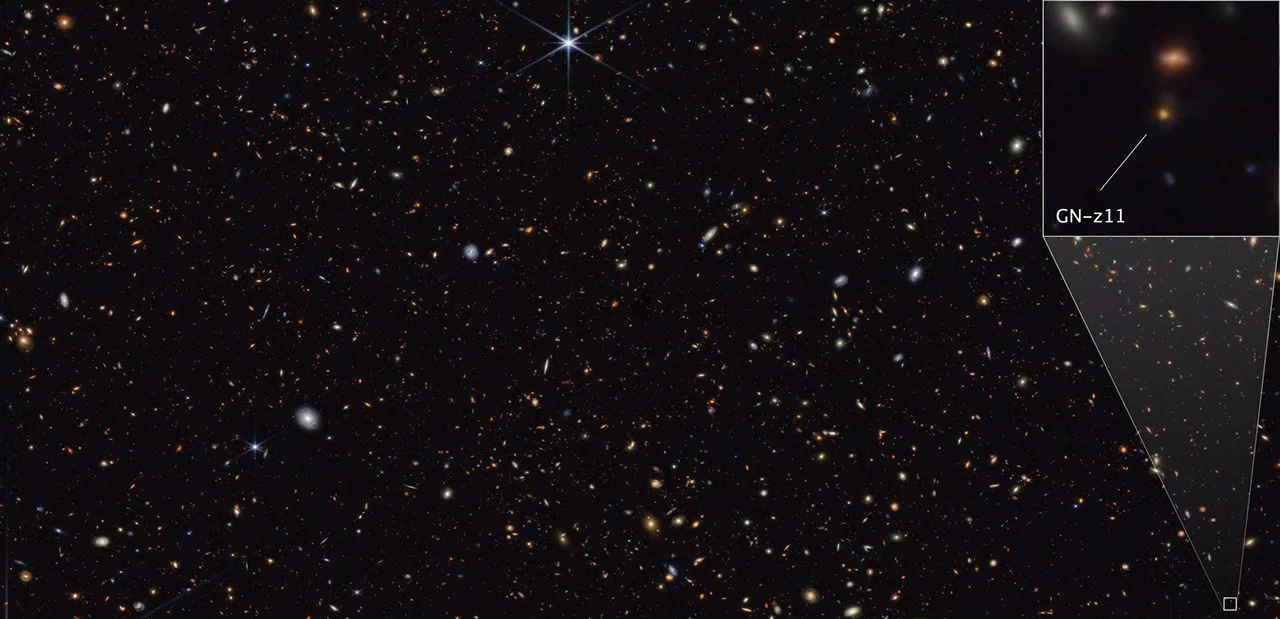
The most discussed sits in the halo of GN-z11, one of the most luminous known galaxies in the very early universe, seen as it was roughly 430 million years after the Big Bang. In 2024, a team led by Roberto Maiolino reported, in Astronomy and Astrophysics, a clump of gas about three kiloparsecs from the galaxy itself showing a strong He II line at a redshift of 10.6, with an exceptionally high equivalent width and, crucially, no detected metal lines. The team inferred a population of very massive Population III stars, with individual masses reaching at least 500 solar masses, totaling on the order of a hundred thousand solar masses. A 2026 follow-up reported that higher-resolution observations confirmed the helium signal is real, resolving it into two velocity components and supporting it with an independent line detection. It remains the strongest single case, and it remains a candidate, not a confirmation.
A second candidate, reported by a team in the Astrophysical Journal Letters, is a galaxy at redshift 8.16 nicknamed RX J2129-z8HeII. It shows a strong He II line with a rest-frame equivalent width of about 21 angstroms and one of the bluest ultraviolet slopes ever measured in a confirmed galaxy, a steepness of around minus 2.5, exactly what a population of hot, dust-free, metal-poor stars should produce. Photoionization models with Population III stars reproduce the observed line ratios well, and the inferred mass of the first-star component is close to a million solar masses, though the galaxy as a whole is clearly not metal-free.
A third line of evidence comes not from a spectral fingerprint but from a feat of resolution. In 2024, Angela Adamo and colleagues, writing in Nature, used gravitational lensing, a foreground cluster acting as a natural magnifying glass, to resolve a galaxy at redshift near 10, about 460 million years after the Big Bang, into five individual bound star clusters. Each is a compact knot only a parsec or so across. The system carries very little dust and a metallicity below one percent of the Sun's, young enough and pristine enough that the authors note it may be a low-metallicity or Population III star-forming galaxy. It does not prove first stars are present, but it shows that dense, metal-poor stellar nurseries existed in exactly the era theory demands.
More recently still, attention has turned to a heavily magnified object known as LAP1-B, lensed roughly a hundredfold. An analysis led by Kimihiko Nakajima concluded that it is most plausibly a cluster of low-mass Population III stars, perhaps a few thousand solar masses in total, with traces of metals that may have come from the cluster's own recent supernovae. Its authors argue it is the first observed system to match three independent theoretical predictions for how the first stars should form. Like the others, it is described in the careful language of candidacy.
Why no confirmation, and what would count as one
The honest state of the field is this: not a single Population III star, and not a single unambiguously Population III system, has been confirmed. Every candidate carries an alternative explanation that cannot yet be ruled out. A strong He II line with weak metals might come from a faint accreting black hole, or from a normal but unusually low-metallicity stellar population, or from instrument systematics in spectra pushed to the limit of what Webb can measure. The signals are faint, they sit at the edge of detectability, and extraordinary claims about the first objects in the universe rightly demand more than a single line in a single spectrum.
What would settle it is convergence. A truly convincing case needs a strong He II detection, a confident absence of metal lines across multiple transitions, a spectral shape that matches first-star models and only first-star models, and ideally the same conclusion drawn from an independent system. The 2026 confirmation of the helium signal near GN-z11 is a step toward that standard, because it moves the most famous candidate from a possible artifact to a real, structured feature. It does not, by itself, prove the source is Population III. The search is now less about finding a hint and more about ruling out the impostors.
A ghost worth chasing
It is worth pausing on what makes this hunt unlike most in astronomy. The first stars are not rare in the way a particular comet or a peculiar nebula is rare. They are, by the logic of their own success, almost extinct. They existed for a cosmically brief window, they made themselves obsolete by enriching the universe with metals, and any that formed have long since died. To see one at all, you must look far enough back in time to catch the era before they vanished, which means looking across nearly the entire age of the universe, at objects so faint that only the largest telescope ever flown can register them, and even then only as a smudge with a telltale line.
That is the quarry. Not a star you can resolve, but a chemical absence and a single bright line of helium, glimpsed in the light of a galaxy as it was when the cosmos was a few percent of its current age. The candidates are real and growing. The confirmation has not come. And so the search continues for a star with no ancestors, made of nothing but the hydrogen and helium of the Big Bang, the first light to break the long dark, still hiding at the edge of what we can see.
A star with no ancestors, made of nothing but the hydrogen and helium of the Big Bang: the first light to break the long dark, still hiding at the edge of what we can see.
Frequently Asked Questions
What are Population III stars?
Population III stars are the hypothesized first generation of stars, formed in the early universe from pristine gas containing only hydrogen, helium, and a trace of lithium, with no heavier elements. Because they lacked metals to cool the collapsing gas, theory predicts they were unusually massive, hot, and short-lived.
Has a Population III star ever been confirmed?
No. Despite decades of searching, no individual Population III star and no unambiguously Population III system has been confirmed. The James Webb Space Telescope has produced several strong candidates, but each still carries alternative explanations that have not been fully ruled out.
How would astronomers recognize a first star?
The key signature is a strong emission line of doubly ionized helium (He II at 1640 angstroms), which requires extremely energetic radiation, combined with a complete absence of metal lines like carbon and oxygen. A strong helium line in a spectrum with no metals is the closest thing the search has to a smoking gun.
What role did the first stars play in the universe?
They helped end the cosmic dark ages by ionizing the surrounding neutral hydrogen, a process called reionization, and they forged the universe's first heavy elements. When the most massive of them exploded as supernovae, they scattered carbon, oxygen, and iron into space, seeding all later generations of stars and planets.
What is the strongest Population III candidate so far?
A clump of gas in the halo of the galaxy GN-z11, at redshift 10.6, shows a strong helium line with no detected metals. A 2024 study inferred very massive first stars, and a 2026 follow-up confirmed the helium signal is real. It remains a candidate rather than a confirmation.
Why are the first stars so hard to find?
By forging metals, the first stars made it nearly impossible for more of their own kind to form, so they are effectively extinct. Any that existed died long ago, and seeing them requires looking back almost to the beginning of the universe, where they appear only as faint, unresolved smudges of light at the limit of what even Webb can detect.
Continue Exploring
- How We Measure the Distance to the StarsYou cannot lay a tape measure to a galaxy. Astronomers built a ladder instead, each rung a different method calibrated...
- The Oldest Light in the UniverseEverywhere you point a radio dish, a faint glow answers back: the cooled afterglow of the Big Bang, released when the...
- The Great Nothing: A Hole in the Universe 330 Million Light-Years WideIn 1981, a redshift survey turned up an emptiness so vast that if the Milky Way sat at its center, we might not have...
- Why There Is Something Instead of NothingThe Big Bang should have made matter and antimatter in perfectly equal amounts, and they should have annihilated each...
- The Fraction of a Second That Made EverythingCosmic inflation says the universe expanded faster than light in its first instant, smoothing space and seeding every...
Sources
- Bromm & Larson (2004). "The First Stars (Annual Review of Astronomy and Astrophysics)." link.
- Maiolino et al. (2024). "JWST-JADES. Possible Population III signatures at z=10.6 in the halo of GN-z11 (A&A)." link.
- Maiolino et al. (2026). "The search for Population III: Confirmation of a HeII emitter with no metal lines at z=10.6." link.
- Wang et al. (2024). "A Strong He II 1640 Emitter with an Extremely Blue UV Slope at z=8.16: Presence of Population III Stars? (ApJL)." link.
- Adamo et al. (2024). "Bound star clusters observed in a lensed galaxy 460 Myr after the Big Bang (Nature)." link.
- Nakajima et al. (2025). "LAP1-B is the First Observed System Consistent with Theoretical Predictions for Population III Stars (ApJL)." link.
- NASA / STScI (2024). "Webb Unlocks Secrets of One of the Most Distant Galaxies Ever Seen (GN-z11)." link.