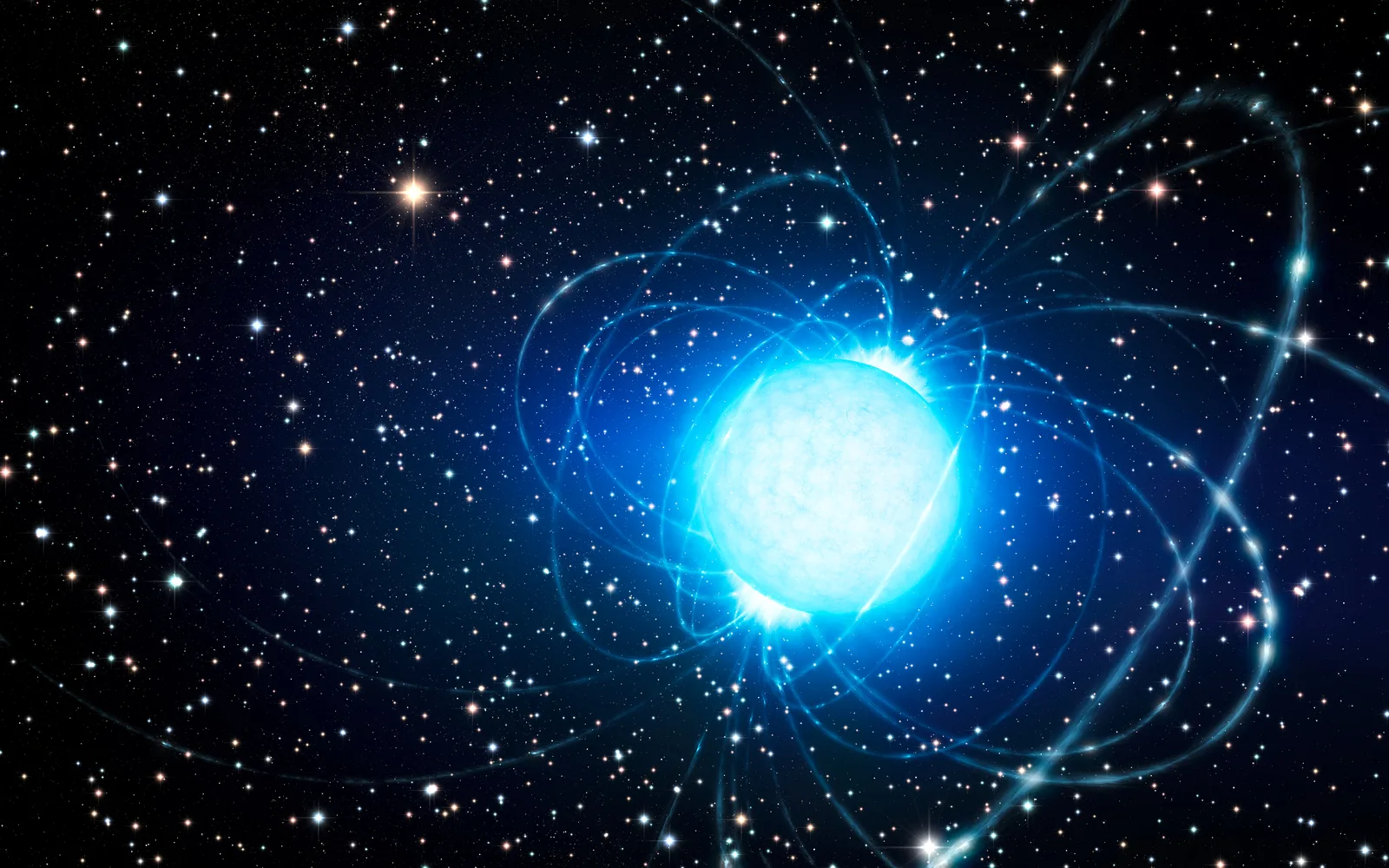
Somewhere in the sky, a flash of radio energy lasts less than a thousandth of a second. In that sliver of time it pours out roughly as much energy as the Sun radiates across three full days. By the time the pulse sweeps across Earth it has been traveling for billions of years, smeared and stretched by everything it passed through. A radio dish records it. And then it is gone, usually never to repeat, leaving astronomers to argue over a question that took sixteen years to answer: what could possibly produce such a thing?
The burst that should not have been found
In 2007, Duncan Lorimer, a radio astronomer at West Virginia University, handed a student named David Narkevic a routine assignment. Go through six-year-old survey data from the Parkes radio telescope in Australia, recorded in 2001, and look for anything unusual. Buried in those archives was a single spike so bright and so brief that it had been overlooked entirely.
The pulse lasted under five milliseconds. It carried a peak flux of about 30 janskys, an enormous figure for a fraction of a second of radio noise. Most striking was its dispersion measure: roughly 375 in the standard units astronomers use, far higher than anything our own galaxy could explain. Lorimer and his colleagues published the find in Science under a deliberately careful title, "A bright millisecond radio burst of extragalactic origin." The word that mattered was extragalactic. Whatever produced this had done so hundreds of millions of light-years away.
The reaction was skepticism. A single event, found in archival data, sitting near a busy frequency band, looked suspiciously like interference. For years the Lorimer Burst stood almost alone, an anomaly that might be an instrument artifact, a lightning strike near the dish, or a microwave oven door opening in the observatory kitchen. That last possibility was not a joke. Parkes really did record a class of false signals later traced to its own staff break room.
A single flash, six years old, found by a student in a data archive. It would take a decade of new instruments to prove it was real, and another to prove what made it.
How a flash becomes a ruler
The reason astronomers could say anything at all about a millisecond pulse comes down to a quirk of physics called dispersion. Radio waves of different frequencies do not travel at quite the same speed when they pass through the thin plasma of intergalactic space. Higher frequencies arrive first, lower frequencies trail behind, and the longer the journey, the wider the gap between them.
That delay is measurable. It is called the dispersion measure, and it counts the total number of free electrons the signal crossed on its way to Earth. A burst from inside the Milky Way carries a small dispersion measure. A burst from across the cosmos carries a large one. The Lorimer Burst's value was far too high to come from our galaxy alone, which is precisely why the team called it extragalactic.
This turned a nuisance into a tool. The dispersion measure became a rough cosmic ruler, a way to estimate how far a burst had traveled before anyone could see its host galaxy. It also turned fast radio bursts, or FRBs, into something more than a curiosity. If they came from across the universe in their thousands, they could be used to weigh the diffuse matter scattered between galaxies, the so-called missing baryons that ordinary surveys struggle to detect. A flash too brief to understand had become a probe of the cosmos itself.
From a single burst to a flood
For most of a decade, fast radio bursts trickled in one or two at a time. The bottleneck was the telescopes. A dish like Parkes sees only a narrow patch of sky, and FRBs do not announce themselves in advance. Catching them was a matter of luck.
That changed with CHIME, the Canadian Hydrogen Intensity Mapping Experiment. CHIME has no moving parts. It is a set of four stationary half-pipe reflectors in British Columbia that stare straight up and let the rotation of the Earth sweep the entire overhead sky past them every day. Built to map hydrogen across the universe, it turned out to be a nearly perfect fast radio burst machine, watching a huge swath of sky at the low radio frequencies between 400 and 800 megahertz.
The numbers tell the story. The first CHIME/FRB catalog, covering July 2018 to July 2019, reported 536 bursts, including 62 from eighteen sources that had been seen to repeat. The second catalog, released in early 2026 and covering observations through September 2023, reported 4,539 bursts from 3,641 distinct sources, with 981 of those bursts coming from 83 known repeaters. In a few years the field went from a handful of disputed events to a population large enough to do statistics on.
CHIME does not chase fast radio bursts. It lies on its back, lets the planet turn, and catches whatever the sky throws past.
Repeaters and one-offs
As the catalog grew, a division appeared. Most fast radio bursts flash once and are never heard from again. A minority repeat, sometimes erratically, sometimes in clustered storms of activity separated by long silences. The first repeating source, FRB 121102, fired again and again from a dwarf galaxy roughly three billion light-years away, which allowed astronomers to pin down its position and study its surroundings in a way a one-off burst never permits.
The split raised an obvious question. Are repeaters and non-repeaters two different kinds of object, or the same kind caught in different moods? A source that repeats rarely could easily masquerade as a one-off if no one happened to be watching during its quiet years. The statistical properties of the two groups differ, with repeaters tending toward longer, narrower-band pulses, but no one has cleanly separated them into distinct physical families. It remains one of the field's genuinely open questions.
What both populations share is the energy problem. To produce a burst bright enough to cross billions of light-years and still register on a radio dish, the source has to release a staggering amount of power in a coherent flash, far more than a normal star or even an ordinary neutron star could manage. Whatever made these signals had to be both compact and violently energetic. The list of candidates kept circling back to one kind of object.
The night the answer came from home
On April 28, 2020, a fast radio burst arrived that broke the entire pattern. Its dispersion measure was small. It had not crossed the cosmos. It came from inside the Milky Way, from a known object catalogued as SGR 1935+2154, a magnetar sitting a few tens of thousands of light-years away.
A magnetar is a neutron star with an absurd magnetic field. SGR 1935+2154 spins once every 3.24 seconds and carries a surface field strength around 2.2 times ten to the fourteenth gauss, hundreds of millions of times stronger than the most powerful magnets ever built on Earth. These objects are already known for erratic flares of X-rays and gamma rays. What no one had caught before was one producing a fast radio burst.
Two instruments saw it at once. CHIME recorded the event, designated FRB 200428, as two roughly millisecond-long components separated by about 30 milliseconds. A second, smaller experiment in California called STARE2, the Survey for Transient Astronomical Radio Emission 2, caught the same burst at higher frequencies and measured a tremendous fluence of around 1.5 million jansky-milliseconds, reported by Bochenek and colleagues. Crucially, a fleet of space telescopes recorded a one-second X-ray burst from exactly the same magnetar at exactly the same moment. The radio flash and the X-ray flare were the same event.
It was not as bright as a true extragalactic FRB. Scaled to the distances of cosmic bursts, FRB 200428 would have been on the faint end of the population, perhaps an order of magnitude or two below the typical event. But it closed a gap that had been open since 2007. A magnetar, a known and well-studied kind of object, had just produced something that looked and behaved like a scaled-down fast radio burst. The prime suspect finally had a face.
For thirteen years the source was a category of theory. On one night in April, it was a specific star with a name and an address.
Reading the magnetic field directly
One detection, however convincing, does not settle a science. It showed that magnetars can make bursts like these. It did not prove that most fast radio bursts come from magnetars, nor did it reveal where on or around the star the radio light is actually generated. Those questions moved to the next generation of observations, and the most decisive came from the polarization of the light itself.
In 2024, two companion papers in Nature dissected a single nearby burst called FRB 20221022A, localized to a galaxy about 65 million light-years away. McKinven and colleagues measured how the angle of the burst's polarization rotated as it played out. Over roughly two and a half milliseconds, the polarization angle swung by about 130 degrees, tracing an S-shaped curve. That shape is a signature familiar from pulsars, where it maps the geometry of a rotating magnetic field sweeping past our line of sight.
In the companion study, Nimmo and colleagues used the way the burst twinkled, a scintillation effect caused by intervening plasma, to estimate the size of the region that emitted it. The answer was small, no larger than about ten thousand kilometers across, and likely much smaller. A region that compact, combined with the pulsar-like polarization swing, pointed to a single conclusion: the radio emission was generated inside the magnetosphere of a rotating neutron star, in the violently magnetized region hugging its surface, rather than in a distant shock wave far from the star.
The picture has continued to sharpen. Detailed multi-frequency campaigns on the hyperactive repeater FRB 20201124A, including a study with India's upgraded Giant Metrewave Radio Telescope published in late 2025, found bursts with high circular and linear polarization and complex behavior across frequencies, consistent with emission from multiple active zones inside a magnetar's magnetosphere embedded in a turbulent plasma. The evidence keeps accumulating in the same direction.
New addresses, and a cosmic census
In 2024, a fast radio burst arrived from a place the magnetar picture did not predict. The repeating source, catalogued as FRB 20240209A, was first caught by CHIME in February 2024 and fired at least 21 more times through that July. When astronomers traced it, they found it not in a bright, star-forming galaxy but on the outskirts of an ancient elliptical, a "dead" galaxy that stopped making new stars long ago. Young magnetars are born from the core-collapse supernovae of massive, short-lived stars, and those do not exist where star formation has ceased. Two teams reported the result in the Astrophysical Journal Letters in January 2025, arguing the most likely birthplace is a dense globular cluster, where a magnetar could form by an exotic route: the merger of two neutron stars, or the collapse of a white dwarf. The engine may be a magnetar after all, but not the kind anyone expected.
A year later, a single burst gave astronomers their sharpest look yet at where an FRB lives. On March 16, 2025, CHIME recorded an extraordinarily bright one-off burst, FRB 20250316A, nicknamed RBFLOAT for "radio brightest flash of all time." Using the newly completed CHIME Outriggers, a continent-spanning array, the team pinned its position to a scale of just 13 parsecs, about 42 light-years, in a galaxy roughly 40 megaparsecs away, around 130 million light-years. That precision let the James Webb Space Telescope resolve individual stars around an FRB for the first time, and it turned up a faint infrared source at the spot, possibly an aging star or a fading echo of the burst itself. The flash sat about 190 parsecs from the nearest star-forming region, close enough to keep the magnetar story alive, far enough to keep the questions open (arXiv 2506.19006; ApJL 989, L49).
And the bursts began to pay off as the cosmic tool they always promised to be. Because each FRB's dispersion measure counts the electrons it crossed, a large enough sample can weigh the thin gas spread between galaxies, the missing baryons that ordinary surveys cannot see. In 2025, Liam Connor and colleagues used a set of localized bursts to do exactly that, reporting in Nature Astronomy that more than three-quarters of the universe's ordinary matter lies in the diffuse gas between galaxies, with only about a quarter bound up inside galaxies and their halos. A flash too brief to understand had become a way to map where the universe keeps most of its atoms.
What is settled and what is not
The core claim is now firm. Magnetars can produce fast radio bursts, and at least some bursts are generated close to the neutron star, within its magnetosphere. The 2020 galactic event proved the mechanism is possible, and the polarization work proved the emission region is small and magnetically structured. That is a genuine resolution to the central mystery of where these signals are born.
What remains open is whether every fast radio burst follows the same script. The universe produces thousands of these flashes every day, with an enormous spread in brightness, repetition, and environment. Some may come from young magnetars freshly born in supernovae. Others may arise from magnetars in older, quieter settings, or from interactions in binary systems, or by mechanisms that have not yet been written down. The split between repeaters and one-offs is still unexplained. And no one has yet caught a true extragalactic FRB with the same multi-messenger clarity as the galactic one, where a radio flash and an X-ray flare were timed to the same instant from the same star.
So the millisecond flash that crosses the universe is no longer a signal from nowhere. It has a plausible engine, a magnetized stellar corpse a dozen miles wide, and a stage on which the burst is struck, the twisted field lines just above its surface. The mystery has narrowed from "what on Earth could do this" to "which kinds of magnetar, and exactly how." That is what progress looks like in astronomy: a question that once had no answer now has a face, even if it does not yet have a complete biography.
It still lasts less than a thousandth of a second. It still carries a Sun's worth of energy across the dark. But the flash from nowhere now has a name, a kind of star, and a place on that star where the light is struck.
Frequently Asked Questions
What is a fast radio burst?
A fast radio burst, or FRB, is an intense flash of radio waves lasting from a fraction of a millisecond up to a few seconds. In that instant it can release roughly as much energy as the Sun emits over several days. Most arrive from galaxies hundreds of millions to billions of light-years away.
When was the first fast radio burst discovered?
The first was found in 2007 by Duncan Lorimer and David Narkevic in archival data from the Parkes telescope in Australia, recorded in 2001. Known as the Lorimer Burst, it was so bright and brief that many researchers doubted it was real until similar events were confirmed years later.
What causes fast radio bursts?
The leading source is a magnetar, a neutron star with an extreme magnetic field. In April 2020 the galactic magnetar SGR 1935+2154 produced a burst resembling a scaled-down FRB, detected at radio and X-ray wavelengths at the same instant. Later polarization studies showed the radio emission is generated close to the star, inside its magnetosphere.
What is a dispersion measure and why does it matter?
As a burst travels, its higher radio frequencies arrive slightly ahead of its lower ones because of the plasma in space. The size of that delay, called the dispersion measure, counts the electrons the signal crossed. It acts as a rough cosmic ruler, letting astronomers estimate a burst's distance and probe the matter spread between galaxies.
What is the difference between repeating and non-repeating FRBs?
Most fast radio bursts flash once and are never seen again. A minority repeat, sometimes in clustered storms. Repeaters can be localized and studied in detail, while one-offs cannot. Whether the two groups are physically different objects or the same objects in different states remains an open question.
How many fast radio bursts have been detected?
The number grew explosively with the CHIME telescope in Canada. Its second catalog, released in early 2026, reported 4,539 bursts from 3,641 distinct sources observed between 2018 and 2023, including 981 bursts from 83 known repeaters. The universe is thought to produce thousands of FRBs every day.
Do all fast radio bursts come from young magnetars?
Probably not. Many FRBs trace to young magnetars in star-forming galaxies, but in 2024 the repeating burst FRB 20240209A was traced to an ancient, dead elliptical galaxy with no recent star formation, most likely within a globular cluster. That points to at least one additional path, a magnetar formed by the merger of two neutron stars or the collapse of a white dwarf, rather than a single universal origin.
Continue Exploring
- The Dead Star That Emits a Mix of Radiation No One Has SeenA stellar corpse in the Scutum arm pulses in radio waves and X-rays every 44 minutes. It does not behave like a...
Sources
- Lorimer et al. (2007). "A Bright Millisecond Radio Burst of Extragalactic Origin." link.
- CHIME/FRB Collaboration (2020). "A bright millisecond-duration radio burst from a Galactic magnetar." link.
- Bochenek et al. (2020). "A fast radio burst associated with a Galactic magnetar." link.
- CHIME/FRB Collaboration (2021). "The First CHIME/FRB Fast Radio Burst Catalog." link.
- CHIME/FRB Collaboration (2026). "The Second CHIME/FRB Catalog of Fast Radio Bursts." link.
- Mckinven et al. (2024). "A pulsar-like polarization angle swing from a nearby fast radio burst." link.
- Nimmo et al. (2024). "Magnetospheric origin of a fast radio burst constrained by scintillation." link.
- uGMRT Collaboration (2025). "Multi-Frequency Study of FRB 20201124A with the uGMRT." link.
- Studies of FRB 20240209A, the first fast radio burst traced to a dead elliptical galaxy (2025). Astrophysical Journal Letters. research summary.
- FRB 20250316A (RBFLOAT), localized to 13-parsec precision with the CHIME Outriggers (2025). arXiv:2506.19006. JWST near-infrared follow-up: ApJL 989, L49.
- Connor et al. (2025). "A gas-rich cosmic web revealed by the partitioning of the missing baryons." Nature Astronomy. link.