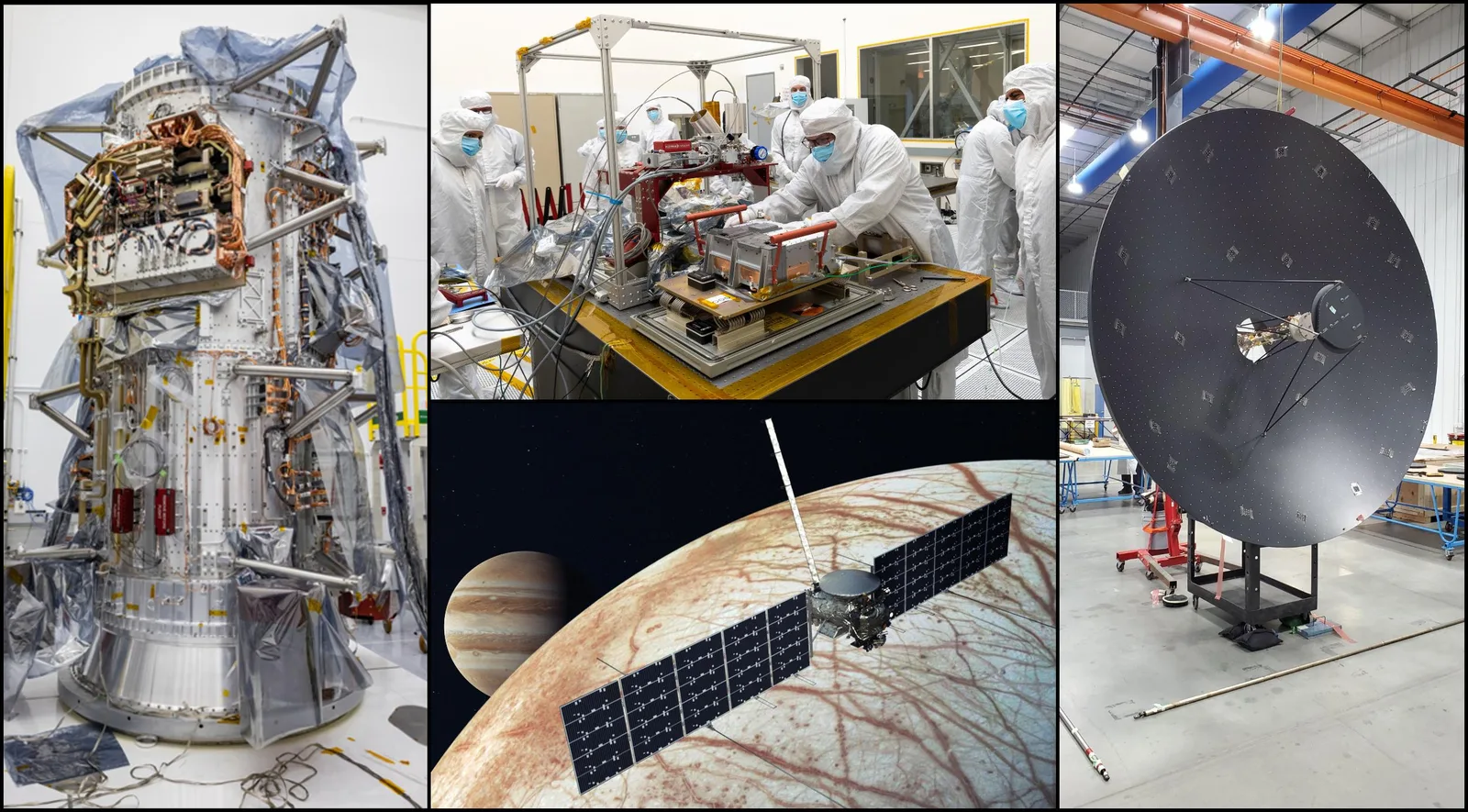
There is a spacecraft the length of a basketball court falling silently through the dark between Mars and Jupiter, and it was built to answer a single question that humans have asked in one form or another for centuries. Not whether there is life out there. Something more careful, and in its own way more honest: whether a place we will never touch, an ocean buried under miles of ice on a moon half a billion miles away, could in principle hold life at all. The machine carries no nets, no microscopes pressed to alien water, no instrument that will ever report back the word "yes." It was designed, deliberately, to stop one step short of that answer. NASA's Europa Clipper is a habitability detector, not a life detector, and understanding the difference is the whole point of the mission.
The Case for an Ocean No One Has Seen
Europa is the smallest of Jupiter's four large Galilean moons, slightly smaller than Earth's Moon, wrapped in a shell of water ice so smooth and bright that it reflects sunlight like fresh snow. For decades it was a curiosity. Then the Galileo spacecraft, which orbited Jupiter from 1995 to 2003, flew past it again and again and returned a result that changed how scientists thought about the outer solar system.
Galileo carried a magnetometer. As it passed Europa, it detected a magnetic field that did not belong to the moon itself but appeared to be induced, generated in response to the powerful, shifting magnetic field of Jupiter. The cleanest explanation for an induced field of that kind is a global layer of electrically conductive material under the surface. Salty liquid water conducts electricity. Pure ice does not. The signal pointed, with uncomfortable consistency, to a worldwide ocean of salt water hidden beneath Europa's frozen crust.
The numbers that follow from that conclusion are difficult to hold in the mind. NASA estimates that Europa's buried ocean may contain more than twice as much liquid water as all of Earth's oceans combined. A moon you could fit inside the continental United States may be the largest body of liquid water in the solar system, and it is sealed beneath an ice shell that has never been broken open to the sky.
A moon you could fit inside the continental United States may hold the largest ocean in the solar system, locked under ice that has never opened to the sky.
Liquid water is not, by itself, a guarantee of anything. But it is the one ingredient that astrobiologists treat as non-negotiable. Every living thing we know of needs it. Europa appears to have more of it than the planet that invented the question.
Three Things Life Needs, and Whether Europa Has Them
When scientists talk about habitability, they are not being romantic. They are running a checklist. Life as we understand it requires liquid water, the right chemical building blocks, and a source of energy to drive metabolism. Europa Clipper's entire instrument suite is organized around testing whether Europa offers all three.
The water, as the magnetometer evidence suggests, is very likely there. The chemical ingredients are plausible: Europa's surface shows reddish-brown streaks that may be salts and sulfur compounds delivered from below, and comets and asteroids have seeded the outer solar system with carbon and organic molecules for billions of years. The hardest question is energy.
On Earth, the base of the food chain at deep-sea hydrothermal vents does not run on sunlight at all. It runs on chemistry, on heat and dissolved minerals welling up where the ocean meets hot rock. Europa may have the same arrangement. The moon is flexed continuously by Jupiter's gravity as it orbits, and that flexing generates internal heat through tidal friction. If that heat reaches the rocky seafloor beneath Europa's ocean, it could power hydrothermal systems much like the ones that sustain entire ecosystems in the lightless depths of our own planet. Clipper cannot see that seafloor. But it can look for the chemical fingerprints that such activity would leave in the ice and the thin gases around the moon.
There is one more possibility the mission is built to chase. Some observations have hinted that Europa may occasionally vent plumes of water vapor through cracks in its ice, jets that briefly connect the hidden ocean to space. The evidence remains debated, and no plume has been confirmed beyond doubt. If Clipper happens to fly through one, its instruments could sample ocean material directly, without any drilling at all. The mission does not depend on that lucky break, but its instruments are ready for it. Even without a plume, the steady rain of dust and gas constantly lifted off Europa's surface carries traces of what lies beneath, and the spacecraft is designed to read that record encounter by encounter.
Nine Instruments and a Beam of Radio Through Ice
Europa Clipper carries nine science instruments plus a gravity experiment that uses its radio link to Earth. They fall into two families. Remote sensing instruments study Europa from a distance using cameras and spectrometers across visible, infrared, thermal, and ultraviolet light. In situ instruments sample the environment the spacecraft physically flies through, the dust and gas immediately around the moon.
The instrument that may matter most for the ocean question is REASON, the Radar for Europa Assessment and Sounding: Ocean to Near-surface. It is a dual-frequency ice-penetrating radar, operating at 9 and 60 megahertz, designed to send radio waves down through the ice shell and listen for the echoes. Where the waves hit a boundary, a pocket of water trapped in the ice, or the bottom of the shell where ice meets ocean, part of the signal reflects back. Layer by layer, REASON is meant to build something like a cross-sectional scan of Europa's crust, revealing how thick the ice is and whether liquid water lurks within it.
The Europa Clipper Magnetometer, mounted on an 8.5-meter (28-foot) boom to keep it clear of the spacecraft's own magnetic noise, will measure the induced field with far more precision than Galileo ever could. From the strength of that field, scientists hope to pin down how deep the ocean is, how salty, and how far it extends.
Two mass spectrometers handle the chemistry. MASPEX, the Mass Spectrometer for Planetary Exploration, will sniff the tenuous gases around Europa and the molecules kicked up from its surface, reading their composition. SUDA, the Surface Dust Analyzer, will catch the microscopic ice and dust grains that constantly fly off the moon, analyzing each one for organic and inorganic compounds. Together they can sample material that came from below without ever landing.
The rest of the suite fills in the picture. The Europa Imaging System will photograph the surface in detail sharp enough to map cracks, ridges, and the chaotic terrain where the ice appears to have broken and refrozen. The Mapping Imaging Spectrometer for Europa reads the moon in infrared light to identify the salts and organic compounds painted across its surface. A thermal imager, E-THEMIS, hunts for warm spots that might mark places where liquid water has recently reached the surface or where the ice is thin. An ultraviolet spectrograph watches for the faint glow of gases that could betray a plume. And a plasma instrument measures the charged particles around Europa, helping separate the moon's induced magnetic signal from the roar of Jupiter's own field. No single instrument settles the question of habitability. The case, if it comes, will be built from all of them at once.
The spacecraft will never touch Europa's ocean. It will read that ocean in the dust the moon throws into space and the radio echoes returning from under the ice.
The Largest Planetary Spacecraft NASA Has Ever Built
Europa Clipper is physically the biggest spacecraft NASA has ever developed for a planetary mission. With its solar arrays unfolded it spans more than 30 meters (about 100 feet), roughly the length of a basketball court, and it has a dry mass of about 3,241 kilograms (7,145 pounds). The vast solar wings are a necessity, not extravagance. At Jupiter's distance from the Sun, sunlight is roughly twenty-five times weaker than it is at Earth, so the panels must be enormous simply to keep the instruments running.
The size also reflects the danger of where it is going. Jupiter is surrounded by one of the most violent radiation environments in the solar system, a belt of high-energy particles trapped and accelerated by the planet's colossal magnetic field. Europa orbits deep inside that hazard. On each close pass, the spacecraft will absorb radiation NASA compares to the equivalent of a million chest X-rays.
Unshielded electronics would not survive long under that bombardment. So the heart of Europa Clipper, its sensitive computers and avionics, is sealed inside a vault with walls of titanium and aluminum-zinc alloy roughly 9.2 millimeters (about one third of an inch) thick. The vault slows the degradation of the electronics dramatically, buying the years of operation the mission needs. Even so, radiation is the clock the entire mission runs against.
Why Fly Past, Instead of Orbiting Europa
Here is a design choice that surprises people: Europa Clipper will not orbit Europa. It will orbit Jupiter, on a long looping path, and dip in to pass Europa close-up again and again. The mission plan calls for nearly 50 flybys, with the closest approaches dropping to roughly 25 kilometers (16 miles) above the surface.
The reason is radiation. An orbit tucked permanently around Europa would sit inside the worst of Jupiter's particle belts continuously, and the spacecraft's electronics would be cooked in a matter of weeks. By looping wide around Jupiter and diving in only briefly, Europa Clipper spends most of its time in calmer regions, absorbs its radiation dose in concentrated bursts, and recovers between encounters. Each flyby targets a different swath of the moon, so that across dozens of passes the instruments build up coverage of nearly the entire surface. It is a slower way to map a world, but on a world bathed in this much radiation it is the way that survives.
A Long Road to Jupiter
Europa Clipper launched on October 14, 2024, at 12:06 p.m. EDT, lifting off from Launch Complex 39A at NASA's Kennedy Space Center atop a SpaceX Falcon Heavy. The original window had been pushed back days earlier when Hurricane Milton swept across Florida.
Jupiter is too far to reach on a straight shot, so the spacecraft is borrowing momentum from planets along the way. On March 1, 2025, it streaked about 884 kilometers (550 miles) above the surface of Mars, bending its path and stealing a little of the planet's orbital energy. In December 2026 it returns to its starting point for a second slingshot, swinging about 3,200 kilometers (2,000 miles) from Earth. That gravity assist is the final shove it needs to climb out to the giant planet.
The spacecraft will travel about 2.9 billion kilometers (1.8 billion miles) in total and arrive at Jupiter in April 2030, when it fires its engines to brake into orbit. Only then does the science campaign of close Europa flybys begin. From launch to first results, the mission is measured not in months but in years, a patience that has become the price of admission to the outer solar system.
What It Will Not Tell Us
It is worth being precise about the limits, because the temptation to overstate is enormous. Europa Clipper is not a life-detection mission. It carries no instrument capable of confirming a living organism. NASA states the goal plainly: to determine whether there are places beneath Europa's surface that could support life. Could, not do.
The distinction is not timidity. It is good science. Detecting life unambiguously requires either bringing a sample home or landing instruments designed from the ground up to recognize biology, and doing so in a way that rules out contamination from Earth. A flyby spacecraft sampling dust and gas in the radiation belts of Jupiter cannot meet that bar, and pretending otherwise would poison any result it returned. What Clipper can do is map the ocean, gauge the chemistry, measure the ice, and assess the energy available. If it finds that Europa has water, the right chemical ingredients, and a plausible energy source all at once, it will have established that one of the most promising places in the solar system is genuinely habitable. The next mission, perhaps a lander, perhaps a spacecraft that drills, would be the one to ask whether anything took advantage of that opportunity.
That is the quiet ambition of the largest planetary spacecraft NASA has ever flown. It will not bring back the answer humanity most wants. It will tell us whether the answer is worth going back for.
The machine was built to stop one step short of the answer humanity most wants. It will not tell us whether Europa's ocean holds life. It will tell us whether that ocean is worth going back for.
Frequently Asked Questions
Will Europa Clipper detect life on Europa?
No. Europa Clipper is a habitability mission, not a life-detection mission. It carries no instrument capable of confirming a living organism. Its goal, in NASA's words, is to determine whether places beneath Europa's surface could support life, by assessing the ocean, the chemistry, the ice, and the available energy.
How much water is in Europa's ocean?
NASA estimates Europa's buried ocean may hold more than twice as much liquid water as all of Earth's oceans combined, despite Europa being slightly smaller than Earth's Moon. The ocean is global and sealed beneath an icy crust.
When will Europa Clipper reach Jupiter?
The spacecraft launched on October 14, 2024, and is scheduled to enter orbit around Jupiter in April 2030. Along the way it used a Mars gravity assist on March 1, 2025, and will use an Earth gravity assist in December 2026 to gain the speed needed to reach the giant planet.
How do scientists know Europa has an ocean if no one has seen it?
The strongest evidence came from NASA's Galileo spacecraft, which orbited Jupiter from 1995 to 2003 and detected an induced magnetic field at Europa. That kind of field is best explained by a global layer of electrically conductive material under the surface, which points to a salty, liquid-water ocean. Europa Clipper's magnetometer and ice-penetrating radar will test and refine that conclusion.
Why does Europa Clipper fly past Europa instead of orbiting it?
Jupiter is surrounded by intense radiation belts, and Europa orbits deep inside them. A permanent orbit around Europa would expose the spacecraft to that radiation continuously and destroy its electronics within weeks. By orbiting Jupiter and making nearly 50 brief close flybys instead, the spacecraft absorbs its radiation in bursts and survives long enough to map most of the moon.
What are Europa Clipper's main instruments?
The spacecraft carries nine science instruments plus a gravity experiment. Key ones include REASON, a dual-frequency ice-penetrating radar that sounds the ice shell; the Europa Clipper Magnetometer, which measures the induced field to gauge the ocean's depth and salinity; and two mass spectrometers, MASPEX and SUDA, which analyze the gases and dust grains around the moon for organic and inorganic compounds.
Continue Exploring
- The Day We Left the Solar BubbleThe Sun blows a vast bubble in the gas between the stars, and everything we call home lives inside it. In 2012 a...
- Three Missions That Make 2026 Europe's Year in SpaceA planet hunter with 26 eyes, a spacecraft photographing Earth's invisible shield, and a probe finally reaching...
- The Mission to a World Made of MetalWe can never drill to the center of the Earth. So NASA sent a spacecraft to the next best thing: 16 Psyche, a metal...