No machine built by human hands has ever taken off, flown, and landed again under its own power on another world. Helicopters have hovered over Mars in thin air. Probes have parachuted onto Venus and bounced across asteroids. But the idea of a craft that flies from one place to another, again and again, choosing where to go next, has belonged to Earth alone. NASA intends to end that monopoly on a moon nearly a billion miles away, on a surface no spacecraft has touched in two decades, beneath a sky the color of dark amber.
A drone the size of a car, on a moon the size of a planet
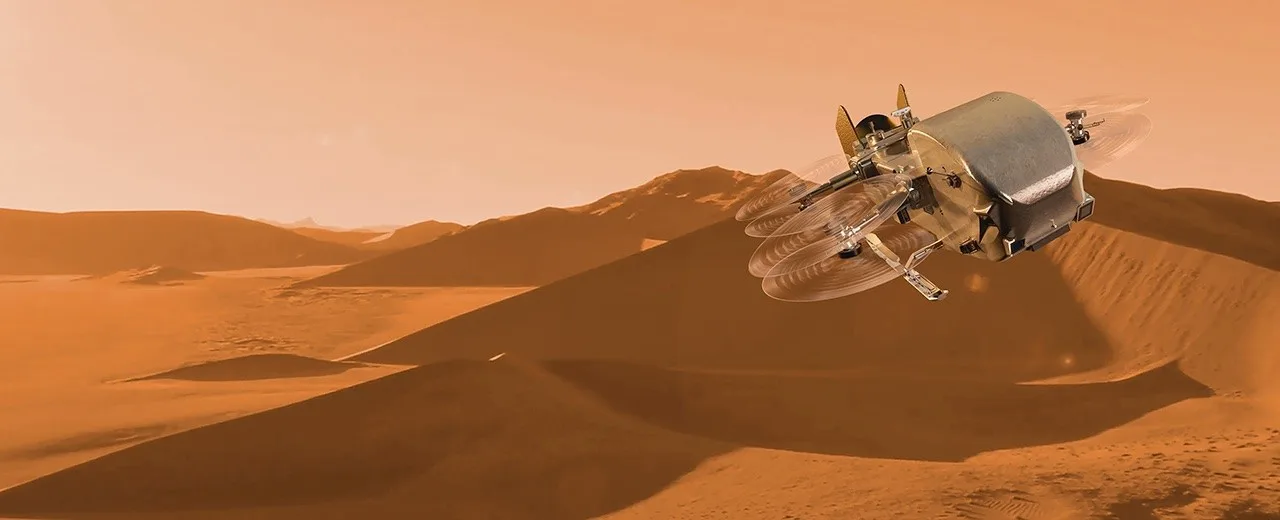
The mission is called Dragonfly, and the name is almost literal. It is a rotorcraft: an eight-rotor lander, roughly the size of a small car, that will lift off from the surface of Saturn's moon Titan, fly several miles, and set down somewhere new. Then it will do it again. Over the course of its planned mission, it is designed to hop across dozens of sites, sampling the chemistry of each, building a survey of a world no rover could ever cover on wheels.
Titan is an unlikely place for a flying machine, and at the same time the perfect one. It is the largest moon orbiting Saturn and the second largest in the solar system, with a radius of about 1,600 miles, larger than the planet Mercury. It is the only moon with a thick atmosphere, and that atmosphere is the reason Dragonfly can fly at all. The air at Titan's surface is mostly nitrogen, the same gas that makes up most of the air you are breathing now, and it presses down about 60 percent harder than Earth's atmosphere does at sea level. Combine that dense air with surface gravity only about one-seventh of Earth's, and you have a place where getting airborne is easier than it is anywhere on our own planet.
The Dragonfly mission is led by the Johns Hopkins Applied Physics Laboratory under principal investigator Elizabeth Turtle. NASA confirmed the mission in April 2024 with a total life-cycle cost of 3.35 billion dollars, moving it from concept into full construction. In its landing configuration, the rotorcraft weighs about 450 kilograms, roughly 990 pounds. Its eight rotors each span about 1.35 meters across.
That choice of design, a flying lander rather than a rover, is itself a statement about the limits of how we have explored other worlds. Every wheeled vehicle humanity has sent to another planet has been governed by the same hard arithmetic: terrain it cannot cross, slopes it cannot climb, distances measured in feet per day. Curiosity has spent more than a decade on Mars and has driven a total distance a fit person could walk in an afternoon. A rotorcraft answers that constraint by refusing to engage with it. A boulder field, a dune, a cliff, a river of liquid methane, none of these matter to a craft that simply rises above them and sets down on the far side. On a world as large and as varied as Titan, that freedom is not a convenience. It is the entire reason the mission can work at all.
The air at Titan's surface presses down about 60 percent harder than Earth's, and gravity pulls about seven times weaker. It is, in physics terms, one of the easiest places in the solar system to fly.
Why fly to Titan and not somewhere closer
Titan is not chosen for novelty. It is chosen because it is, in a chemical sense, one of the most Earth-like places known, and at the same time one of the most alien. It is the only world in the solar system besides Earth with stable liquid on its surface. But the liquid is not water. At a surface temperature of about minus 290 degrees Fahrenheit, water on Titan is frozen as hard as rock. What flows instead are methane and ethane, hydrocarbons that on Earth exist only as gases. On Titan they fall as rain, carve river channels, and pool into lakes and seas near the poles.
Above all of this hangs a sky thick with organic haze, a smog of carbon-and-nitrogen molecules built by sunlight breaking apart methane high in the atmosphere. Those molecules drift down and settle on the surface as a dark, sooty material that scientists call tholins. Titan is, in effect, a planet-sized natural laboratory running prebiotic chemistry: the kind of carbon chemistry that, on the early Earth, came before life. It is doing so continuously, across an entire world, and it has been doing so for a very long time.
There is one more ingredient. Beneath Titan's icy crust, measurements from the earlier Cassini-Huygens mission suggest a global ocean of liquid water, possibly mixed with ammonia, lying perhaps 35 to 50 miles below the surface. Water, organic molecules, and an energy source are the ingredients scientists look for when they ask whether a world could support chemistry of biological interest. Titan has all three, separated only by a shell of ice.
What makes Titan scientifically rare is the way these layers sit on top of one another. The surface chemistry, the haze, and the buried ocean are not three unrelated stories. Organic material made in the upper atmosphere drifts down and accumulates on the ground. Impacts and other processes can, in places, briefly bring that organic material into contact with liquid water before everything freezes again. Each of those brief contacts is a small natural experiment in how complex carbon molecules behave in the presence of water, the same general conditions under which life is thought to have taken hold on the early Earth. Titan does not just preserve the ingredients. It occasionally mixes them, and then locks the result in ice for a spacecraft to read later.
What we already learned, and then stopped learning
Almost everything we know about Titan's surface comes from a single afternoon. In January 2005, the European Space Agency's Huygens probe, carried to Saturn aboard NASA's Cassini orbiter, parachuted through Titan's haze and landed on a damp plain scattered with rounded pebbles, rocks smoothed as if by flowing liquid. It survived for a few hours and fell silent. Cassini continued mapping Titan from orbit through radar and infrared until 2017, but it could only peer through the haze from far above.
That gap, between a few hours on the ground and years of distant observation, is the gap Dragonfly is built to close. Rather than studying Titan as a blur seen from orbit, it will live on the surface, breathe its weather, dig into its soil, and carry its laboratory from place to place. It is the natural successor to Huygens, except that where Huygens fell once and stopped, Dragonfly will keep moving.
The images Huygens returned during its descent are worth keeping in mind, because they shaped how this mission was designed. They showed branching channels that looked unmistakably like drainage networks cut by flowing liquid, and a landing zone littered with rounded cobbles that appeared to have been tumbled smooth in a streambed. This was not a dead, static world. It was a landscape shaped by rain, erosion, and flow, processes familiar from Earth but driven by methane instead of water and operating at temperatures that would freeze the air out of our lungs. Dragonfly is built to investigate the chemistry of exactly that kind of terrain, not from a single fixed point, but across the range of environments that such an active surface produces.
Nearly everything we know about Titan's surface was gathered in a single afternoon in 2005. Dragonfly is designed to turn that afternoon into years.
How you power a drone where sunlight barely reaches
Titan orbits with Saturn at nearly ten times Earth's distance from the Sun, and its thick haze dims what little sunlight arrives. Solar panels are not an option. Instead, Dragonfly carries a Multi-Mission Radioisotope Thermoelectric Generator, the same class of nuclear power source that drives the Perseverance and Curiosity rovers on Mars. Supplied by the U.S. Department of Energy, the MMRTG converts the heat from naturally decaying plutonium-238 into electricity, with no moving parts. By the time Dragonfly reaches Titan, the generator is expected to deliver around 70 watts of electrical power, less than a household light bulb draws.
Seventy watts is not nearly enough to keep eight rotors spinning. So Dragonfly does not fly on the generator directly. Instead, the MMRTG slowly trickles its power into a battery during Titan's long nights, and the battery delivers the surge needed for flight. The waste heat from the same nuclear source does double duty, keeping the electronics warm in an environment cold enough to freeze gasoline solid. Each flight is short, on the order of half an hour, covering up to about 8 kilometers and climbing as high as 4 kilometers before landing again to recharge and study its new surroundings.
The rhythm of the mission is set by Titan itself. A single day on Titan, one full rotation, lasts about 16 Earth days. Dragonfly is designed to fly roughly once per Titan day, spending the long dark hours on the ground charging its battery and conducting science, then lifting off when conditions allow. The mission as confirmed is planned to run about 3.3 years on the surface.
The instruments, and what they are listening for
Dragonfly carries a compact suite of instruments chosen for one purpose: to read Titan's chemistry. At its core is a mass spectrometer called DraMS, which can take a pinch of surface material, vaporize it, and sort the molecules by mass to identify what they are. This is the instrument that will search for organic compounds of astrobiological interest, the complex carbon-based molecules that hint at how far prebiotic chemistry has progressed.
Alongside it, a gamma-ray and neutron spectrometer named DraGNS can analyze the composition of the ground directly beneath the lander without it needing to dig, telling the team whether a given site is worth sampling before a single scoop is taken. A camera suite called DragonCam will photograph the landscape and scout future landing sites, while a geophysics and meteorology package, DraGMet, measures wind, pressure, temperature, and seismic activity, listening, in effect, for the faint signatures of the buried ocean far below.
The mission's stated goal is careful, and worth repeating exactly. Dragonfly is not a life-detection mission. It will not, and is not designed to, announce that something is alive on Titan. As the mission team puts it, it is a mission to investigate the chemistry that came before biology on Earth, to measure how far Titan's organic chemistry has advanced toward the threshold that life on our own world once crossed. The distinction matters. The honest question Dragonfly asks is not "is there life there" but "how close does chemistry get, on its own, without it."
Dragonfly is not designed to find life. It is designed to measure how far chemistry can climb toward life on its own, on a world that has been running the experiment for billions of years.
The long road to Selk crater
Getting Dragonfly to Titan is its own feat of patience. The plan calls for a launch aboard a SpaceX Falcon Heavy rocket during a window opening in July 2028. From there, the spacecraft faces a cruise of roughly six years through the outer solar system, arriving at Titan in 2034. The rotorcraft will ride encased in a protective shell, then enter Titan's atmosphere directly, slowing under parachutes before separating and flying down to its first landing site under its own rotors.
That first site sits in a field of dunes near a region called Shangri-La, dark expanses of organic sand that ripple across Titan's equator. From there, flight by flight, Dragonfly will work its way toward its main target: Selk crater, an impact scar tens of miles across. Selk is compelling because an impact there would have momentarily melted Titan's water ice, mixing liquid water with the surface organics, exactly the combination of ingredients that interests astrobiologists, and then refreezing the record in place. Dragonfly is built to read that record where it lies.
None of this is guaranteed. A mission of this ambition, with a price tag of 3.35 billion dollars and a decade between launch and first science, carries real schedule and budget risk, and the timeline has shifted before. But the hardware is now being built and integrated, not just designed. The question is no longer whether such a thing can be imagined. It is whether it arrives intact.
For all of history, only one world has watched a flying machine rise, travel, and land of its own accord. Sometime after 2034, if the rotors spin as planned in that dense amber air, Titan will become the second.
Frequently Asked Questions
What is NASA's Dragonfly mission?
Dragonfly is a NASA mission to send a car-sized, eight-rotor drone, called a rotorcraft, to fly across the surface of Saturn's moon Titan. Led by the Johns Hopkins Applied Physics Laboratory, it will hop between dozens of sites to study Titan's organic chemistry and assess how far prebiotic chemistry has progressed there.
When does Dragonfly launch and arrive at Titan?
Dragonfly is targeted to launch on a SpaceX Falcon Heavy during a window opening in July 2028. After a cruise of about six years through the outer solar system, it is expected to arrive at Titan in 2034 and operate on the surface for roughly 3.3 years.
How can a drone fly on Titan?
Titan's atmosphere is about 60 percent denser than Earth's at sea level, and its surface gravity is only about one-seventh of Earth's. Dense air and weak gravity make generating lift far easier than on Earth, so a rotorcraft can fly using relatively little power, which is why NASA chose a flying lander over a wheeled rover.
What powers Dragonfly?
Dragonfly is powered by a Multi-Mission Radioisotope Thermoelectric Generator, the same nuclear power source used on the Curiosity and Perseverance Mars rovers. It converts heat from decaying plutonium-238 into roughly 70 watts of electricity, which slowly charges a battery. The battery then provides the surge of power needed for each short flight.
Why is Titan a target in the search for life?
Titan is the only world besides Earth with stable surface liquid, in its case rivers and lakes of methane and ethane, and it has a thick nitrogen atmosphere rich in organic chemistry. It also appears to hide a subsurface ocean of liquid water beneath its icy crust. That mix of organics, liquid water, and energy makes it a leading place to study the chemistry that precedes life.
Will Dragonfly find life on Titan?
No. Dragonfly is not a life-detection mission. It is designed to measure how far Titan's prebiotic chemistry has advanced, identifying organic compounds of astrobiological interest, rather than to confirm or rule out living organisms. Its goal is to understand the chemistry that came before biology, not to announce life.
Continue Exploring
- The Mission to Grab a Piece of a Martian MoonMars has two small, mysterious moons, and no one is sure where they came from. In late 2026 a Japanese spacecraft is...
- Three Missions That Make 2026 Europe's Year in SpaceA planet hunter with 26 eyes, a spacecraft photographing Earth's invisible shield, and a probe finally reaching...
- The Spacecraft Built to Decide If an Alien Ocean Is HabitableEuropa Clipper, the largest spacecraft NASA has ever sent to another world, is racing toward a Jupiter moon that may...
- The Mission to a World Made of MetalWe can never drill to the center of the Earth. So NASA sent a spacecraft to the next best thing: 16 Psyche, a metal...
Sources
- NASA. "Dragonfly mission overview." link.
- Johns Hopkins APL (2024). "Dragonfly Mission Confirmed for 2028 Launch to Saturn's Moon Titan." link.
- NASA (2024). "NASA's Dragonfly Rotorcraft Mission to Saturn's Moon Titan Confirmed." link.
- Barnes, Turtle, Lorenz et al. (2021). "Science Goals and Objectives for the Dragonfly Titan Rotorcraft Relocatable Lander, Planetary Science Journal 2(4):130." link.
- NASA. "Titan: Facts." link.