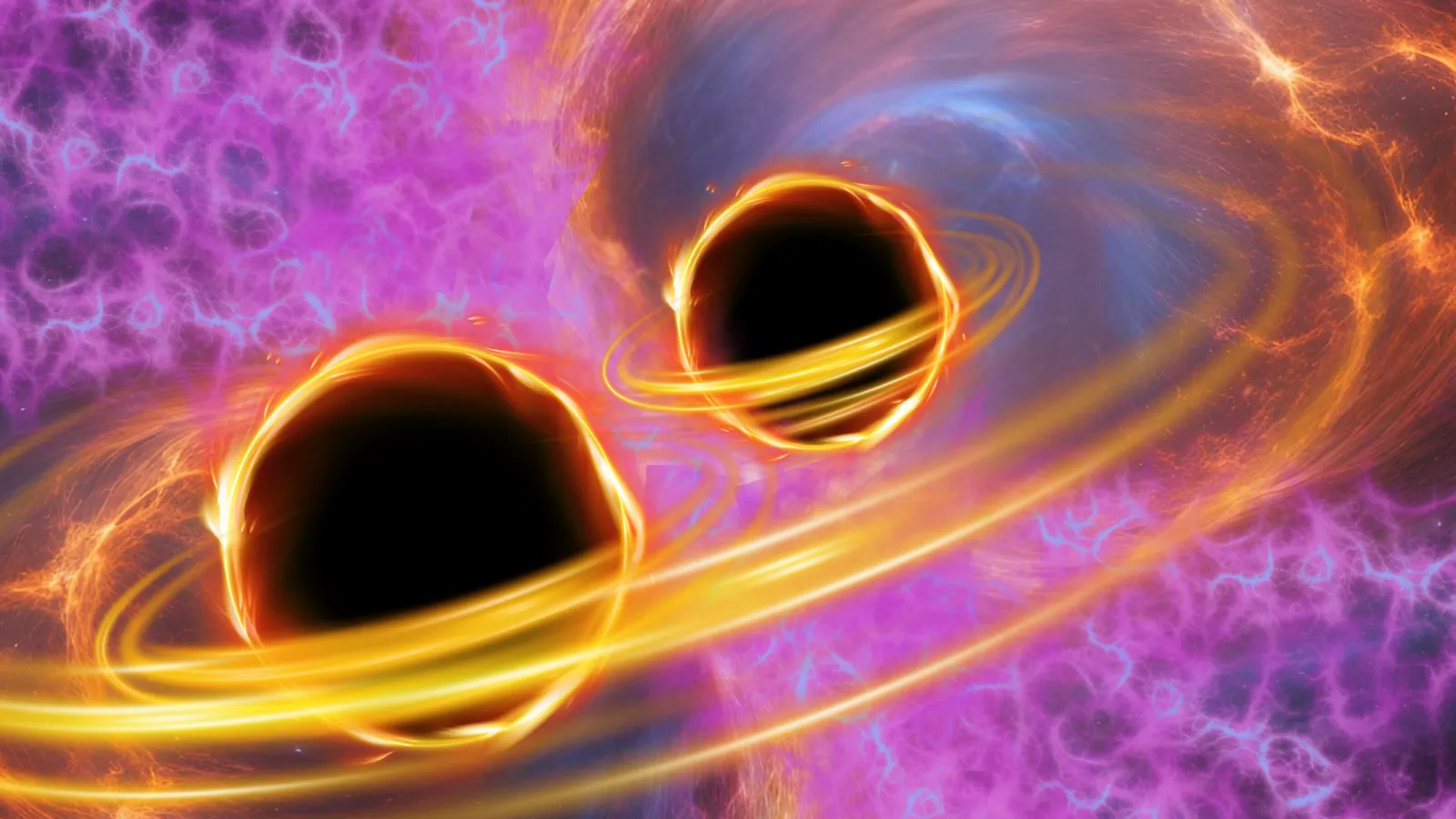
There is a kind of cosmic crime scene at the edge of the observable universe, and for the past three years the James Webb Space Telescope has been walking investigators straight into it. Out near the dawn of cosmic time, less than a billion years after the Big Bang, sit black holes that are far too big to be there. Some weigh as much as a billion suns. By every conservative reading of the physics, they did not have enough time to grow. They are evidence of a process we have not fully identified, and a 2026 theoretical study points a finger at an unexpected suspect: dark matter, quietly decaying in the dark, seeding the very first giants.
A black hole that grew up too fast
The problem is one of arithmetic and patience. A black hole grows by swallowing gas, but it cannot swallow without limit. As matter spirals inward and heats up, it radiates, and that radiation pushes outward against the very gas trying to fall in. At some point the outward push balances the inward pull. That ceiling is called the Eddington limit, and it sets a maximum rate at which a black hole of a given mass can feed.
Run the math forward. If you start with a stellar-mass black hole, the corpse of an early massive star weighing perhaps a hundred times the sun, and let it gorge at the Eddington limit without pause, it still takes the better part of a billion years to reach the mass of the quasars we see. The trouble is that JWST keeps finding those quasars long before the billion-year mark has passed.
Consider CEERS 1019, reported by Rebecca Larson and colleagues in 2023. Its black hole, roughly nine million times the mass of the sun, was already shining about 570 million years after the Big Bang. Or take UHZ1, identified the same year through a rare pairing of the Chandra X-ray Observatory and JWST: an accreting black hole of tens of millions of solar masses, sitting in a galaxy at a redshift of about ten, just 470 million years into cosmic history. These are not gentle outliers. They are objects that, under standard assumptions, should not yet exist.
The first supermassive black holes are not a mystery of how big they got. They are a mystery of how early they got there.
The two ways to build a giant
Astrophysicists have long sorted the possible origins of supermassive black holes into two broad families, distinguished by the size of the initial seed.
The first family is built from light seeds. When the universe's earliest stars, enormous, short-lived, made of nearly pristine hydrogen and helium, burned through their fuel and collapsed, they left behind black holes of perhaps ten to a few hundred solar masses. These are the natural seeds, but they are small, and small seeds need a long, uninterrupted feast to become giants. Any interruption, any phase where feedback blows the surrounding gas away, resets the clock. For the earliest quasars, the timeline is brutally tight.
The second family is built from heavy seeds, and the leading mechanism for making one is called direct collapse. Instead of waiting for a star to be born, live, and die, a sufficiently large cloud of primordial gas collapses more or less in one motion into a single object of tens of thousands, sometimes a hundred thousand, solar masses. A heavy seed of that size has a colossal head start. It can reach billion-solar-mass scales in the time available, no heroic assumptions required. UHZ1 is frequently cited as a candidate for exactly this pathway: its black hole is unusually massive compared to the stars around it, a signature predicted for galaxies born from a heavy seed rather than grown from a light one.
Direct collapse, in other words, would solve the timing problem neatly. The difficulty has always been the conditions it demands.
Why direct collapse needs the gas kept warm
For a gas cloud to collapse directly into a black hole, it has to resist the temptation to fragment into stars. That resistance comes down to chemistry, and specifically to a single molecule: molecular hydrogen, H2.
Molecular hydrogen is an extraordinarily efficient coolant. When primordial gas contains even a trace of it, the gas can shed heat, cool to low temperatures, and break apart into the dense knots that become stars. A cloud that cools efficiently makes stars, not a black hole. To get direct collapse, you need the opposite: you need to suppress H2 so the gas stays warm, around ten thousand kelvin, cooling only through atomic hydrogen rather than molecular hydrogen. Warm gas does not fragment. It stays whole, flows inward as a single massive body, and can collapse into a heavy seed.
In the standard recipe, the agent that keeps the gas warm is radiation. Specifically, ultraviolet light in a band of energies known as the Lyman-Werner band, emitted by nearby populations of young stars, photons in that band knock molecular hydrogen apart before it can do its cooling work. The catch is that this requires a galaxy bright enough, close enough, and switched on at exactly the right moment, sitting beside a cloud of pristine gas. Such coincidences are rare. Rare enough that direct collapse has always felt like an explanation that needs a lucky neighbor.
The first galaxies are essentially balls of pristine hydrogen gas whose chemistry is incredibly sensitive to atomic-scale energy injection.
That quote belongs to Philip Tanedo, a physicist at the University of California, Riverside, and it is the hinge on which the new proposal turns. If the chemistry of these gas clouds is that sensitive, then perhaps the Lyman-Werner photons do not have to come from a conveniently placed galaxy. Perhaps they can come from the dark matter itself.
A new suspect: dark matter that does not last forever
In April 2026, Yash Aggarwal, a graduate student at UC Riverside, together with James Dent of Sam Houston State University, Tao Xu of the University of Oklahoma, and Tanedo, published a study in the Journal of Cosmology and Astroparticle Physics titled "Direct Collapse Black Hole Candidates from Decaying Dark Matter." It is a theoretical proposal, not an observation, and the authors are careful about that distinction. But the idea is elegant.
Dark matter outweighs ordinary matter roughly five to one, yet we do not know what it is made of. One long-standing candidate is the axion, a hypothetical lightweight particle. In many models the axion is not perfectly stable. Very slowly, over cosmic timescales, an axion can decay, converting itself into a pair of photons. For a particle in the right mass range, those photons carry exactly the kind of energy, ones to a few electronvolts, up to the 13.6 electronvolt threshold of hydrogen, that lands inside the Lyman-Werner band.
The team modeled the thermo-chemical behavior of primordial gas bathed in this faint, pervasive glow of decay photons. They found a narrow window of axion masses, roughly 24 to 27 electronvolts in the press summaries, and 24.5 to 26.5 electronvolts in the paper itself, where the decaying particles inject just enough energy to suppress molecular hydrogen across the early universe. Not in one lucky galaxy beside a bright neighbor, but everywhere at once, as a built-in background. In that scenario direct collapse stops being a coincidence and becomes something closer to a default.
An impossibly small amount of energy
What makes the proposal striking is how little energy it asks for. The gas does not need to be blasted. It needs only the faintest nudge, applied uniformly and continuously, to tip its chemistry away from cooling and toward warmth.
The researchers put the scale in human terms. Each decaying dark matter particle would need to inject an amount of energy equal to about a billion trillionth of the energy stored in a single AA battery. That is not a typo with a missing word, it is a number so small it barely registers as energy at all. Multiplied across the staggering abundance of dark matter filling the early cosmos, those vanishing contributions add up to a steady, universe-wide influence on the gas that would go on to build the first galaxies.
The required photon coupling, the strength with which the axion talks to light, is correspondingly tiny, on the order of a few times ten to the minus twelfth per giga-electronvolt. The picture is one of a near-silent process: dark matter that does almost nothing, almost imperceptibly, but does it everywhere and for a very long time.
We showed that the right dark matter environment can help make the coincidence of direct collapse black holes much more likely.
A hypothesis, and why it can be tested
It is worth being precise about what this study is and what it is not. It is not a detection of decaying dark matter, nor a measurement of an axion mass, nor proof that any particular early black hole formed this way. It is a calculation showing that, if dark matter has a specific property within a specific narrow range, one of cosmology's most stubborn timing problems eases considerably. That is a hypothesis. Its value lies in the fact that it makes predictions, and predictions can be checked.
The most direct test runs through that 24-to-27-electronvolt window. Axions in this mass range decaying into photons would leave fingerprints beyond the early universe. Their decay produces light at a particular wavelength, and that signal could in principle show up in the diffuse cosmic backgrounds that telescopes measure, or in the spectra of galaxy clusters where dark matter pools densely. A non-detection that rules out the relevant coupling strength would weaken the proposal. A faint, unexplained emission line at the right energy would do the opposite.
The second test runs through the black holes themselves. If decaying dark matter suppressed molecular hydrogen across the whole early universe, direct collapse should not be a rare accident confined to galaxies with bright neighbors. It should be comparatively common, producing a population of heavy seeds and, downstream, a population of overmassive black holes like the one suspected in UHZ1. As JWST and future X-ray observatories assemble a fuller census of the earliest black holes, the statistics, how many there are, how massive they are relative to their host galaxies, how early they appear, will either fit a universe seeded by decaying dark matter or fail to.
Either way, the proposal has done something useful. It has connected two of the deepest open questions in physics, the nature of dark matter and the origin of supermassive black holes, into a single chain of cause and effect that observation can pull on.
The crime scene is still open. But for the first time, the same invisible substance that holds galaxies together may also be the quiet hand that lit their first giant black holes, and we now know exactly where to look to find out.
Frequently Asked Questions
What does the 2026 dark matter study actually claim?
It proposes, as a theoretical possibility, that if dark matter is made of axions in a narrow mass range of about 24 to 27 electronvolts, those particles slowly decaying into photons could have heated primordial gas across the early universe, suppressing molecular hydrogen and making it far easier for gas clouds to collapse directly into heavy black hole seeds. It is a hypothesis with testable predictions, not a confirmed observation.
Why can't standard models explain the earliest supermassive black holes?
Black holes grow by accreting gas, but the Eddington limit caps how fast they can feed. Starting from a small stellar-mass seed, reaching billion-solar-mass scales takes close to a billion years of uninterrupted feeding. Yet JWST has found supermassive black holes shining only 470 to 570 million years after the Big Bang, such as in UHZ1 and CEERS 1019, leaving too little time under the standard light-seed picture.
What is a direct collapse black hole?
It is a heavy black hole seed, typically tens of thousands of solar masses, formed when a large cloud of primordial gas collapses more or less as a single body instead of fragmenting into stars. Because it starts much larger than a stellar seed, it has a head start that lets it reach supermassive scales within the tight early-universe timeline.
Why does suppressing molecular hydrogen matter?
Molecular hydrogen is an efficient coolant. When gas cools, it fragments into stars. To get direct collapse, the gas must stay warm and unfragmented, which means molecular hydrogen has to be suppressed. In standard models, ultraviolet Lyman-Werner radiation from nearby stars does this. The new proposal has decaying dark matter supply that suppressing radiation instead, everywhere at once.
How much energy does the dark matter need to provide?
Remarkably little. The researchers estimate each decaying particle need only inject about a billion trillionth of the energy in a single AA battery. The effect works not through brute force but through a tiny, uniform, persistent nudge to the gas chemistry, applied across the enormous reservoir of dark matter filling the early cosmos.
Can this idea be confirmed or ruled out?
Yes, in two ways. Axions decaying in that mass window would emit light at a specific wavelength, which could appear in cosmic background measurements or galaxy-cluster spectra, or be excluded by them. And if the mechanism is real, direct collapse should be common, producing many overmassive early black holes. The growing JWST and X-ray census of the first black holes will test that prediction.
Continue Exploring
- The Thing Pulling Us Across the UniverseThe Milky Way is falling toward a gravitational anomaly we cannot easily see, hidden behind the dust of our own galaxy....
- When Gravity Bends the SkyMass warps space, and light must follow the curves. Galaxies are smeared into arcs, multiplied into quartets, and bent...
- The Two Ghosts of the Cosmos May Be TouchingDark matter and neutrinos are the universe's most elusive residents, each almost incapable of feeling anything. A...
- The Collision That Left Its Own Gravity BehindWhen two galaxy clusters smashed through each other, the visible matter slowed and the gravity kept going. The gap...
Sources
- Aggarwal, Dent, Tanedo & Xu (2026). "Direct Collapse Black Hole Candidates from Decaying Dark Matter (JCAP)." link.
- Aggarwal et al. (2025). "Direct Collapse Black Hole Candidates from Decaying Dark Matter (arXiv preprint 2509.25325)." link.
- UC Riverside / Scientific Frontline (2026). "Dark matter could explain earliest supermassive black holes." link.
- Bogdan, Goulding, Natarajan et al. (2024). "Detection of an over-massive black hole galaxy UHZ1: evidence for heavy seed formation from direct collapse (ApJL)." link.
- Larson et al. (2023). "A CEERS Discovery of an Accreting Supermassive Black Hole 570 Myr after the Big Bang (ApJL)." link.
- Goulding, Andika, Bogdan et al. (2023). "UNCOVER: spectroscopic redshift confirmation of an X-ray luminous AGN at z=10.1 in UHZ1." link.