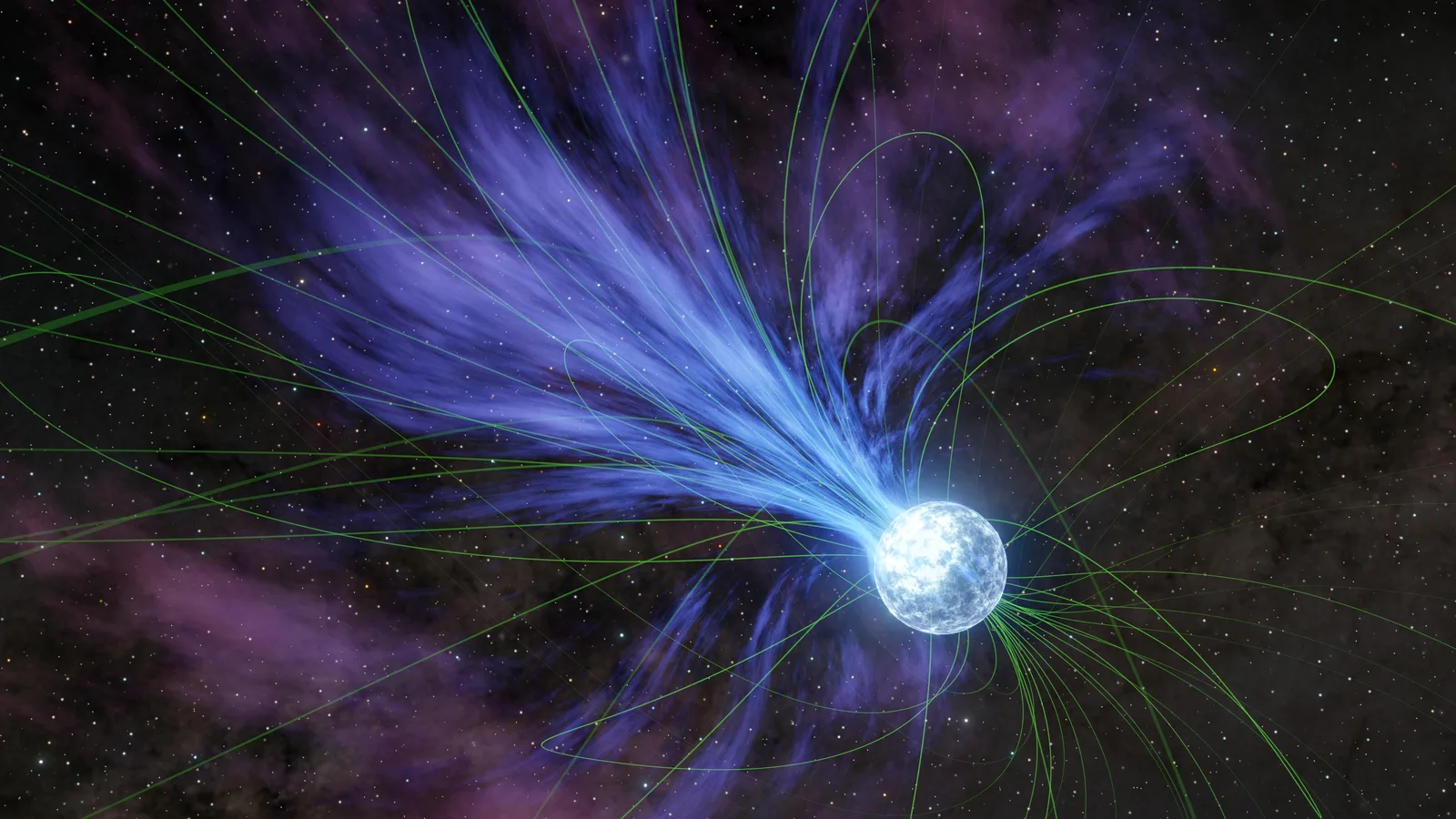
Somewhere in the Scutum arm of the Milky Way, about 15,000 light-years from Earth, a dead star is keeping time. Once every 44 minutes it flares for roughly two minutes, then falls silent. The pulse arrives in radio waves, the kind of low-frequency hum a backyard antenna might catch. It also arrives, at the very same moment, in X-rays, the kind of high-energy light that only escapes a planet's atmosphere into orbiting telescopes. No stellar corpse in our galaxy has ever been caught doing both at once on a clock this slow. The object is cataloged as ASKAP J1832-0911, and it does not fit any of the boxes astronomers built to hold the dead.
A corpse that breaks the rules
When a massive star exhausts its fuel and collapses, it usually leaves one of two remnants. If the core is heavy enough, it becomes a neutron star, a city-sized sphere so dense that a sugar cube of its material would weigh as much as a mountain. If the star is lighter, like the Sun, it leaves a white dwarf, an Earth-sized ember that will glow for billions of years as it cools. Both are governed by strict physics. A spinning neutron star with a strong magnetic field, a pulsar, sweeps a beam of radio waves across the sky like a lighthouse, and it does so fast, often many times a second. The most magnetized neutron stars, called magnetars, occasionally release violent bursts of X-rays and gamma rays as their fields buckle and snap.
ASKAP J1832-0911 obeys none of these schedules. Its 44-minute rhythm is impossibly slow for a spinning neutron star, which should have shed that much rotational energy and gone quiet long ago. The physics is unforgiving here. A pulsar's radio engine is powered by its rotation, and as the star spins down over thousands of years it eventually crosses a threshold, the so-called death line, beyond which it can no longer accelerate the particles needed to shine. A neutron star turning once every 44 minutes lies far past that line, deep in territory where radio emission should be impossible. Yet the pulses are not faint. They are extraordinarily bright, reaching peak flux densities on the order of ten janskys, a brightness more typical of an active, youthful object than a slow, aging one. And then there is the X-ray signal, varying on exactly the same 44-minute beat as the radio. That is the part that has no precedent.
Astronomers have looked at countless stars with all kinds of telescopes, and we have never seen one that acts this way.
The words belong to Ziteng Wang of Curtin University in Australia, who led the team that pinned the object down. The discovery, published in Nature in May 2025, marked the first time a long-period radio transient had ever been detected in X-rays at all. For years these slow-pulsing radio sources had been a category unto themselves, defined entirely by their radio behavior. ASKAP J1832-0911 added a second channel of evidence, and the new evidence only deepened the mystery.
How an accident became a discovery
The object was first noticed by the Australian Square Kilometre Array Pathfinder, ASKAP, a field of antennas in the remote Western Australian outback. ASKAP scans wide swaths of sky and is well suited to catching transients, sources that brighten and fade rather than shining steadily. In its data, J1832 stood out as a point of light flashing on a strange, leisurely cycle. The radio detection alone would have placed it among a small but growing family of long-period transients, perhaps a dozen of which were known.
What turned a curiosity into a landmark was the decision to look at the same patch of sky in X-rays. The team had a stroke of luck. NASA's Chandra X-ray Observatory happened to have the region in its field of view during an unrelated observation, a coincidence of pointing that gave the astronomers a high-energy view they had not planned for. When Wang's group examined the archived data, they found the X-ray source varying in lockstep with the radio, every 44 minutes. Without that accidental overlap, the X-ray nature of the object might have gone unnoticed for years, and J1832 would have remained just another entry in the radio catalog. To confirm the behavior, the investigation drew on several high-energy observatories beyond Chandra, including the European Space Agency's XMM-Newton, NASA's Neil Gehrels Swift Observatory, and the Einstein Probe. The picture that emerged was consistent across instruments: two forms of radiation, separated by enormous gulfs of energy, rising and falling together.
Using Chandra, the team discovered that the object is also regularly varying in X-rays every 44 minutes. This is the first time such an X-ray signal has been found in a long-period radio transient.
Why the radiation mix is the real puzzle
To appreciate why this combination is so strange, it helps to understand what each kind of radiation usually means. Radio waves from a dead star generally trace coherent processes, charged particles accelerated together in a strong magnetic field, producing a beam far brighter than the sum of its parts. X-rays, by contrast, usually trace heat or violence, gas heated to millions of degrees, or matter falling onto a compact object and releasing gravitational energy. The two emissions come from different physics, and in most objects one dominates while the other is absent or faint.
ASKAP J1832-0911 produces both, brightly, and ties them to the same clock. The X-ray luminosity sits in a range that for a magnetar would imply the object is actively flaring, yet the rest of its behavior looks nothing like a flaring magnetar. The radio luminosity, meanwhile, is enormous for something pulsing this slowly. The two channels do not merely coexist; they vary together and they vary a lot, which means whatever drives the radio also drives the X-rays, or both are driven by a single underlying engine that astronomers have not identified.
This is the heart of the problem. A model that explains the radio pulses tends to leave the X-rays unaccounted for, and a model that explains the X-rays struggles with the brightness and slowness of the radio. The object refuses to let one explanation cover both.
The fact that the two signals track each other so closely is itself a powerful clue. If the radio and X-ray emission came from independent regions of the object, there would be no reason for them to brighten and dim in unison. Their synchrony argues that they share a common source, or at least a common trigger, some periodic event that releases energy across the entire electromagnetic spectrum at once. Identifying that trigger is the key to the whole puzzle, and so far it has resisted every attempt.
Magnetar, white dwarf, or something new
Wang's team worked methodically through the candidates. A magnetar was the natural first guess, since magnetars are the one class of dead star known to produce strong X-rays. But an old magnetar, slowed to a 44-minute period, should not be able to generate radio emission this bright and this variable. The energetics do not line up.
A white dwarf offered another route. A highly magnetized white dwarf spinning every 44 minutes is at least plausible from a timing standpoint, since white dwarfs rotate far more slowly than neutron stars. But an isolated white dwarf cannot easily account for the data either. A white dwarf with a companion star might do better, drawing energy from the binary interaction, except that this scenario would demand a magnetic field stronger than any white dwarf yet measured in the Milky Way, pushing the model to the edge of what is physically known.
We looked at several different possibilities involving neutron stars and white dwarfs, either in isolation or with companion stars. So far nothing exactly matches up, but some ideas work better than others.
Those are the words of Nanda Rea of the Institute of Space Sciences in Barcelona, a co-author on the study and one of the field's leading authorities on magnetars. Her careful phrasing captures the state of play. Nothing is ruled in, nothing is fully ruled out, and the object sits in the uncomfortable gap between categories. Wang has gone further, suggesting that the discovery could point toward new physics or a previously unrecognized path in stellar evolution.
The widening family of slow transients
ASKAP J1832-0911 did not appear in a vacuum. It belongs to a class of objects that barely existed a few years ago and is now forcing astronomers to rethink what dead stars can do. Long-period transients pulse on timescales of minutes to hours, far longer than any ordinary pulsar, and each new example has complicated the picture rather than simplifying it.
One of the most revealing was ILT J1101+5521, identified in data from the European LOFAR radio array and reported in Nature Astronomy in 2025 by a team led by Iris de Ruiter. Its roughly minute-long radio pulses repeat every 125.5 minutes, and the cause turned out to be not a single spinning star but two stars orbiting each other, a white dwarf paired with a small red M dwarf. The pulses arrive when the two stars line up, meaning the period reflects the orbit, not the rotation of any one object. That discovery proved that at least some long-period transients are binaries, their rhythm set by celestial mechanics rather than by a lone magnetic rotor.
Whether ASKAP J1832-0911 fits that mold is unknown. Its X-ray emission sets it apart from the binary white-dwarf systems, and not every model that works for J1101 carries over. The family is real, but its members may not all share a single origin. Some could be magnetars, some white-dwarf binaries, and some, perhaps, objects with no name yet.
The exotic alternative
Not everyone is convinced the answer lies among ordinary stellar corpses at all. In late 2025, a separate analysis published in Astronomy and Astrophysics, led by Antonios Nathanail, proposed a far stranger possibility. Rather than a dead star, the source might be a black hole, specifically an intermediate-mass black hole feeding from a tilted accretion disk. In this picture, the disk wobbles like a spinning top under the black hole's gravity, a motion known as Lense-Thirring precession, and the jet it launches sweeps across our line of sight for two minutes out of every 44, producing the regular flares.
The model is speculative, and the authors present it as one option among several rather than a confirmed identification. But its very existence underscores how far the interpretations now range. When a single object can plausibly be a slow magnetar, a record-breaking magnetic white dwarf, a binary system, or a precessing black hole, the honest conclusion is that the underlying physics has not yet been settled. The data are clean. The explanation is not.
What it would mean to solve it
Resolving the nature of ASKAP J1832-0911 would do more than close a single case. Long-period transients may represent a previously hidden phase in the lives of dead stars, a stage in which old magnetars or magnetized white dwarfs briefly switch on radio engines that theory said should be dormant. If so, the boundary between magnetars, white-dwarf pulsars, and these slow transients is more porous than the textbooks suggest, and the rules governing how stellar corpses emit radiation will need revision.
There is also a broader stake. For most of the history of astronomy, the inventory of stellar endpoints felt nearly complete. White dwarfs, neutron stars, and black holes covered the possibilities, each with well-mapped behavior. Objects like ASKAP J1832-0911 suggest that the catalog of how dead stars can radiate is still being written, and that the survey telescopes now sweeping the radio sky are pulling genuinely new behavior out of the dark. Every long-period transient found so far has been at least slightly different from the last, which hints that the population is diverse rather than a single uniform class waiting for one tidy label.
The path forward is more data. Future X-ray missions with sharper vision could pin down the geometry of the emission and test whether a companion star is present. Continued radio monitoring could reveal whether the 44-minute clock drifts over time, a clue to whether it is set by rotation or orbit. A drifting period would point toward a binary orbit slowly decaying or widening; a perfectly stable one would favor a spinning object. Polarization measurements, which record how the radio waves are twisted, could expose the geometry of the magnetic field that launches them. Each measurement narrows the field of suspects. For now, the object keeps its rhythm, flaring in two kinds of light no dead star was supposed to combine, a corpse in the Scutum arm that has not finished telling its story.
It still keeps time in the Scutum arm, flaring in two kinds of light no stellar corpse was meant to combine, a dead star that has not yet agreed to be named.
Frequently Asked Questions
What is ASKAP J1832-0911?
It is a long-period radio transient in the Scutum arm of the Milky Way, about 15,000 light-years away. It emits pulses of radio waves and X-rays lasting roughly two minutes, repeating every 44 minutes. It is the first object of its class detected in X-rays, and it does not match any known type of dead star.
Why is its mix of radiation never-before-seen?
Radio waves and X-rays from dead stars usually come from different physical processes, and most objects produce one strongly and the other faintly or not at all. ASKAP J1832-0911 produces both brightly and varies them on the same 44-minute cycle, which means a single engine drives both. No previously known galactic object combines the two this way at this slow a pace.
Is it a magnetar or a white dwarf?
Neither cleanly fits. An old magnetar slowed to a 44-minute period should not produce radio emission this bright. An isolated white dwarf cannot explain the data, and a white dwarf with a companion would require the strongest magnetic field ever measured for a white dwarf in our galaxy. The team concluded that nothing exactly matches, though some models work better than others.
How was it discovered?
The radio pulses were first detected by the ASKAP radio telescope in Western Australia. The X-ray signal was confirmed using NASA's Chandra X-ray Observatory, which had the field in view during an unrelated observation, with supporting data from ESA's XMM-Newton, NASA's Swift Observatory, and the Einstein Probe.
What is a long-period radio transient?
It is a radio source that brightens and fades on a cycle of minutes to hours, far slower than ordinary pulsars, which flash many times a second. The class barely existed a few years ago. Some examples, such as ILT J1101+5521, have turned out to be binary star systems, while others may be unusual magnetars or white dwarfs.
Could it be a black hole instead of a dead star?
One 2025 study proposed that the source could be an intermediate-mass black hole with a tilted, precessing accretion disk whose jet sweeps past Earth every 44 minutes. The idea is speculative and presented as one possibility among several. The true nature of the object remains unresolved.
Sources
- Wang et al. (2025). "Detection of X-ray emission from a bright long-period radio transient (Nature)." link.
- Chandra X-ray Center (2025). "Eccentric 'Star' Defies Easy Explanation, NASA's Chandra Finds." link.
- University of Maryland (2025). "Astronomers Discover Mysterious Milky Way Object That Emits Radio Waves and X-rays." link.
- de Ruiter et al. (2025). "Sporadic radio pulses from a white dwarf binary at the orbital period (Nature Astronomy)." link.
- Nathanail et al. (2025). "Identifying long radio transients with accompanying X-ray emission as disk-jet precessing black holes: ASKAP J1832-0911 (A&A)." link.