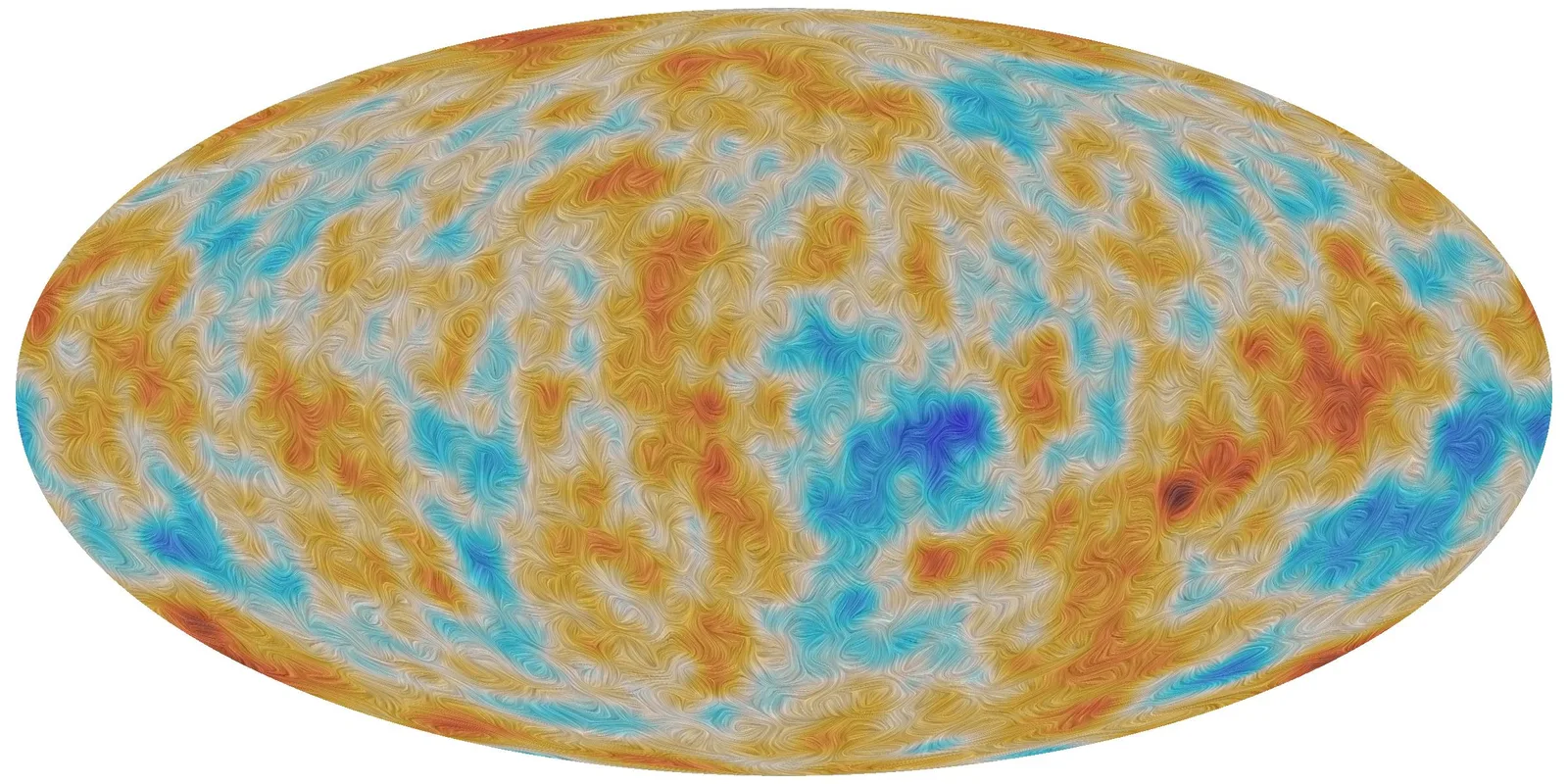
Turn an old analog television to a channel with no station, and a small fraction of the static hissing on the screen is not from Earth at all. It is light that has been traveling for nearly fourteen billion years, released when the universe was young and hot and had just become transparent. Astronomers call it the cosmic microwave background, and it is the oldest light that exists. No telescope will ever see anything older, because before it, the universe was opaque.
This faint glow fills the entire sky, in every direction, at almost exactly the same temperature. It is the single most important piece of evidence we have that the universe began in a hot, dense state and has been expanding and cooling ever since. Reading it has become one of the most precise sciences humans have ever built.
Light from when the universe cleared
The cosmic microwave background, or CMB, is radiation left over from about 380,000 years after the Big Bang. Before that moment, the cosmos was a glowing plasma so dense that light could not travel freely; photons scattered off free electrons almost instantly, the way light scatters inside fog. As the universe expanded and cooled below roughly 3,000 degrees, electrons and protons combined into neutral hydrogen atoms. Suddenly the fog lifted. Photons could stream in straight lines, and they have been streaming ever since. That moment is called recombination, and the CMB is a snapshot of the universe as it was then.
The light released was not microwaves at first; it was closer to the orange glow of a hot object. But the universe has expanded roughly a thousandfold since, stretching those wavelengths far into the microwave part of the spectrum and cooling the glow to just 2.725 degrees above absolute zero. What set out as visible fire arrives as a whisper of cold microwaves.
Before this light was set free, the universe was opaque. There is no older thing to see. The CMB is the wall at the edge of cosmic sight.
An accident that won a Nobel Prize
The CMB was found by accident. In 1965, Arno Penzias and Robert Wilson, radio astronomers at Bell Labs in New Jersey, were troubleshooting a large horn antenna picking up a persistent hiss they could not eliminate. It came from every direction, day and night, in all seasons. They checked their equipment, cooled their instruments, and famously cleared out pigeons nesting in the horn. The noise remained. Only when they connected with a group of physicists at nearby Princeton did they realize what they had: the predicted afterglow of the Big Bang, forecast decades earlier and never before detected. Penzias and Wilson received the Nobel Prize in 1978 for a signal they had spent months trying to make go away.
The map that decoded the cosmos
At first the CMB looked perfectly smooth, the same temperature everywhere. But theory demanded tiny variations, the seeds from which galaxies would later grow. Finding them required going to space. NASA's COBE satellite detected the first faint ripples in 1992, variations of only a few parts in a hundred thousand. Later missions, NASA's WMAP and the European Space Agency's Planck, mapped those ripples in exquisite detail across the whole sky.
Those maps turned cosmology into a precision science. The exact pattern of hot and cold spots, and their characteristic sizes, encodes the geometry, age, and composition of the universe. From the CMB, we learned that the cosmos is about 13.8 billion years old, that it is geometrically flat, and that ordinary matter makes up only about five percent of it, with dark matter and dark energy accounting for the rest. A faint hiss became a full inventory of the universe.
Still the best evidence for the Big Bang
The CMB is not just old light; it is a test that the hot Big Bang model has passed again and again. Its spectrum matches that of a perfect thermal glow more precisely than almost any measurement in physics. Its temperature is the same in opposite corners of the sky to a remarkable degree, a uniformity that itself points to the theory of cosmic inflation, a burst of expansion in the first instant that would have smoothed the universe out. And the faint patterns within it line up with the distribution of galaxies we see today.
Every competing idea about the universe's origin has to explain this glow, and none does it as cleanly as a hot, dense beginning. The CMB is the fossil of that beginning, still arriving at our detectors, still carrying the imprint of a universe that had just become clear enough to see.
It is everywhere at once, older than every star and galaxy: the light of the universe's first clear morning, still on its way to us.
Frequently Asked Questions
What is the cosmic microwave background?
The cosmic microwave background is the oldest light in the universe, radiation released about 380,000 years after the Big Bang when the cosmos cooled enough to become transparent. It fills the entire sky and now glows at just 2.725 degrees above absolute zero in the microwave range.
How was the cosmic microwave background discovered?
It was found by accident in 1965 by Arno Penzias and Robert Wilson at Bell Labs, who detected a persistent hiss from every direction they could not eliminate. They realized it matched the predicted afterglow of the Big Bang, and won the Nobel Prize in 1978.
Why is the CMB important?
It is the strongest evidence that the universe began in a hot, dense state. Detailed maps of its tiny temperature ripples reveal the universe's age, geometry, and composition, showing that ordinary matter is only about five percent of the cosmos, with dark matter and dark energy making up the rest.
Why can't we see anything older than the CMB?
Before recombination, the universe was an opaque plasma in which light could not travel freely. The CMB comes from the moment it first became transparent, so it forms a wall beyond which no light can reach us. Seeing further back requires other messengers, such as gravitational waves or neutrinos.
What temperature is the cosmic microwave background?
About 2.725 kelvin, or roughly minus 270 degrees Celsius, only a few degrees above absolute zero. It was far hotter when released, but the expansion of the universe has stretched and cooled the light over nearly 14 billion years.