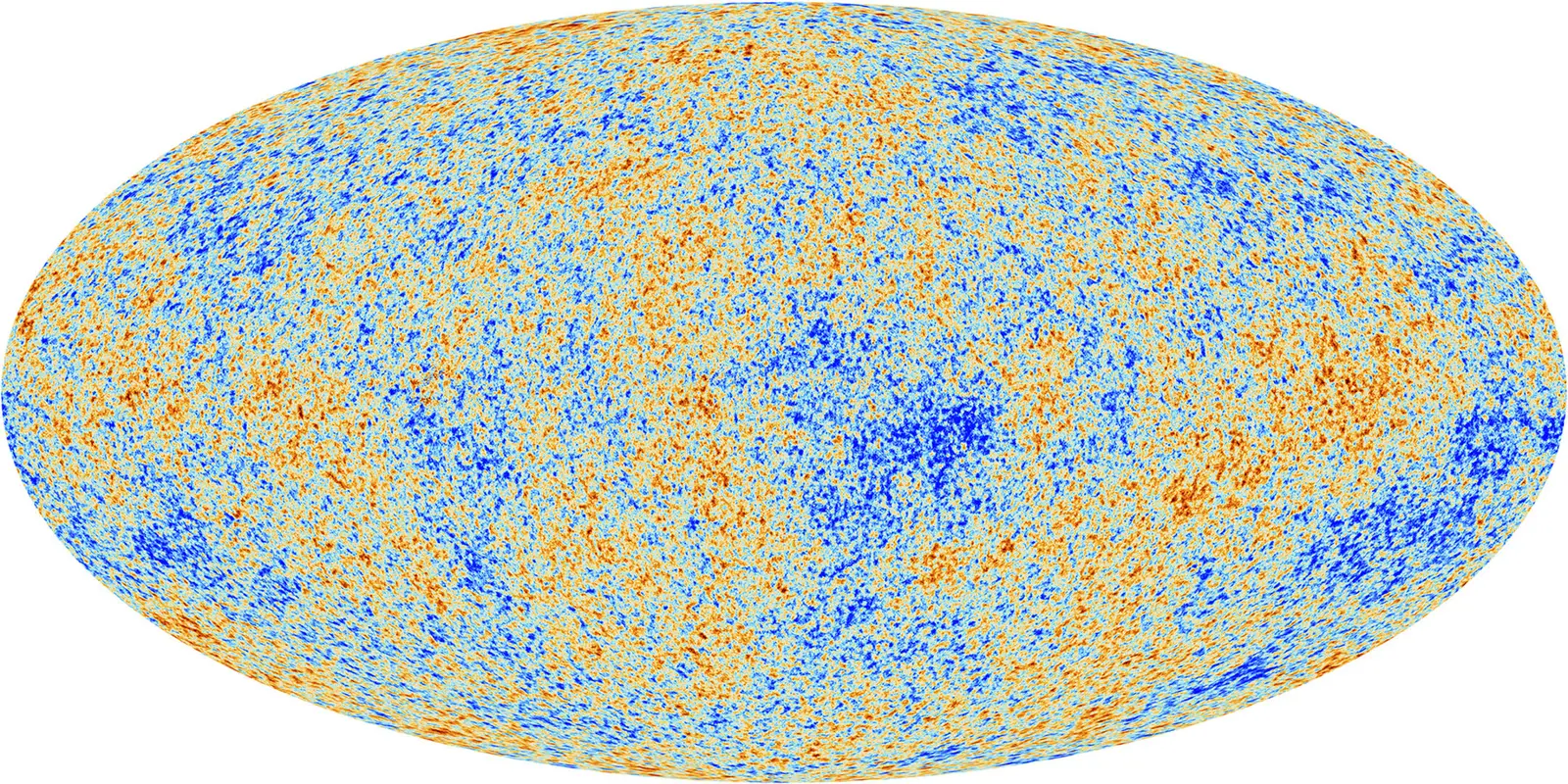
Somewhere inside the first split second of the universe, before there were atoms, before there was light that could travel freely, before the cosmos had cooled enough for anything we would recognize as physics to settle into place, a decision was made about everything that would follow. The universe chose to be smooth instead of lumpy. It chose to be flat instead of curved. It planted, in the form of microscopic quantum tremors, the seeds of every galaxy that would ever form. And it did all of this in a window of time so brief that writing it down requires a decimal point followed by more than thirty zeros.
This is the claim of cosmic inflation, one of the most ambitious ideas in modern science. It proposes that in its earliest moment the universe underwent a burst of expansion so violent that space itself stretched faster than light, doubling in size again and again until a patch smaller than a proton swelled into something larger than the observable cosmos. If it happened, it explains a great deal that the standard Big Bang model simply assumes. The trouble is that, more than four decades after the idea was proposed, the one piece of direct evidence that would confirm it has not arrived.
The problems no one could solve
By the late 1970s, the hot Big Bang model had triumphed. It explained the expansion of the universe, the abundance of light elements, and the faint bath of microwave radiation left over from the cosmos at roughly 380,000 years old. But it carried two awkward secrets that physicists preferred not to discuss too loudly.
The first was the horizon problem. Look at the cosmic microwave background, the oldest light we can see, in one direction. Now look in the exact opposite direction. The two patches of sky are the same temperature to within a few parts in a hundred thousand. That sounds unremarkable until you realize those two regions have never been in contact. In the standard model, light has not had time to travel between them since the beginning. They could not have exchanged heat, compared notes, or settled into a common temperature. Yet they match. The universe looks like a room where every corner sits at the same temperature, except no thermostat could ever have reached them all.
The second was the flatness problem. The geometry of the universe depends on how much matter and energy it contains. Too much and space curves in on itself; too little and it curves outward. Observations show the universe sitting almost exactly on the knife edge between the two, a flat geometry. The catch is that flatness is unstable. Any tiny departure from perfect balance in the early universe would have grown enormously over billions of years. For the cosmos to look flat today, it had to be flat in its first instant to a precision of dozens of decimal places. Nothing in the standard model required that. It simply had to be assumed.
In 1981, a young physicist named Alan Guth published a paper in Physical Review D with a title that named both ailments at once: a possible solution to the horizon and flatness problems. His proposal was that the early universe briefly supercooled and entered a state of exponential expansion, blowing up by a factor so large that the entire observable cosmos descended from a single, tiny, causally connected patch.
Two regions of sky that never touched sit at the same temperature. Inflation says they were once close enough to whisper.
How a burst of expansion fixes everything
The logic is elegant once you see it. If the entire visible universe began as one small region that was in thermal contact, then there is no mystery about why opposite ends of the sky match. They were neighbors before inflation drove them apart. The horizon problem dissolves.
Flatness falls just as cleanly. Imagine the surface of a balloon covered in wrinkles. Inflate it to the size of the Earth and any patch you examine looks perfectly flat, not because the balloon has no curvature but because the curvature has been stretched far beyond your ability to detect it. Inflation does this to space. Whatever curvature the universe started with, exponential expansion drove it so close to flat that it remains indistinguishable from flat today.
Guth's original version had a flaw: once inflation started, it would not stop cleanly, leaving a universe full of bubbles rather than the smooth cosmos we inhabit. Within a couple of years, Andrei Linde and, independently, Andreas Albrecht and Paul Steinhardt proposed refined models, often grouped under the heading of slow-roll inflation, in which the expansion winds down gracefully. The mechanism survived, refined but recognizable.
In these refined pictures, inflation is driven by a hypothetical field, sometimes called the inflaton, whose energy behaves like a temporary form of repulsive gravity. As long as the field sits high on a gently sloping potential, it powers the exponential stretch. As it slowly rolls down toward the bottom, the expansion eases, and when it reaches the floor its energy converts into a hot soup of particles, the moment usually identified with the conventional Big Bang. The genius of the slow-roll idea is that it gives inflation both a beginning and a graceful end, and it ties the duration of the expansion to the shape of the potential, which different models specify in different ways. That is ultimately why the theory makes testable predictions at all: the slope of the potential leaves an imprint on the sky.
Galaxies born from quantum noise
The most startling consequence of inflation is not what it smooths out but what it leaves behind. Quantum mechanics forbids perfect emptiness. Even in a vacuum, fields flicker with tiny fluctuations, appearing and vanishing on timescales too short to matter. Under ordinary conditions these fluctuations average to nothing. But inflation does not allow them to average out. It seizes them while they are happening and stretches them across the sky faster than they can subside, freezing microscopic quantum jitters into ripples in the density of the cosmos.
Those ripples became the slightly denser regions where gravity could later gather matter. Every galaxy, every cluster, the great cosmic web of filaments and voids that astronomers map across billions of light-years, traces back, in this picture, to quantum noise that existed for less than a trillionth of a trillionth of a second. The largest structures in the universe are the fossilized shadows of its smallest.
This is not merely poetic. Inflation makes a quantitative prediction about the pattern of those ripples: their strength should be very nearly the same on all scales, with a slight tilt toward more power on larger scales. The European Space Agency's Planck satellite measured this tilt with remarkable precision. The spectral index that describes it, called ns, came out to 0.9649, plus or minus 0.0042, in the Planck collaboration's 2018 analysis. The value sits just below one, exactly the gentle departure from perfect uniformity that the simplest inflationary models predict. It is one of the strongest pieces of circumstantial evidence the theory has.
The grandest objects in existence are frozen photographs of quantum tremors that lasted less than an instant.
The signal that would settle it
Circumstantial evidence is not proof. Inflation explains the smoothness, the flatness, and the spectrum of structure, but each of those could in principle have other causes. What physicists want is a fingerprint that only inflation could leave. That fingerprint is gravitational waves.
The same violent expansion that stretched quantum density fluctuations would also have stretched quantum fluctuations in the fabric of spacetime itself, producing a background of gravitational waves, ripples in the geometry of the cosmos. These primordial waves would be too faint and too long to detect directly. But they would leave a mark on the cosmic microwave background.
The oldest light is polarized, its waves aligned in particular directions by the conditions at the moment it was released. That polarization can be split into two patterns. One, called the E-mode, looks like a field of combed lines and is produced abundantly by ordinary density variations. The other, the B-mode, has a distinctive swirling, handed character, like water spiraling down a drain. Density variations cannot produce primordial B-modes on large scales. Gravitational waves can. A B-mode swirl in the ancient light, on the right angular scale, would be a signature of inflation that nothing else in the early universe could counterfeit. Its strength is captured by a single number, the tensor-to-scalar ratio, written r, which compares the power in gravitational waves to the power in density ripples.
The number is more than a bookkeeping device. The value of r is directly tied to the energy scale at which inflation took place. A large r would mean inflation happened at an energy close to the scale where physicists expect the forces of nature to unify, a regime far beyond anything a particle collider can reach. To measure r, then, is to probe physics at energies a trillion times higher than those at the Large Hadron Collider, using the sky itself as the apparatus. This is why the search has drawn some of the most ambitious experimental efforts in cosmology, and why a single faint swirl carries such weight. The difficulty is that the B-mode signal, if it exists at the levels current models favor, is fainter than the lensing and foreground effects that overlay it, which is why every claimed detection must survive a brutal gauntlet of cross-checks before anyone trusts it.
The false dawn
On a March morning in 2014, a team operating a telescope at the South Pole called BICEP2 announced that they had found it. They reported a B-mode signal corresponding to a tensor-to-scalar ratio of about 0.2, a value so large it implied inflation at a tremendous energy scale. The announcement made headlines worldwide. One of the scientists involved went to Andrei Linde's home with a camera to deliver the news, and the footage of Linde's astonishment circulated widely. It looked like one of the great discoveries in the history of cosmology.
The doubts came quickly. The BICEP2 instrument observed at a single frequency, which made it difficult to separate a true primordial signal from contamination by something much closer to home: dust in our own Milky Way. Interstellar dust grains, aligned by galactic magnetic fields, emit polarized light that can mimic a B-mode swirl. The BICEP2 team had estimated the dust contribution using the best information available, but they could not measure it directly.
Planck could. The satellite had mapped the sky at multiple frequencies, including ones where dust dominates. When the two teams combined their data in a joint analysis published in 2015, the verdict was sobering. Once the galactic dust was properly accounted for, the apparent signal largely evaporated. The joint study could only set an upper limit, finding the tensor-to-scalar ratio to be less than about 0.12, with no detection of primordial gravitational waves. The swirl that had looked like the birth cry of the universe was, to a substantial degree, the glow of dust between the stars.
The signal that looked like the universe's first breath turned out to be the shine of dust in our own galaxy.
Where the hunt stands now
The BICEP2 episode was a setback but also a lesson, and the field absorbed it. Successor instruments, the BICEP and Keck Array telescopes, kept observing from the South Pole, now across multiple frequencies and with far greater sensitivity, and combined their measurements with Planck and WMAP data. In 2021 the collaboration published its result in Physical Review Letters, volume 127, article 151301. They found no primordial gravitational waves, but they pinned the ceiling much lower than before: the tensor-to-scalar ratio must be less than 0.036, at 95 percent confidence. That is roughly three times tighter than the joint limit of six years earlier.
This tightening matters because different models of inflation predict different values of r. Some of the simplest and most natural versions, including ones that produce a large signal, are now squeezed or excluded. Others, favored on theoretical grounds, predict values of r far below current reach, down near 0.001 or lower. The fact that no signal has appeared does not refute inflation. It refines it, ruling out the louder versions and pointing toward quieter ones.
The next decade is built to listen for those quieter signals. The Simons Observatory in Chile's Atacama Desert is already deploying small-aperture telescopes designed to constrain r to a few thousandths. CMB-S4, a planned array of telescopes at the South Pole and in Chile, aims to push the sensitivity to a statistical uncertainty on r of around one thousandth. And LiteBIRD, a Japanese-led satellite mission slated to survey the full sky from space, has set itself the demanding goal of measuring r with a total uncertainty below 0.001, the level at which several leading inflationary models would finally come within reach.
None of these is guaranteed to find anything. It is possible that primordial gravitational waves exist at a level too faint for any foreseeable experiment, in which case inflation may remain forever a beautifully successful theory that we cannot fully confirm. It is also possible that within a few years one of these instruments will detect a faint, handed swirl in the oldest light and, in doing so, read a message written in the first fraction of a second of time. The decision the universe made in that instant left a signature. We are still learning whether we can see it.
The universe decided everything in less than an instant. We have spent four decades trying to read what it wrote, and the page is still mostly blank.
Frequently Asked Questions
What is cosmic inflation in simple terms?
Cosmic inflation is the theory that in the first tiny fraction of a second after the Big Bang, the universe expanded exponentially, doubling in size repeatedly. This brief burst stretched a microscopic region into something larger than the observable cosmos, explaining why the universe looks smooth and flat and why it contains the structure it does.
Who proposed the theory of inflation?
The physicist Alan Guth proposed inflation in a 1981 paper in Physical Review D, framing it as a solution to the horizon and flatness problems. His original model had flaws, and refined versions by Andrei Linde and by Andreas Albrecht and Paul Steinhardt soon followed, producing the slow-roll inflation models used today.
What are primordial gravitational waves?
They are ripples in the fabric of spacetime that inflation would have generated by stretching quantum fluctuations in gravity itself. Too faint to detect directly, they would leave a distinctive swirling polarization pattern, called a B-mode, in the cosmic microwave background. Detecting that pattern would be strong evidence that inflation occurred.
What happened with the BICEP2 announcement in 2014?
The BICEP2 team announced a detection of primordial gravitational waves with a tensor-to-scalar ratio near 0.2. A later joint analysis with Planck data, published in 2015, showed that polarized dust in our own galaxy could account for most of the signal. The result was downgraded to an upper limit, and no detection stood.
Have primordial gravitational waves been detected?
No. As of 2026 they have only been constrained, not detected. The BICEP and Keck collaboration's 2021 result set the tensor-to-scalar ratio below 0.036 at 95 percent confidence, the tightest limit to date, but found no signal.
What experiments are searching for the signal now?
Several next-generation projects are hunting for the faint B-mode swirl: the Simons Observatory in Chile, the planned CMB-S4 array at the South Pole and in Chile, and the Japanese-led LiteBIRD satellite. Each aims to measure the tensor-to-scalar ratio at the level of about 0.001, where leading inflation models could be confirmed or ruled out.
Continue Exploring
- The Oldest Light in the UniverseEverywhere you point a radio dish, a faint glow answers back: the cooled afterglow of the Big Bang, released when the...
Sources
- Guth, A. H. (1981). "Inflationary universe: A possible solution to the horizon and flatness problems, Phys. Rev. D 23, 347." link.
- BICEP2/Keck and Planck Collaborations (2015). "Joint Analysis of BICEP2/Keck Array and Planck Data, Phys. Rev. Lett. 114, 101301." link.
- Planck Collaboration (2020). "Planck 2018 results. X. Constraints on inflation, A&A 641, A10." link.
- BICEP/Keck Collaboration (2021). "Improved Constraints on Primordial Gravitational Waves using Planck, WMAP, and BICEP/Keck through 2018, Phys. Rev. Lett. 127, 151301." link.
- LiteBIRD Collaboration (2023). "Probing Cosmic Inflation with the LiteBIRD CMB Polarization Survey, PTEP 2023, 042F01." link.
- CMB-S4 Collaboration (2020). "CMB-S4: Forecasting Constraints on Primordial Gravitational Waves, ApJ 926, 54." link.