The signal arrived as a rhythm. Not a single flash and a slow fade, the familiar shape of a dying star, but a series of bright pulses that came faster and faster, like a drumbeat accelerating toward a finale. The light had traveled for roughly a billion years to reach the telescopes that caught it. And buried inside that light was a pattern no supernova had ever shown before: a chirp, the same rising note that ripples through spacetime when two black holes spiral into each other. Something deep inside the explosion was keeping time.
A star that refused to behave
In December 2024, the ATLAS survey flagged a new point of light about a billion light-years away. It was catalogued as SN 2024afav and quickly recognized as a superluminous supernova, a member of a rare class of stellar explosions that shine ten to one hundred times brighter than an ordinary supernova. Fewer than three hundred have ever been found. By any reasonable standard, this was a once-in-a-career object simply by existing.
Then it started misbehaving. A team led by Joseph Farah, a graduate student at the University of California, Santa Barbara, working under Andy Howell at Las Cumbres Observatory, trained the observatory's global network of telescopes on the fading explosion and followed it for more than two hundred days. A normal supernova brightens, peaks, and declines along a smooth curve set by the radioactive decay of nickel and cobalt forged in the blast. SN 2024afav did not do that. Its light curve carried bumps, four distinct rises and falls riding on top of the overall fade.
Bumps in a supernova are unusual but not unheard of. What made this one impossible to ignore was the spacing. The bumps were not random, and they were not evenly spaced. Each one arrived sooner than the last. The interval between pulses was shrinking, the rhythm tightening as the weeks passed. Following that pattern required patience and the kind of telescope coverage few teams can muster. Las Cumbres Observatory operates a network of twenty-seven telescopes spread around the globe, which meant the supernova was almost never out of view, and the bumps could be traced continuously rather than glimpsed in scattered snapshots. Over two hundred nights, the pattern resolved into something unmistakable.
There was just no existing model that could explain a pattern of bumps that get faster in time.
That sentence, from Farah, is the whole problem in miniature. Astronomers had spent years explaining bumpy supernova light curves with shells of gas, clumps of debris, and collisions between ejecta and surrounding material. None of those explanations produces a signal that accelerates. A clearly sinusoidal pattern whose period kept getting shorter pointed somewhere else entirely.
The long argument over the brightest explosions
To understand why the chirp mattered, you have to understand the argument it walked into. For more than a decade, superluminous supernovae have been one of the most stubborn puzzles in stellar death. They are too bright. The ordinary engine that powers a supernova's afterglow, the radioactive decay of roughly a tenth of a solar mass of nickel-56, cannot produce the luminosity these objects reach. Something else has to be feeding them.
Three main candidates have competed for the role. The first is pair instability, a scenario in which an extremely massive star becomes so hot in its core that photons spontaneously convert into electron-positron pairs, robbing the star of the radiation pressure that holds it up. The core collapses, runaway fusion ignites, and the entire star is blown apart, leaving no remnant behind and producing several solar masses of radioactive nickel. Pair-instability events are real in theory, but they require enormous progenitor stars and predict slow, broad light curves that do not match most superluminous supernovae.
The second candidate is circumstellar interaction. If a dying star has shed thick shells of gas in the centuries before exploding, the supernova blast wave slams into that material and converts its kinetic energy into light. This works well for some events, but it tends to produce specific spectral fingerprints of dense surrounding gas, fingerprints that the brightest hydrogen-poor supernovae often lack.
The third candidate, and the one that has quietly gained ground, is the magnetar. In 2010, Daniel Kasen and Lars Bildsten worked out the math: if a supernova leaves behind a neutron star spinning hundreds of times per second with a magnetic field hundreds of trillions of times stronger than Earth's, the star bleeds its rotational energy into the surrounding debris over days to weeks. That energy reheats the expanding cloud from the inside and can make it blaze far brighter than radioactivity alone ever could. The idea was elegant, and it fit the light curves. But it had a problem.
The magnetar idea has felt almost like a theorist's magic trick, hiding a powerful engine behind layers of supernova debris.
That assessment comes from Kasen himself, now at UC Berkeley, reflecting on the awkward position the theory had been in. A magnetar would sit at the dead center of the explosion, wrapped in an opaque shroud of expanding gas. You could match its predicted output to a light curve, but you could never see the engine. The fit was suggestive. It was never proof. For fifteen years, the magnetar model was the leading explanation precisely because it could not be ruled out, which is a different thing from being confirmed.
What a chirp can tell you that a glow cannot
A smooth glow carries limited information. You can measure how bright it is and how fast it fades, and from those two numbers you can estimate the energy budget. But a periodic signal carries something a glow never can: a clock. And a clock that changes speed carries even more, because the rate of change encodes the physics driving it.
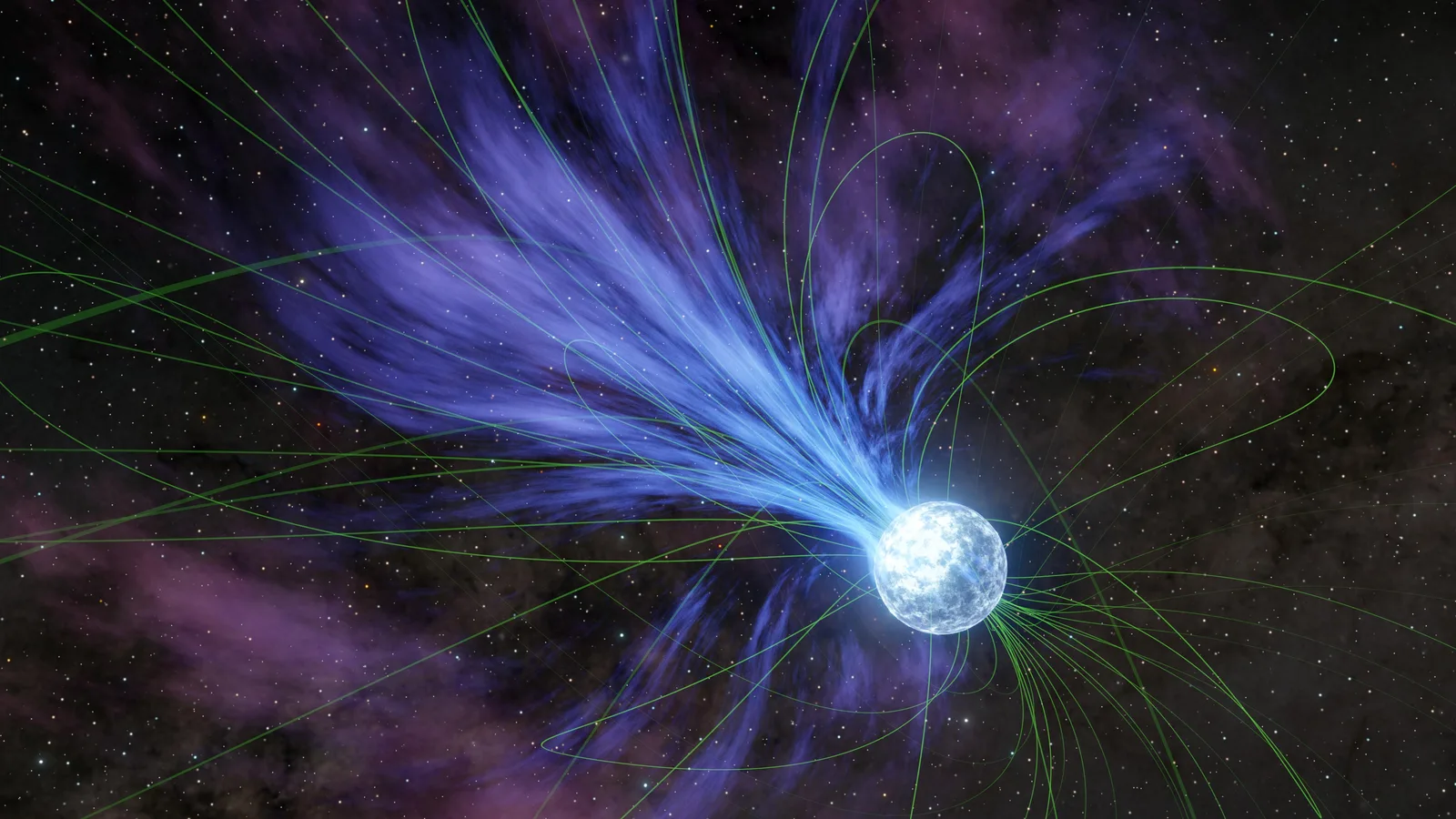
Farah's interpretation is that the chirp is the signature of a tilted accretion disk wobbling around the newborn magnetar. As the explosion expanded, some of the innermost material did not escape. It fell back toward the neutron star and settled into a disk. But the magnetar was not spinning straight up and down relative to that disk, and here general relativity enters the story in a way it rarely does in supernova astrophysics. A spinning massive object drags spacetime around with it, an effect called frame dragging, or Lense-Thirring precession. The disk, sitting in that dragged spacetime and tilted with respect to the magnetar's spin, cannot hold still. It precesses, wobbling like a coin spun on a table.
As the disk wobbles, it periodically blocks and reflects the intense light from the magnetar, brightening and dimming the supernova on the rhythm of its precession. And as more material falls inward and the disk spirals closer to the neutron star, the precession speeds up. The clock runs faster. The bumps come sooner. The supernova chirps, a rising tone that echoes the gravitational-wave chirp LIGO records as two black holes spiral together.
The reason this is so striking is that the gravitational field near a millisecond magnetar is strong enough for relativity's stranger predictions to become large, measurable effects rather than tiny corrections. Adam Ingram of Newcastle University, who reviewed the paper, put it plainly: the gravitational field is strong enough for the most exotic predictions of general relativity to be large effects. The same frame-dragging that takes exquisite gyroscopes in Earth orbit to detect is, around a newborn magnetar, written across the light curve of an entire exploding star.
Reading the engine through its rhythm
Because the chirp is tied directly to the magnetar's gravity and spin, its shape can be inverted to recover the engine's properties. The team reports that the model independently and self-consistently constrains both the spin period and the magnetic field strength of the neutron star, two numbers that previously could only be inferred indirectly by fitting the overall brightness.
The values are extreme even by the standards of dead stars. The magnetar appears to rotate once every 4.2 milliseconds, roughly 240 times every second, a sphere of nuclear matter the size of a city turning faster than a kitchen blender. Its magnetic field is estimated at around 300 trillion times the strength of Earth's, placing it firmly in the magnetar regime, the most strongly magnetized objects known to exist. These are precisely the conditions Kasen and Bildsten had identified in 2010 as capable of powering a superluminous supernova. The chirp did not just suggest a magnetar in general. It measured this one.
That is the difference between a model that fits and a model that is confirmed. A smooth light curve can be reproduced by tuning free parameters until the curve matches; with enough knobs to turn, almost any rise and fall can be reproduced, which is why a good fit alone has never settled the question. A chirping light curve is different. Its period accelerates at a specific rate, and that rate is not a free parameter the modeler chooses. It is dictated by the physics of a precessing disk in the gravitational field of a spinning neutron star. The signal demands a physical clock and reveals the properties of the thing keeping time. Once the chirp was measured, the signal and the engine became inseparable.
No supernova has had a chirp before, so there has to be something weird going on.
How sure can we be
Confirmation in astrophysics is rarely a single moment, and the scientists involved are careful not to overstate it. The result, published in Nature, is the clearest evidence yet that a magnetar can power the brightest supernovae, and the first time astronomers have read a magnetar's birth directly out of an explosion's light rather than inferring it from afar. But a single object, however well observed, is a single object.
Matt Nicholl of Queen's University Belfast, who has spent years modeling superluminous supernovae and was not part of the team, offered a measured verdict: he does not think it is the final smoking gun yet. That caution is healthy and is exactly how the field should treat a first detection. One chirping supernova is a spectacular existence proof. It is not yet a population. The magnetar model has survived fifteen years partly because it was flexible, and a careful community will want to see the pattern repeat in objects that no one tuned a model to fit.
What makes the caution livable is that the test is coming. The Vera C. Rubin Observatory in Chile is beginning the most comprehensive survey of the night sky ever attempted, and it is expected to discover thousands of superluminous supernovae, more than ten times the entire historical catalog. If chirping supernovae are a genuine feature of magnetar-driven explosions and not a fluke of one strange object, Rubin should turn up dozens of them, each one carrying its own clock and its own measurable engine. Farah expects exactly that. Within a few years, the question of whether SN 2024afav was unique or representative will likely be answered by sheer numbers.
Why a rhythm a billion years old matters
It is worth stepping back to absorb what was actually measured. The light left SN 2024afav when the most complex life on Earth was single-celled. It crossed a billion light-years of expanding space, arrived at a network of telescopes scattered across our planet, and delivered, intact, the precessing wobble of a disk orbiting a neutron star that has been dead for a billion years. The frame-dragging of spacetime around a city-sized object was reconstructed from a flickering point of light fainter than almost anything the eye could register.
This is also a quiet vindication of a particular way of doing science. Kasen and Bildsten wrote down a mechanism in 2010 that could not be directly tested with the data of their time. They published it anyway, as a clean prediction, and waited. Fifteen years later a graduate student followed an unusually stubborn supernova for two hundred nights, noticed that its rhythm was accelerating, and recognized in that acceleration the shape of the engine the theorists had described. The prediction and the observation met across a decade and a half and a billion light-years.
The brightest explosions in the universe have hidden their engines behind a curtain of debris since the first superluminous supernova was identified. For the first time, one of them kept a beat clear enough to read. The drumroll that arrived from a billion years ago was not noise on top of a dying star. It was the star's last machine, spinning, telling us exactly what it was.
The drumroll that arrived from a billion years ago was not noise on top of a dying star. It was the star's last machine, spinning, telling us exactly what it was.
Frequently Asked Questions
What is a superluminous supernova?
A superluminous supernova is a stellar explosion that shines roughly ten to one hundred times brighter than an ordinary supernova. They are rare, with fewer than three hundred confirmed before 2026, and their extreme brightness cannot be explained by the radioactive decay that powers normal supernovae, which is why their energy source has been debated for over a decade.
What does it mean for a supernova to "chirp"?
The supernova SN 2024afav showed periodic bumps in its brightness whose interval kept getting shorter over time, producing a quasi-periodic signal of rising frequency. Astronomers call this a chirp because it resembles the accelerating gravitational-wave signal that two black holes produce as they spiral together before merging. No supernova had ever shown such a pattern before.
What is a magnetar?
A magnetar is a young neutron star with an exceptionally strong magnetic field, in this case estimated at around 300 trillion times the strength of Earth's. The one inferred at the center of SN 2024afav spins once every 4.2 milliseconds, about 240 times per second. As it slows, it can transfer enormous rotational energy into the surrounding debris and make the supernova blaze far brighter than radioactivity alone.
How does a chirp reveal a magnetar?
The leading explanation is that material falling back onto the newborn magnetar formed a tilted accretion disk. Because the rapidly spinning neutron star drags spacetime around it through an effect called Lense-Thirring precession, the disk wobbles, periodically blocking and reflecting the magnetar's light. As the disk spirals inward, the wobble accelerates, which makes the brightness pulses arrive faster and produces the chirp. The rate of acceleration encodes the magnetar's spin and magnetic field.
What other theories competed to explain superluminous supernovae?
Two main alternatives have been pair instability, in which an extremely massive star is torn apart after photons convert into electron-positron pairs, and circumstellar interaction, in which the blast wave collides with thick shells of gas the star shed before exploding. Both explain some events but struggle with the brightest hydrogen-poor cases. The magnetar model, proposed by Kasen and Bildsten in 2010, fit the light curves well but could not be directly confirmed until this chirp.
Is the magnetar explanation now settled?
It is the strongest evidence so far, published in Nature, but scientists remain appropriately cautious. SN 2024afav is a single, exceptionally well-observed object, and at least one independent researcher has noted it is not yet a final smoking gun. The decisive test will come from the Vera C. Rubin Observatory, which is expected to find thousands of superluminous supernovae and should reveal whether chirping is a common signature of magnetar-driven explosions.
Continue Exploring
- The Supernova a Machine Saw Before Anyone ElseA star 730 million light-years away brightened for four years, exploded, then exploded again. No human flagged it. An...
- The Explosion That May Have Detonated TwiceIn August 2025, a faint gravitational tremor and a fading point of light arrived together from 1.3 billion light-years...
Sources
- Farah et al. (2026). "Lense-Thirring precessing magnetar engine drives a superluminous supernova." link.
- Farah et al. (2025). "Lense-Thirring precessing magnetar engine drives a superluminous supernova (preprint)." link.
- Kasen & Bildsten (2010). "Supernova Light Curves Powered by Young Magnetars (ApJ 717, 245)." link.
- UC Santa Barbara (2026). "UCSB researcher bridges the worlds of general relativity and supernova astrophysics." link.
- Science News (2026). "A strange 'chirp' in a brilliant stellar blast points to a magnetar." link.
- Smithsonian Magazine (2026). "Astronomers Witnessed the Birth of a Magnetar for the First Time." link.