Somewhere in a collapsing cloud of gas, an object began the same way every star begins. Gravity pulled hydrogen inward. The core grew denser and hotter. The pressure climbed toward the threshold where atoms fuse and a sun switches on. And then, just short of that threshold, the climb stopped. The object had run out of mass. It would never be a star. It would spend the rest of cosmic time slowly cooling in the dark, glowing faintly from the heat of its own failed beginning.
These objects have a name that sounds almost like an apology: brown dwarfs. They are not brown, and most are not especially small. They are the galaxy's near misses, bodies caught in the gap between the largest planets and the smallest stars. For most of the twentieth century they were a theoretical prediction with no confirmed example. Today they are known to be everywhere, and the coldest one yet found drifts barely seven light-years from the Sun at a temperature near the freezing point of water.
The Line Between Planet and Star
What separates a star from everything smaller is a single event: sustained nuclear fusion of ordinary hydrogen in the core. A star is an object massive enough that gravity squeezes its center to roughly ten million Kelvin, hot and dense enough to fuse hydrogen nuclei into helium and release energy faster than the object radiates it away. That balance, energy made in the core against energy lost from the surface, is what lets a star shine steadily for millions or billions of years.
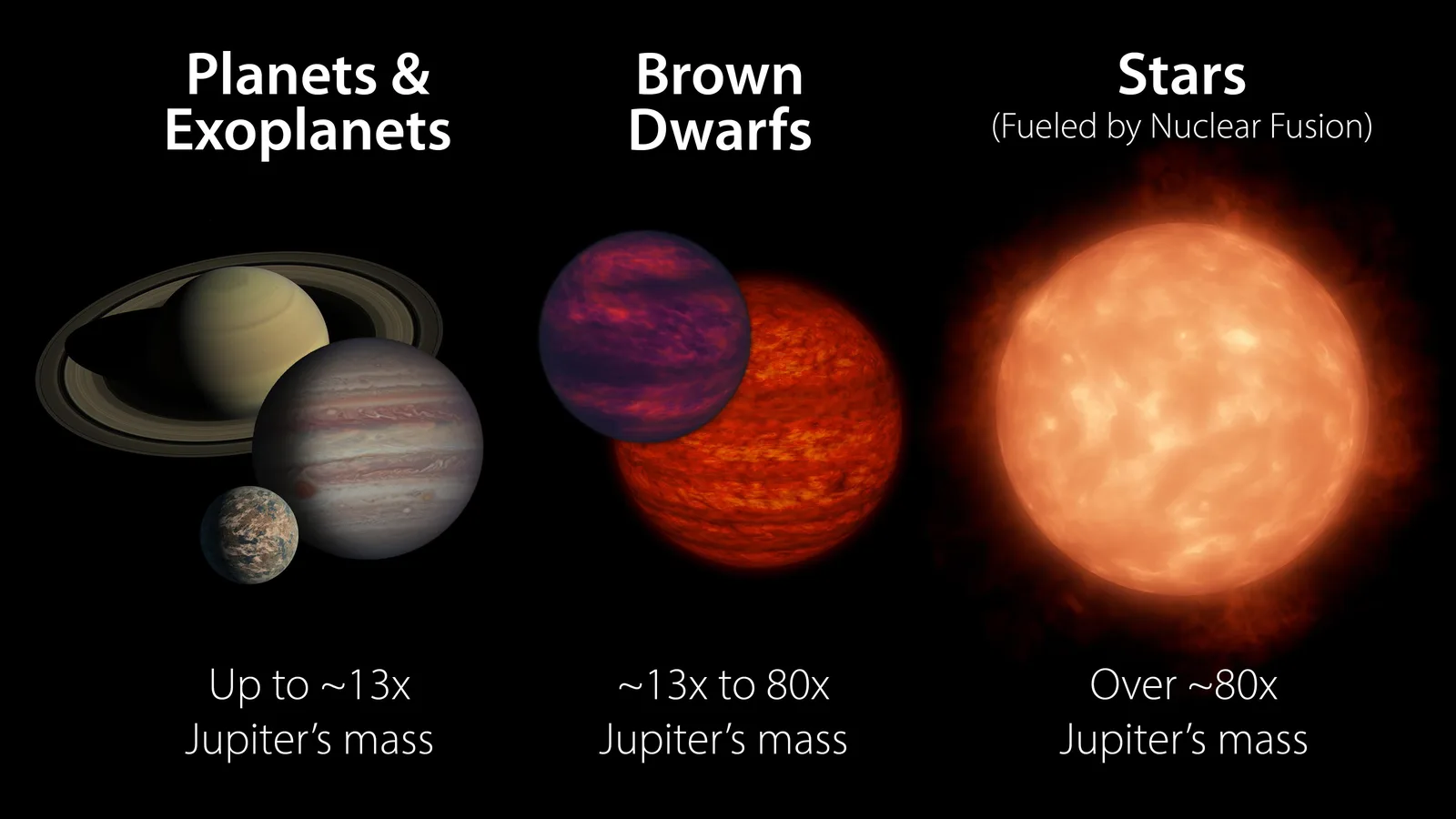
Brown dwarfs fall short of that mark. The minimum mass needed to ignite and sustain hydrogen fusion is about 75 to 80 times the mass of Jupiter, close to 0.075 solar masses. Below that, the core never gets hot enough. The object can compress, it can glow, but it cannot light the fire that defines a star. Anything heavier crosses into the realm of red dwarfs, the smallest true stars. Anything lighter is something else.
The lower boundary is subtler. Around 13 times Jupiter's mass, the core grows hot enough to fuse deuterium, a heavier isotope of hydrogen with an extra neutron. Deuterium fusion ignites at a lower temperature than ordinary hydrogen fusion, so even modest brown dwarfs can briefly burn the small supply of deuterium they were born with. That deuterium-burning limit, calculated near 13 Jupiter masses by David Spiegel, Adam Burrows, and John Milsom in 2011, is the conventional dividing line between a giant planet and a brown dwarf. The exact figure shifts with composition, but the principle holds.
A brown dwarf is defined not by what it does, but by what it cannot do. It can fuse deuterium for a moment. It can never fuse hydrogen for a lifetime.
So the entire category lives inside a narrow band of mass, from roughly 13 to 80 Jupiter masses. Below it, worlds. Above it, stars. Inside it, the objects that tried to become stars and could not.
Built Like a Star, Stalled Like a Planet
Brown dwarfs do not form the way planets do. A planet assembles slowly inside the disk of dust and gas circling a young star, building up from collisions of rock and ice. A brown dwarf, by contrast, usually forms the way a star does: a fragment of a molecular cloud collapses directly under its own gravity. The difference is simply that the collapsing fragment did not carry enough material to finish the job.
This shared origin is why brown dwarfs are so often described as failed stars rather than oversized planets. They begin on the stellar path. They gather hydrogen, heat their cores, and start contracting toward fusion. But without enough mass, the contraction halts when the interior reaches a state called electron degeneracy, a quantum effect in which crowded electrons resist further compression. The core stops shrinking before it ever reaches the temperature hydrogen fusion demands.
From that moment the object has no internal furnace to sustain it. It simply radiates away the heat left over from its formation and its brief deuterium burning, cooling steadily across billions of years. A young brown dwarf can be warm enough to resemble a small red star. The same object, aged, fades into something far cooler and dimmer. Mass alone does not tell you a brown dwarf's temperature; you also have to know its age.
That cooling history is what makes them so hard to find and so revealing once found. A brown dwarf is, in a sense, a fossil of its own birth, still leaking the warmth of the day it gave up on becoming a star.
The same logic explains why a single brown dwarf can drift between categories over its lifetime. A newborn object of, say, 30 Jupiter masses might shine as a warm L dwarf, its atmosphere thick with mineral clouds. Over hundreds of millions of years it cools through the T class, where methane takes hold, and a sufficiently old and light example can eventually fade into the frigid Y regime. The spectral classes are not fixed identities so much as stages in a slow descent. To read a brown dwarf's temperature is therefore to read a moment in a cooling that began at its formation and will continue, in principle, until the universe itself grows cold around it.
L, T, and Y: A New Alphabet for Cold
Astronomers sort stars by spectral class, the familiar sequence O, B, A, F, G, K, M running from hottest to coolest. For most of the twentieth century, M marked the cold end of the line. Brown dwarfs forced the alphabet to grow. Three new classes were added beyond M, each cooler than the last: L, T, and Y.
L dwarfs are the warmest, with surface temperatures from roughly 2,200 K down to about 1,300 K. They are not all brown dwarfs; the warmest L dwarfs are genuine low-mass stars. Their atmospheres are hot enough to hold mineral clouds, with grains of silicates and iron suspended in the air like soot in smoke. They glow a deep red.
T dwarfs are colder, below about 1,300 K, and their defining signature is methane. At these temperatures carbon binds with hydrogen to form methane gas, the same molecule that tints Neptune blue, and its absorption bands carve dark gaps into the spectrum. The first confirmed brown dwarf, Gliese 229B, is the prototype of this class. Its methane fingerprint was the proof that it could not be a star.
Y dwarfs are colder still, the most recent and most extreme addition. Predicted as a possible class as early as 1999 and finally confirmed by Michael Cushing and colleagues in 2011 using NASA's Wide-field Infrared Survey Explorer, Y dwarfs have temperatures below about 500 K and can dip near or below room temperature. Their atmospheres carry water vapor and ammonia, and the coldest may grow clouds of water ice. Fewer than a hundred are known. They are the faintest, nearest objects of their kind, and they sit at the very bottom of the temperature ladder.
The cold end of the cosmos needed three new letters. L glows like an ember, T breathes methane, and Y reaches temperatures you could survive.
The Coldest Object in the Sun's Neighborhood
In March 2013, the astronomer Kevin Luhman was studying images from the WISE spacecraft, an infrared telescope that had mapped the entire sky in heat rather than visible light. He noticed a faint point of warmth shifting position against the background stars, a sign that it was very close. When he pinned down its distance, the result was startling: about 7.4 light-years, making it the fourth-closest known system to the Sun, nearer than all but a handful of stars.
The object, catalogued as WISE 0855-0714, turned out to be the coldest brown dwarf ever found. Its temperature sits near 250 K, roughly minus 23 degrees Celsius, close to the freezing point of water and far colder than any other known substellar body at the time of its discovery in 2014. Estimates of its mass place it between about 3 and 10 times Jupiter, near the boundary where the brown dwarf definition itself starts to blur into the planetary.
WISE 0855 is a glimpse of how cold and quiet these objects can become. It emits almost no visible light at all; it shines only in the deep infrared, the wavelength of leftover warmth. Spectra suggest its frigid atmosphere may host clouds, possibly of water ice, though the exact composition is still debated. It is, in effect, a free-floating world the size of a small star's failure, drifting alone through interstellar space within shouting distance of home.
That such an object went unnoticed until 2014, despite being one of our nearest neighbors, says something about how dark these bodies are. The sky is full of them. We are only now building instruments sensitive enough to feel their faint heat.
Weather on a Failed Star
The most surprising thing about brown dwarfs may be that they have weather. Because they do not burn steadily like stars, their atmospheres behave less like a sun's outer layers and more like the turbulent skies of a giant planet. They have cloud decks, storms, and bands. They rotate, often quickly, and as they spin, different cloud patterns turn into view, changing their brightness in regular cycles. Astronomers can read those cycles like a weather report from light-years away.
The James Webb Space Telescope has transformed this study. By watching brown dwarfs across a wide span of infrared wavelengths, Webb can probe different depths of an atmosphere at once, building a layered picture of conditions from the high haze down to the warm interior. One closely studied object, a young brown dwarf called SIMP 0136 that spins once every 2.4 hours, was monitored across a full rotation. Webb found that its changing brightness was driven mainly by temperature variations deep in the atmosphere rather than by clouds passing overhead, and it detected a thermal inversion, a layer where temperature rises with altitude, possibly heated from above by auroral activity.
Webb has also tracked a pair of nearby brown dwarfs, WISE 1049AB, over months, finding patchy silicate clouds and shifting temperature structures that persisted in consistent patterns. The picture emerging is of atmospheres genuinely dynamic, with distinct layers governed by distinct processes, much like the banded storms of Jupiter but on bodies that nearly became stars.
What makes this possible is the sheer reach of Webb's instruments. By extending coverage to the mid-infrared, the telescope can detect the absorption signature of silicate grains, the same mineral dust that forms mineral clouds, and watch how that feature changes from one rotation to the next. Different wavelengths originate at different pressures, so a single broad spectrum is really a stack of probes reaching from the cold upper haze down to the warmer interior. Astronomers can now ask not just whether a brown dwarf has clouds, but at what altitude, of what composition, and how those clouds shift as the object turns. It is a level of detail that, a decade ago, belonged only to the planets of our own solar system.
For the coldest objects, the questions only deepen. Webb observations of WISE 0855 have been matched, in some analyses, by cloudless models, suggesting its frigid air may be clearer than expected, though deep, exotic cloud layers cannot be ruled out. Each spectrum is a step toward reading the chemistry and circulation of worlds that defy the planet-or-star binary entirely.
Why the Failures Matter
Brown dwarfs are not a curiosity at the margins of astronomy. They are a bridge. Their atmospheres are cool enough to share chemistry with giant exoplanets, the water vapor, methane, ammonia, and mineral clouds that astronomers want to read on distant worlds. But unlike most exoplanets, many brown dwarfs float alone in space, unobscured by the glare of a nearby star. That makes them ideal laboratories, exoplanet analogs we can study in clean isolation.
They also test the limits of what fusion can and cannot do. By marking the exact boundary where hydrogen burning becomes impossible, brown dwarfs define the faint edge of the stellar world and the heavy edge of the planetary one. Every refinement of their mass limits sharpens our understanding of how stars and planets are made, and of how much of the galaxy's matter is locked up in objects that never lit.
And there is the simple strangeness of them. The object that began this story set out to become a star and stopped just short. It is still out there, somewhere, cooling in the dark, glowing with the last warmth of a beginning that never finished. The galaxy is full of these quiet near-misses, more numerous, perhaps, than the stars themselves. They are the proof that the line between success and failure in the cosmos can come down to a few dozen Jupiters of mass, and that what almost became a star can be just as remarkable as the stars that did.
It set out to become a star and stopped just short. It is still out there, cooling in the dark, glowing with the last warmth of a beginning that never finished.
Frequently Asked Questions
What exactly is a brown dwarf?
A brown dwarf is a substellar object more massive than a giant planet but too light to sustain hydrogen fusion in its core, the process that powers true stars. It occupies the mass range from roughly 13 to 80 times the mass of Jupiter. It forms like a star, by the collapse of a gas cloud, but stalls before fusion ever ignites.
Why are brown dwarfs called failed stars?
Because they begin on the stellar path. A brown dwarf gathers hydrogen and heats its core just as a star does, but it lacks the mass to reach the temperature needed for sustained hydrogen fusion, about ten million Kelvin. The contraction halts, the core never ignites, and the object spends the rest of its existence slowly cooling, glowing only from leftover heat.
What are the mass limits of a brown dwarf?
The lower limit is about 13 Jupiter masses, where deuterium fusion can briefly occur, which separates brown dwarfs from giant planets. The upper limit is about 75 to 80 Jupiter masses, near 0.075 solar masses, where sustained hydrogen fusion begins and the object becomes a true star. The exact values vary slightly with chemical composition.
What are L, T, and Y dwarfs?
They are spectral classes extending the star sequence beyond the coolest stars. L dwarfs are the warmest, roughly 1,300 to 2,200 K, with mineral clouds. T dwarfs are cooler, below about 1,300 K, defined by methane in their atmospheres. Y dwarfs are the coldest, below about 500 K, with water vapor and ammonia and, in the coldest cases, possible water-ice clouds.
What is the coldest known brown dwarf?
WISE 0855-0714, discovered by Kevin Luhman in 2013 and announced in 2014. It lies about 7.4 light-years away, making it one of the closest systems to the Sun, and has a temperature near 250 K, close to the freezing point of water. It is so cold and faint that it shines only in deep infrared light.
What is the James Webb Space Telescope revealing about brown dwarfs?
Webb observes brown dwarfs across a broad range of infrared wavelengths, probing different atmospheric depths at once. It has found genuine weather, including patchy silicate clouds, temperature-driven brightness changes, and even thermal inversions possibly heated by aurorae, on objects such as SIMP 0136 and the nearby pair WISE 1049AB. These make brown dwarfs powerful, isolated analogs for studying the atmospheres of distant exoplanets.
Sources
- Nakajima et al. (1995). "Discovery of a cool brown dwarf (Gliese 229B)." link.
- Spiegel, Burrows & Milsom (2011). "The Deuterium-Burning Mass Limit for Brown Dwarfs and Giant Planets." link.
- Cushing et al. (2011). "The Discovery of Y Dwarfs Using Data from the Wide-field Infrared Survey Explorer (WISE)." link.
- Luhman (2014). "Discovery of a ~250 K Brown Dwarf at 2 pc from the Sun (WISE 0855-0714)." link.
- Beamin et al. (2014). "Temperature constraints on the coldest brown dwarf known: WISE 0855-0714." link.
- McCarthy et al. (2025). "The JWST Weather Report: temperature variations, auroral heating, and cloud coverage on SIMP-0136." link.