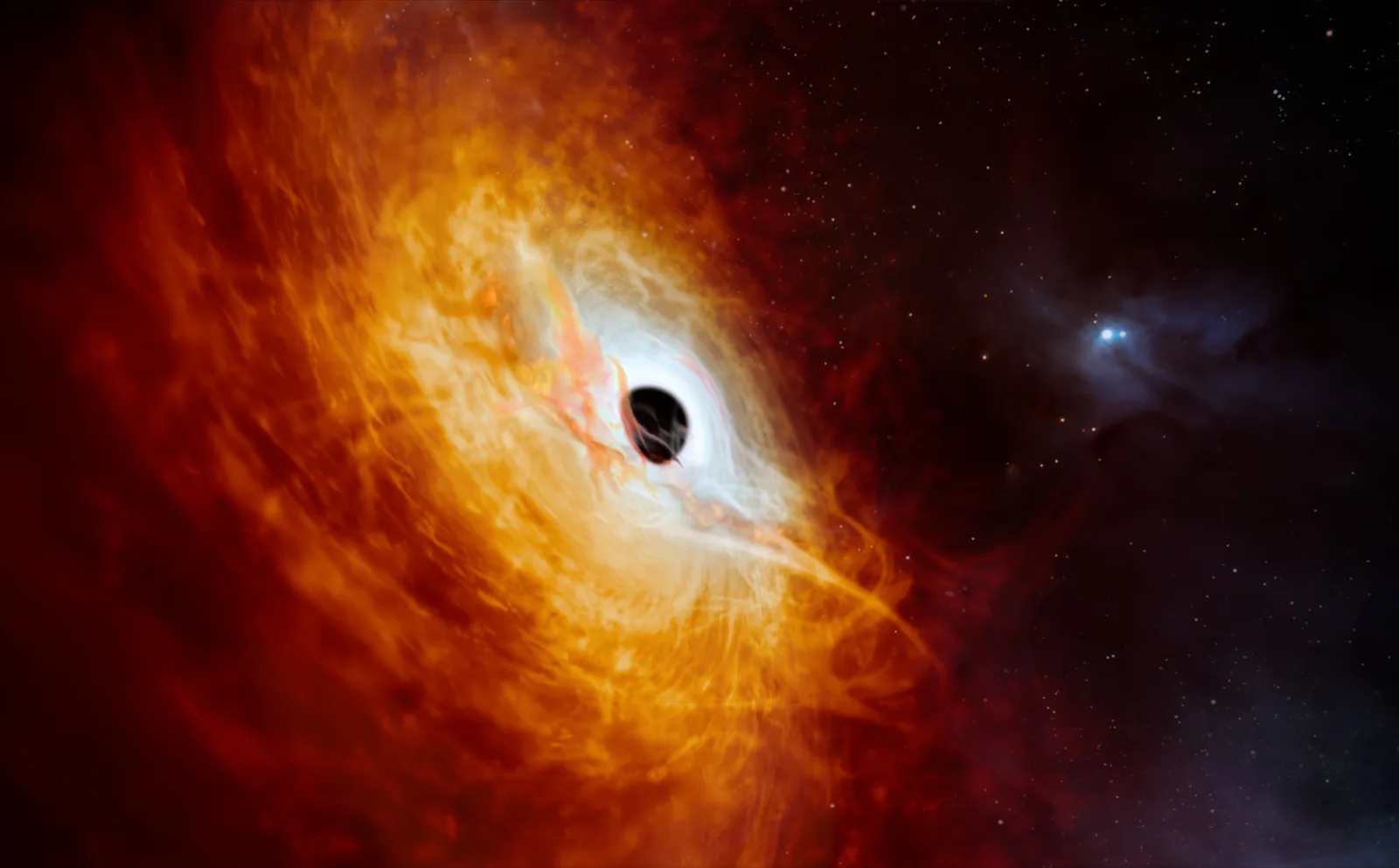
For more than forty years, the brightest object in the known universe sat in our photographic archives, catalogued and ignored. It first appeared on a glass plate exposed by a survey telescope in southern Australia in 1980, a single dot among millions. Software looked at it, measured its brightness, and concluded the obvious: anything that luminous, that nearby in appearance, had to be a star. The machine was wrong by a margin almost too large to state. The dot was not a star. It was a black hole seventeen billion times the mass of the Sun, devouring matter at the far edge of the cosmos, and it was shining with the light of more than five hundred trillion Suns.
A point of light that lied
The object now carries the name J0529-4351, a string drawn from its coordinates on the sky. To the eye it looks like nothing: a faint sixteenth-magnitude speck, well below the threshold of naked-eye vision, indistinguishable in a single image from any of the foreground stars scattered across the constellation Pictor. That ordinariness is precisely what protected its secret. A quasar this bright was, by the reasoning of the survey software, an impossibility. The automated pipelines that sift modern sky surveys are trained to expect quasars to be faint, because quasars are distant, and distance dims everything. An object this luminous and this sharp was flagged as too bright to be a quasar and quietly reclassified as a local star.
The error was not careless. It was structural. When the European Space Agency's Gaia mission processed the same patch of sky, its algorithms reached the same verdict. The light of J0529-4351 broke the assumptions baked into the catalogues, and so the catalogues filed it under the wrong heading and moved on. It took a team led by Christian Wolf at the Australian National University, following up candidates with the university's 2.3-metre telescope at Siding Spring Observatory, to look again and ask whether the bright point might be something the machines had refused to imagine.
The irony runs deep. Astronomers had been hunting for objects exactly like this for years, combing through catalogues for the brightest quasars in the sky. The hunt failed not because the prize was faint or obscured, but because it was so luminous that the search criteria themselves rejected it. Wolf has compared the experience of finally identifying it to a childhood treasure hunt, a few minutes a day spent searching the records for something that had eluded everyone, and finding it not at the dim limit of detection but sitting near the top of the brightness scale, mislabeled all along.
A quasar this luminous was, by the logic of the survey software, an impossibility. So the catalogues filed it as a star and moved on.
It was. The spectrum returned by the follow-up observations did not show the calm, narrow signatures of a stellar atmosphere. It showed the broad, smeared emission lines of gas moving at thousands of kilometers per second, the fingerprint of matter falling into a supermassive black hole. To confirm what they were seeing, Wolf and his colleagues turned to the most precise instrument available, the X-shooter spectrograph on the European Southern Observatory's Very Large Telescope in Chile. Their results were published in Nature Astronomy in 2024, and they were unambiguous. This was the most luminous object ever measured.
What a quasar actually is
The word quasar is a contraction of quasi-stellar radio source, a name coined in the 1960s when astronomers first found these objects and could only describe them by what they resembled: starlike points that were anything but stars. We now understand them as the engines at the centers of young, active galaxies. Every large galaxy, our own included, harbors a supermassive black hole at its core. Most of the time those black holes are quiet, starved of fuel. A quasar is what happens when the fuel arrives in force.
When gas, dust, and disrupted stars spiral toward a supermassive black hole, they do not fall straight in. Conservation of angular momentum forces the infalling material into a flattened, rotating structure called an accretion disk. As the matter in the disk grinds against itself and spirals inward, friction and gravitational compression heat it to extraordinary temperatures. The surface of a quasar's accretion disk can exceed ten thousand kelvin, hotter than the surface of the Sun, and the innermost regions blaze far hotter still. That heat is radiated outward as light across the spectrum, from infrared through ultraviolet. A quasar is, in essence, gravity converted into light with brutal efficiency, the brightest sustained light source the universe knows how to make.
The light of J0529-4351 left its source when the universe was roughly a tenth of its present age. It has traveled for more than twelve billion years to reach us, which means we see the quasar not as it is but as it was, during the era astronomers call cosmic noon, when galaxies were forming stars and feeding their central black holes at the most furious rate in cosmic history. The measured redshift is 3.962, a precise marker of how much the expansion of the universe has stretched its light on the long journey here.
The numbers that break intuition
The mass of the black hole at the heart of J0529-4351 is measured from the motion of the gas swirling around it. The faster that gas moves, the deeper the gravitational well, and the larger the mass that must sit at the bottom of it. The team's best estimate places the black hole at a mass of ten to the power of 10.24 times the mass of the Sun, with an uncertainty of only a few percent. In plain terms, that is about seventeen billion solar masses. A single object, concentrated within a region not much larger than our solar system, holding the mass of seventeen billion Suns.
Its luminosity is harder still to hold in the mind. The bolometric luminosity, the total energy radiated across all wavelengths, is recorded as ten to the power of 48.27 erg per second. That works out to roughly two times ten to the forty-first watts, or more than five hundred trillion times the luminosity of the Sun. No galaxy of ordinary stars comes close. J0529-4351, a single accreting black hole, outshines entire galaxies of hundreds of billions of stars combined.
A single accreting black hole, no larger than our solar system, outshines whole galaxies of hundreds of billions of stars.
To produce that much light, the black hole must consume an enormous amount of fuel. The team calculates an accretion rate of roughly 370 solar masses per year, with the various modeling methods spanning a range from about 280 to nearly 490 solar masses per year. Divided across a year, that comes to a little more than one solar mass falling into the black hole every single day. The brightest object in the universe is powered by a black hole that eats the equivalent of our Sun for breakfast, and does it again the next morning, and the next.
The distance compounds the spectacle. At a redshift of 3.962, the light now reaching telescopes in Chile set out when the universe was less than one and a half billion years old. To remain a sixteenth-magnitude object after a journey of more than twelve billion years, dimmed by the vast expansion of space along the way, the source has to be staggeringly powerful at its origin. If J0529-4351 were placed at the distance of a typical bright star in our own galaxy, it would flood the night sky and outshine the full Moon many times over. Instead, its prodigious output is stretched and faded across cosmic distance until it registers as nothing more than a faint, anonymous dot, which is exactly the disguise that fooled the surveys.
The largest disk in the cosmos
An accretion disk that feeds a black hole this massive cannot be small. According to the ESO team's analysis, the disk that surrounds J0529-4351 spans roughly seven light-years from edge to edge. That is a structure of superheated plasma wider than the distance from the Sun to its nearest stellar neighbor, Proxima Centauri. If our solar system sat at the center of that disk, the disk would extend well beyond every star within reach of unaided human imagination. It is, by the team's reckoning, very likely the largest accretion disk in the universe.
Inside that disk, conditions defy comparison. Gas does not drift; it tears around the black hole at a meaningful fraction of the speed of light, colliding, compressing, and igniting. The region where the broad emission lines form, the part of the disk whose light first betrayed the quasar's true nature, has a radius of about 2.2 parsecs, roughly seven light-years, and an angular size on the sky of just 0.64 milliarcseconds. That is the largest such region expected to exist anywhere in the observable universe, and yet it is so distant that resolving it remains at the frontier of what our instruments can do. Christian Wolf described the daily reality near such an object in stark terms in interviews surrounding the discovery: a place where storms of charged gas blast outward and the environment is among the most violent anywhere in the cosmos.
Eating at the speed limit
There is a ceiling on how fast a black hole can grow, and J0529-4351 is pressed close against it. The limit is named for the British astrophysicist Arthur Eddington, who worked out in the 1920s that a luminous object cannot shine without limit. The radiation streaming out of an accretion disk exerts pressure on the gas trying to fall in. Brighten the disk enough, and that outward radiation pressure balances the inward pull of gravity. Push past that balance, the Eddington limit, and the radiation itself blows the incoming fuel away, choking off the very accretion that produced the light. A black hole that tries to eat too fast starves itself.
The team measured the Eddington ratio of J0529-4351, the ratio of its actual luminosity to that theoretical maximum, at about 0.9. The black hole is consuming matter at very nearly the fastest rate physics allows before its own brilliance would begin to drive the fuel away. This is not a quasar coasting. It is a quasar running its engine at the redline, growing about as quickly as the laws of radiation and gravity permit any black hole to grow. That is what earns J0529-4351 its second title alongside most luminous: the fastest-growing black hole known, measured by the sheer mass it adds to itself in a given span of time.
This is not a black hole coasting. It is running its engine at the redline, growing about as fast as the laws of physics permit.
Why a single quasar matters
One extreme object can rewrite expectations. The existence of a seventeen-billion-solar-mass black hole already fully assembled when the universe was barely a tenth of its current age sharpens one of cosmology's hardest questions: how did the earliest supermassive black holes grow so large so quickly. Build a black hole from the collapse of a single massive star, and even feeding it continuously at the Eddington limit for the entire available time leaves it short of the giants we observe in the early universe. J0529-4351, caught in the act of feeding at almost the maximum permissible rate, is a vivid demonstration that nature found a way. Whether through unusually heavy seed black holes, brief episodes of feeding beyond the Eddington limit, or rapid mergers, the early cosmos grew monsters faster than the simplest models allow. J0529-4351 does not settle that debate, but it puts an extreme, well-measured data point on the table, an object caught growing at almost the theoretical ceiling, which any successful model of early black hole growth will have to accommodate.
There is also a humbler lesson in the way J0529-4351 was found. The brightest object in the universe was not hidden behind a wall of dust or buried at the limit of our telescopes' reach. It was sitting in plain sight, recorded again and again, and dismissed by the very tools built to find it, because it was too extraordinary to fit the expected pattern. The automated surveys that now map billions of objects are extraordinary instruments, but they find what they are taught to expect. The truly anomalous, the record-breaker that violates the assumptions, can slip through precisely because it is too remarkable to be believed. It took human curiosity, the willingness to look again at a flagged and discarded point of light, to recognize the most luminous thing we have ever seen.
The brightest object in the universe was never hidden. It was catalogued, measured, and dismissed, because nothing was supposed to shine that bright. It took someone willing to doubt the answer to see the light for what it was.
Frequently Asked Questions
What is J0529-4351?
J0529-4351 is a quasar, an extremely luminous active galactic nucleus powered by a supermassive black hole. It is the most luminous object ever observed, shining with more than five hundred trillion times the luminosity of the Sun. It lies in the southern constellation Pictor at a redshift of 3.962, meaning its light has traveled more than twelve billion years to reach us.
How big is the black hole powering it?
The black hole has a mass of about seventeen billion times the mass of the Sun, measured from the motion of gas orbiting it. The published value is log M over M-Sun equal to 10.24, with an uncertainty of only a few percent, reported by Wolf and colleagues in Nature Astronomy in 2024.
How much matter does it consume?
The black hole accretes roughly 370 solar masses of material per year, with estimates ranging from about 280 to nearly 490 solar masses per year depending on the model. That works out to a little more than one Sun's worth of mass falling in every single day, making it the fastest-growing black hole known.
Why was it mistaken for a star?
Automated survey pipelines, including those of the Gaia mission, expect quasars to be faint because they are distant. J0529-4351 was so bright that the software judged it too luminous to be a quasar and classified it as a nearby star. It appeared in survey images dating back to 1980 but was not recognized as a quasar until human astronomers followed it up decades later.
How large is its accretion disk?
The disk of superheated gas feeding the black hole is estimated to span about seven light-years across, very likely the largest accretion disk in the universe. That is wider than the distance between the Sun and its nearest neighboring star. The disk surface reaches temperatures characteristic of quasars, exceeding ten thousand kelvin.
What is the Eddington limit and how close is this quasar to it?
The Eddington limit is the maximum luminosity an accreting object can reach before its own radiation pressure blows away the infalling fuel. J0529-4351 has an Eddington ratio of about 0.9, meaning it is feeding at nearly the maximum rate physics permits before the process would become self-limiting.
Continue Exploring
- When a Black Hole Shreds a StarWander too close to a supermassive black hole and gravity becomes a weapon. The star is stretched into a stream of gas...
- The Lighthouses at the End of a Star's LifeIn 1967 a young researcher found a signal so regular it was half-jokingly labeled Little Green Men. It was a city-sized...
- The Supernova a Machine Saw Before Anyone ElseA star 730 million light-years away brightened for four years, exploded, then exploded again. No human flagged it. An...
Sources
- Wolf et al. (2024). "The accretion of a solar mass per day by a 17-billion solar mass black hole, Nature Astronomy." link.
- Wolf et al. (2024). "The accretion of a solar mass per day by a 17-billion solar mass black hole (preprint)." link.
- ESO (2024). "Brightest and fastest-growing: astronomers identify record-breaking quasar (eso2402)." link.
- Australian National University (2024). "ANU press coverage of the J0529-4351 discovery." link.