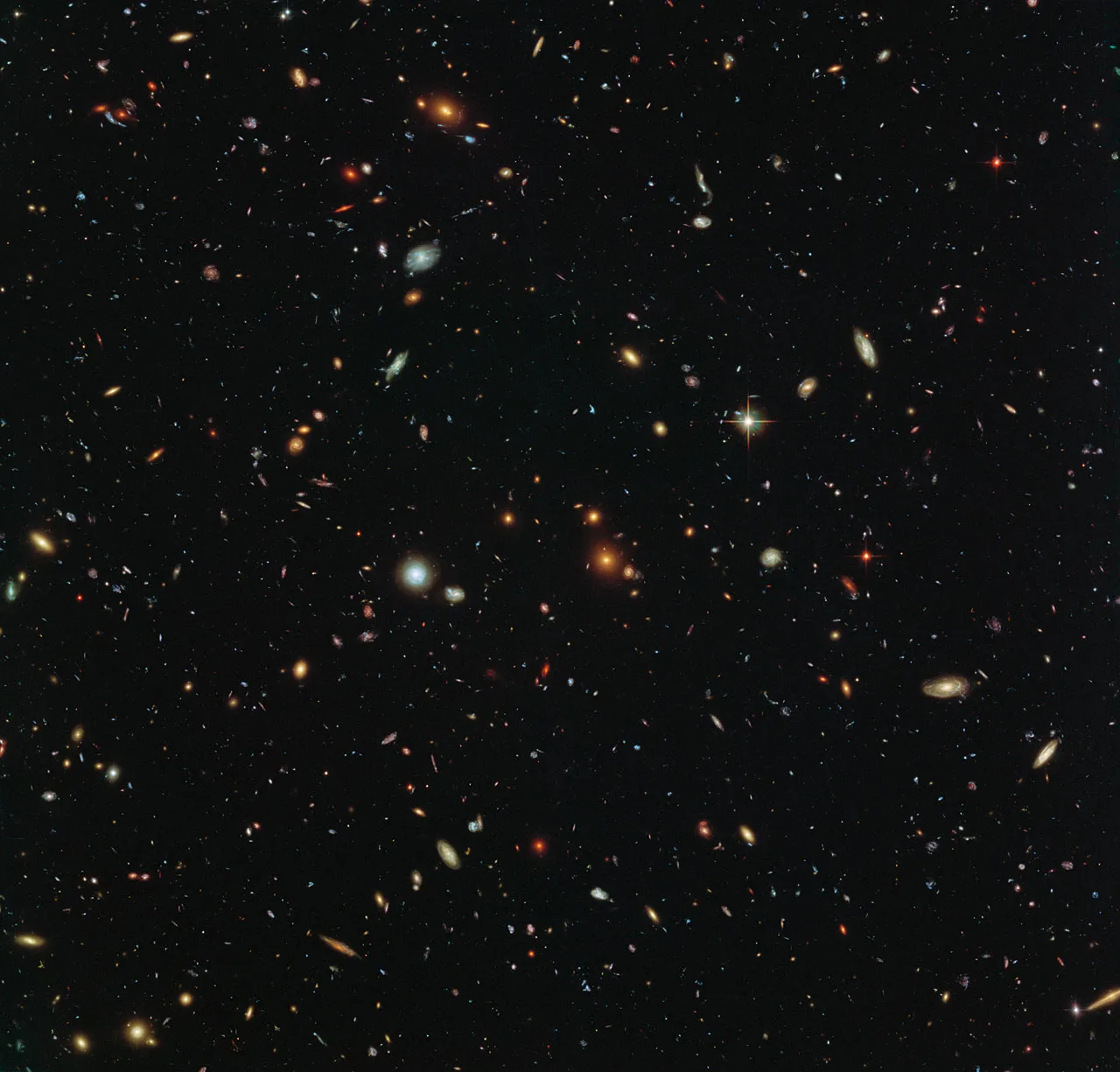
There is a place in the sky, high overhead on spring evenings in the northern hemisphere, where the universe runs out of galaxies. Point a telescope toward the constellation Bootes, the Herdsman, and look past the foreground stars of our own galaxy, out to a distance of roughly 700 million light-years, and you enter a region where the cosmos thins to almost nothing. Across a span of some 330 million light-years, a volume large enough to hold tens of thousands of galaxies like our own, only about five dozen have been found. Astronomers gave it an unglamorous name that has since taken on an eerie weight: the Bootes void. Some simply call it the Great Nothing.
An Accidental Hole
The discovery was not the goal. In the late 1970s, a small team of American astronomers set out to map how galaxies are distributed in depth, not just across the sky but in three dimensions, by measuring the redshift of each galaxy and converting it into distance. A galaxy's light is stretched toward the red end of the spectrum in proportion to how fast the expanding universe is carrying it away from us, and that velocity stands in for distance. Build up enough redshifts and a flat photograph of the sky becomes a three-dimensional model of where galaxies actually sit.
Robert Kirshner, Augustus Oemler, Paul Schechter, and Stephen Shectman took a sampling approach. Measuring every galaxy in a large patch of sky was beyond the instruments of the era, so rather than survey one continuous region they aimed their spectrographs at three narrow pencil-beam fields, widely separated, and recorded the velocities of the galaxies in each. The idea was to core into the universe at a few points, like taking soil samples, and infer the larger structure from the pattern of the cores.
What they noticed was a coincidence that should not have been a coincidence. In all three fields, the galaxies fell into clumps at certain distances, and in all three fields there was the same conspicuous gap. Between recession velocities of roughly 12,000 and 19,000 kilometers per second, a range corresponding to a particular shell of distance, almost no galaxies appeared. Three separate lines of sight, all puncturing the same emptiness. The team published the result in 1981 in the Astrophysical Journal Letters under a title that captured the scale of the thing plainly: "A million cubic megaparsec void in Bootes."
A million cubic megaparsecs is a number that resists imagination. The team had stumbled onto a roughly spherical region of space, tens of megaparsecs across, that was effectively scrubbed clean of bright galaxies. Nothing in the prevailing picture of cosmology had prepared anyone for an emptiness on this scale.
Three separate lines of sight, widely separated on the sky, all punched through the same hole. That was not chance. That was a structure.
Confirming the Emptiness
A gap detected in three thin beams could, in principle, be a statistical fluke or a trick of the sampling. So the same team went back to look more carefully. In 1987 they published a follow-up survey in the Astrophysical Journal, this time selecting galaxies by eye from hundreds of small fields scattered across the suspect region and measuring redshifts for 239 of them. The void survived the scrutiny. They confirmed a large, roughly spherical underdense region with a radius of about 62 megaparsecs, centered near right ascension 14 hours 50 minutes, declination plus 46 degrees, at a recession velocity of about 15,500 kilometers per second.
A radius of 62 megaparsecs translates to a diameter of around 124 megaparsecs, or roughly 330 million light-years. To anchor that figure: the Milky Way and the Andromeda galaxy, our nearest large neighbor, are separated by about 2.5 million light-years. The Bootes void is more than a hundred times wider than the gulf between the two largest galaxies in our Local Group. Strung end to end, you could line up more than a hundred such gulfs and still not cross it.
It is from this scale that the void's most quoted thought experiment comes. If the Milky Way were located near the center of the Bootes void rather than in its modestly crowded corner of the cosmos, the nearest galaxies would be so far away and so faint that early twentieth-century telescopes might never have resolved them. We could have spent generations believing our galaxy was the entire universe. Edwin Hubble's 1920s demonstration that the spiral nebulae were other galaxies, the discovery that reframed humanity's place in the cosmos, might have waited decades longer, or not arrived at all.
The Milky Way's actual neighborhood is, by cosmic standards, busy. We sit in the Local Group, a gathering of dozens of galaxies bound by gravity, which itself rides along the outskirts of the Virgo Supercluster. We learned that other galaxies existed almost as soon as telescopes were sharp enough to look, because there were bright neighbors close at hand to be found. A civilization at the center of the Bootes void would have had no such luck. Its astronomers would have aimed instrument after instrument at a sky that grew darker the deeper they looked, and reasonably concluded that the galaxy of their birth floated alone in an endless void. The thought experiment is a reminder that what we take to be obvious facts about the universe depend partly on the accident of where we happen to stand.
Not Quite Empty
The early descriptions of the void as a sphere of pure nothing were a simplification, and the astronomers knew it. The void is underdense, not vacant. Later surveys went hunting for the galaxies hiding inside, and they found some. Counts have crept upward as instruments improved, settling at roughly sixty galaxies detected within the void's boundaries, a number small enough that each one is, in effect, individually known to the researchers who study the region.
Sixty sounds like a lot until you compare it to expectation. If the Bootes void contained galaxies at the average density of the universe at large, it would hold on the order of two thousand. The deficit is the whole point. There is also a subtler pattern in where the void's galaxies sit. Rather than scattering at random through the cavity, many of them trace a faint tube or filament running across the interior, a ghostly bridge of structure spanning the emptiness. This is what the standard model predicts: even the inside of a void is not perfectly smooth but retains the imprint of fainter substructure, the last threads of the cosmic web stretched thin across the gap.
The deficit is also why the void resists easy detection. By the late 1980s and 1990s, deep redshift surveys of infrared-selected galaxies toward the void, including work led by Greg Aldering and collaborators, refined the picture. They confirmed that the galaxy density inside is a small fraction of the cosmic mean and showed that, once measured carefully, the Bootes void's density profile is not bizarrely extreme. It resembles, in its essentials, the other large voids that wide-area surveys were beginning to map across the sky. The Bootes void was not a unique aberration. It was the first clear example of something the universe does everywhere.
The void was not a flaw in the cosmos. It was a first glimpse of the cosmos's actual architecture, mostly emptiness, threaded by thin walls of light.
The Cosmic Web
To understand the Bootes void, you have to stop thinking of galaxies as scattered like grains of sand and start thinking of them as foam. On the largest scales, matter in the universe is arranged in what cosmologists call the cosmic web: a vast network of filaments and sheets of galaxies wrapped around enormous bubbles of near-emptiness. The galaxies live in the walls and along the strands. The voids are the interiors of the bubbles, occupying most of the volume of the universe even though they contain very little of its luminous matter.
This structure was not imposed from outside. It grew. In the first instant after the Big Bang, the distribution of matter was almost perfectly smooth, but not quite. There were tiny fluctuations in density, regions a hundred-thousandth denser or sparser than average, imprinted in the primordial plasma and visible today as ripples in the cosmic microwave background. Gravity is an amplifier. Slightly overdense regions pulled in surrounding matter and grew denser still, eventually collapsing into the clusters and filaments where galaxies form. Slightly underdense regions did the opposite. With less matter to hold themselves together, they were outpaced by their denser surroundings and effectively expanded, their contents draining outward onto the walls.
A void, in this sense, is not a hole that was carved out. It is a region that was born slightly empty and grew emptier as the universe aged, like a low spot in a landscape from which water continually runs off. The matter that once occupied the Bootes void did not vanish. Over billions of years, gravity swept most of it toward the denser walls and filaments surrounding the cavity. What remains inside is a sparse population of stragglers, including the few dozen galaxies astronomers can count.
This picture emerged not just from observation but from simulation. When cosmologists model the growth of structure on a computer, beginning with the faint density ripples seen in the cosmic microwave background and letting gravity act over billions of simulated years, the cosmic web assembles itself without being told to. Filaments knit together, clusters condense at their intersections, and between them open the great rounded voids. The match between these simulations and the real distribution of galaxies is one of the quieter triumphs of modern cosmology. The Bootes void is not an oddity that theory struggles to explain. It is exactly the kind of feature the standard model of cosmology predicts the universe should be riddled with.
Reading the Quiet Galaxies
The handful of galaxies that do live inside the Bootes void are scientifically valuable precisely because of where they sit. A galaxy in the dense heart of a cluster is constantly disturbed: it collides and merges with neighbors, has its gas stripped away by the hot intracluster medium, and is gravitationally harassed at every turn. A void galaxy lives in near isolation. It evolves, as much as any galaxy can, on its own terms. Studying these galaxies lets astronomers separate the changes driven by environment from the changes intrinsic to galaxies themselves.
That separation has been a long-running question, and the void galaxies offer a partial answer. A 2021 ultraviolet imaging survey of the Bootes void, carried out with the Ultraviolet Imaging Telescope aboard India's AstroSat observatory and published in the Astrophysical Journal, examined the star-forming galaxies inside the cavity. The survey found that the void's galaxies tend to be blue and actively forming stars, with a dominant fraction of blue galaxies over red ones, and that the void environment exerts only a weak influence on their star formation rates. Isolation, it turns out, does not simply switch galaxies off. The void's residents go on making stars, quietly, far from the crowded scaffolding of the cosmic web.
What Emptiness Teaches
For decades, voids were treated as the leftover background of cosmology, the dark spaces between the structures that actually mattered. That view has reversed. Voids have become some of the most prized laboratories in the field, and the reason is dark energy, the unknown influence driving the accelerating expansion of the universe.
Inside a void, the ordinary gravitational pull of matter is at its weakest, because there is so little matter present. That makes voids the one place where the repulsive effect of dark energy is most dominant relative to gravity. The way a void grows, how fast it empties and how its boundaries stretch over cosmic time, is exquisitely sensitive to the balance between matter and dark energy. By measuring the sizes, shapes, and abundance of voids across the sky and comparing them to the predictions of competing cosmological models, astronomers can constrain the nature of dark energy in ways that crowded regions cannot. Voids also distort the light of more distant galaxies through weak gravitational lensing, and the slight shapes they imprint carry information about how much matter the universe contains.
There is a further reason voids are valuable: they are simple. The dense interiors of galaxy clusters are governed by messy, nonlinear physics, gas shock-heated to millions of degrees, galaxies colliding and merging, magnetic fields and supernovae stirring the pot. Voids are the opposite. With so little matter inside, their evolution stays close to the clean, well-understood regime that theory handles best. A void's growth can be modeled almost from first principles, which means any discrepancy between prediction and observation points more cleanly to something missing in the underlying cosmology rather than to some local complication. Emptiness, paradoxically, is easier to read than abundance.
Modern surveys have mapped tens of thousands of voids, and large programs now under way, mapping the positions of millions of galaxies, will catalog far more. The Bootes void, once a curiosity at the edge of what 1980s technology could detect, is now understood as one member of a population that fills the universe. The cosmic web is mostly void by volume. To map the emptiness is to map the whole.
The Great Nothing turned out not to be nothing at all, but the universe showing its true shape: a web of light strung across an ocean of emptiness, with us tucked, by luck, into one of its brighter threads.
Frequently Asked Questions
How big is the Bootes void?
The Bootes void has a radius of roughly 62 megaparsecs, which corresponds to a diameter of about 124 megaparsecs, or approximately 330 million light-years. That figure comes from the 1987 follow-up survey by Kirshner, Oemler, Schechter, and Shectman published in the Astrophysical Journal.
How many galaxies are inside the Bootes void?
Roughly sixty galaxies have been detected within the void's boundaries. If the region held galaxies at the average density of the universe, it would contain on the order of two thousand. The shortfall is what makes it a void.
Who discovered the Bootes void and when?
It was identified in 1981 by Robert Kirshner, Augustus Oemler, Paul Schechter, and Stephen Shectman, using a set of pencil-beam redshift surveys. They published the result in the Astrophysical Journal Letters under the title "A million cubic megaparsec void in Bootes."
What causes cosmic voids to form?
Voids grow from tiny underdense regions present in the early universe. Because they contained slightly less matter than average, gravity pulled their contents outward onto surrounding denser regions over billions of years, leaving expanding cavities. The result is the cosmic web: filaments and walls of galaxies wrapped around vast empty bubbles.
Is the Bootes void really completely empty?
No. It is underdense, not vacant. It contains about sixty known galaxies and an unknown amount of diffuse gas and dark matter. The early shorthand of calling it empty was a simplification of a region that is simply far sparser than its surroundings.
Why do astronomers study voids?
Voids are sensitive probes of dark energy and cosmic structure. Because matter is scarce inside them, the repulsive influence of dark energy is most pronounced there, and the way voids grow constrains cosmological models. Their effect on the light of background galaxies also helps measure how much matter the universe contains.
Continue Exploring
- The Oldest Light in the UniverseEverywhere you point a radio dish, a faint glow answers back: the cooled afterglow of the Big Bang, released when the...
Sources
- Kirshner, Oemler, Schechter & Shectman (1981). "A million cubic megaparsec void in Bootes (ApJ Letters, 248, L57)." link.
- Kirshner, Oemler, Schechter & Shectman (1987). "A Survey of the Bootes Void (ApJ, 314, 493)." link.
- Dey, Strauss & Huchra (1990). "A Deep Redshift Survey of IRAS Galaxies Toward the Bootes Void (AJ, 99, 463)." link.
- Szomoru et al. (1996). "An H I Survey of the Bootes Void. I. The Data (AJ, 111, 2141)." link.
- Pustilnik et al. (2021). "The Ultraviolet Deep Imaging Survey of Galaxies in the Bootes Void. I (ApJ, 919, 101)." link.