For thirty years, almost every planet we knew about beyond our own Sun was a planet we had never seen. We deduced them. A star dimmed by a fraction of a percent and we inferred a world crossing its face. A star wobbled by a few meters per second and we inferred something unseen tugging on it. The catalog of more than five thousand confirmed exoplanets is, overwhelmingly, a catalog of shadows and tremors, of evidence rather than portraits. We knew the planets were there the way you know someone is standing behind a closed door. We had almost never opened the door.
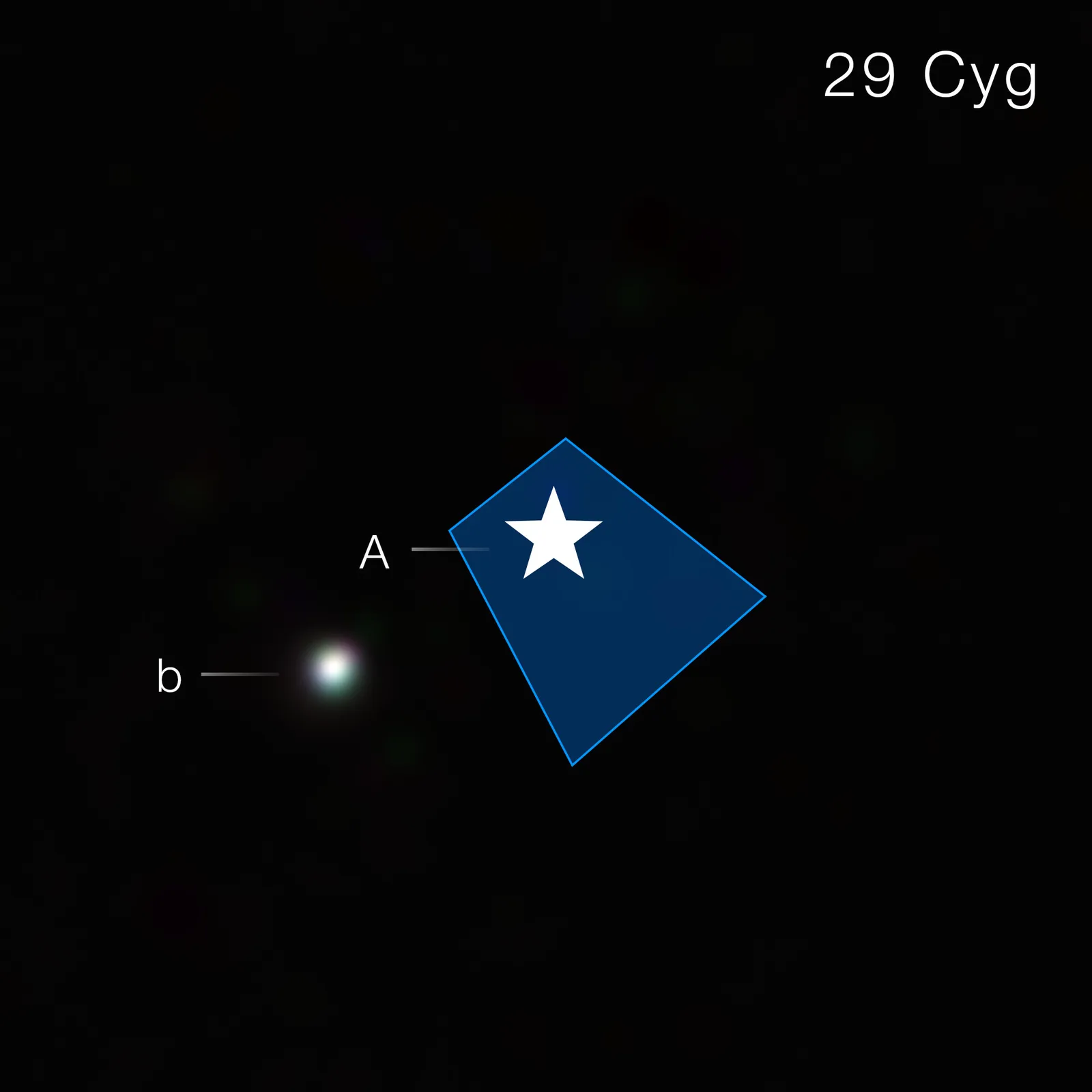
In April 2026, the James Webb Space Telescope opened one. Pointed at a bright star in the constellation Cygnus, Webb blocked out the star's overwhelming glare and recorded, as a single faint off-white point of infrared light, the planet orbiting it. The world is called 29 Cygni b. It is roughly fifteen times the mass of Jupiter, sitting almost exactly on the contested border between what we call a planet and what we call a failed star. And unlike nearly every exoplanet before it, we are not inferring its existence. We are looking at it.
Inferring a world versus photographing one
The two dominant methods of exoplanet discovery never actually see the planet. The transit method, which Kepler and TESS used to find thousands of worlds, watches for the tiny periodic dip in a star's brightness when a planet passes in front of it. The radial velocity method watches for the rhythmic Doppler shift in a star's spectrum as an unseen companion pulls it back and forth. Both are extraordinarily powerful. Both are, fundamentally, detective work. The planet itself contributes no photons that we measure. We reconstruct it from its effect on the star.
Direct imaging is a different enterprise entirely. It means collecting light that comes from the planet itself and forming an actual image of it as a distinct point separated from its star. This is brutally hard, and the difficulty is worth stating plainly. A young giant planet may shine with perhaps one ten-thousandth the brightness of its host star, and often far less. The star and planet are separated, as seen from Earth, by an angle smaller than a coin held up at the distance of several kilometers. You are trying to photograph a firefly hovering beside a searchlight, from across a city.
The transit and wobble methods reconstruct a planet from its effect on a star. Direct imaging does the one thing those methods never do: it collects the planet's own light.
This is why, of all the thousands of known exoplanets, only a few dozen have ever been directly imaged, and why nearly all of those are young, massive, and orbiting far from their stars, the cases where the contrast problem is least hopeless. Each new direct image is therefore not a routine addition to a catalog. It is a rare event, and 29 Cygni b is one of the most informative of them.
The star at upper right
The host, 29 Cygni A, is not a copy of our Sun. It is an A-type star, hotter, brighter, and more massive, weighing about 1.8 times the mass of the Sun. It carries the chemical fingerprint astronomers call a lambda Bootis abundance pattern, a curious surface depletion of certain heavy elements, and it pulses faintly as a delta Scuti variable, its whole body breathing in and out over hours. The system lies roughly 133 light-years from Earth, close enough by galactic standards to be a favorable target, far enough that the star is no more than a bright point to the unaided eye.
Around that star, on an orbit with a semimajor axis of about 14.7 astronomical units and a measured separation of roughly 16 astronomical units at the time of observation, moves 29 Cygni b. One astronomical unit is the Earth-Sun distance, so the planet orbits at something close to the distance of Saturn in our own solar system, around 2.4 billion kilometers out from its star. That separation is not incidental. It is precisely what makes the direct image possible: far enough from the glare to be pried apart from it, close enough to belong unambiguously to the same system.
The mass ratio between the planet and the star is tiny, only about one percent. In the language astronomers use to distinguish the children of a star from rival stellar companions, that low ratio is itself a clue. This object did not form as a star's twin. It formed as a star's planet, and the image would go on to show why.
How you photograph something next to a searchlight
The instrument that made the portrait possible is Webb's Near-Infrared Camera, NIRCam, used in coronagraphic mode. A coronagraph is, at heart, an artificial eclipse. It places a small occulting mask, in this case a wedge-shaped bar called MASKLWB, directly over the image of the bright star, swallowing the floodlight so that the faint surroundings can finally register. The technique borrows its name and its logic from the instruments built a century ago to study the Sun's corona by blotting out the solar disk.
Blocking the star is only half the work. The remaining starlight does not vanish cleanly; it spreads into a textured halo of speckles, the fingerprint of the telescope's own optics, and those speckles can drown a faint planet as effectively as the star itself. Astronomers defeat them with reference subtraction, observing a similar star with no planet and using it as a template of the speckle pattern, then mathematically removing that template to leave only what is genuinely there. What survives the subtraction, in the case of 29 Cygni, is a single point of light where no star should be.
A coronagraph is an artificial eclipse. It blots out the floodlight of the star so that the firefly beside it can finally register as more than glare.
The image of 29 Cygni b was assembled from observations in several near-infrared filters, centered around 4.1, 4.3, and 4.6 microns, with an additional shorter-wavelength filter near 2.1 microns. Those are wavelengths well beyond what the human eye can see, in the thermal infrared where a warm young giant planet glows of its own accord. The colors in the published image are therefore a translation: the longest wavelength rendered as red, the shortest as blue, a map of invisible heat made visible. The planet appears as a modest off-white dot. That dot is one of the more important photographs in modern exoplanet science.
A warm giant that glows by its own heat
What makes direct imaging possible at all is that 29 Cygni b is not reflecting its star's light so much as radiating its own. With an effective temperature of about 1,300 kelvin, well over a thousand degrees Celsius, the planet is still warm with the leftover energy of its formation. Giant planets are born hot, as gravitational collapse converts the energy of infalling gas into heat, and they cool slowly over hundreds of millions of years. A young super-Jupiter is, in effect, a self-luminous object, an ember rather than a mirror, and it is that ember glow in the infrared that Webb collected.
That warmth is also what let the telescope do more than take a picture. Spread across NIRCam's filters, the planet's light carries the imprint of the molecules in its atmosphere. In the 4-to-5-micron window, two of those imprints stand out. Around 4.3 microns, the light is suppressed by the absorption signature of carbon dioxide. Near 4.6 microns sits the signature of carbon monoxide. Webb did not merely locate 29 Cygni b. It read the chemistry of its air.
That chemistry matters because carbon dioxide, in particular, is a sensitive tracer of how much heavy material a planet's atmosphere contains. Stronger carbon dioxide absorption points to an atmosphere enriched in elements heavier than hydrogen and helium, and the strength of that feature in 29 Cygni b's spectrum is the thread that leads back to the question of where this world came from.
Born like a planet, not like a star
An object fifteen times the mass of Jupiter sits in genuinely ambiguous territory. Above roughly thirteen Jupiter masses, an object becomes hot enough at its core to fuse deuterium, a heavy isotope of hydrogen, and by one long-standing convention that threshold is the line between a planet and a brown dwarf, the class of bodies often called failed stars. By that definition alone, 29 Cygni b could be filed under either heading. The deuterium-burning line, the Webb team argues, is not enough to settle the matter.
The deeper question is how the object formed. Stars and brown dwarfs are thought to form from the top down, by the gravitational fragmentation of a collapsing cloud of gas. Planets form from the bottom up, by accretion within the flattened disk of gas and dust that surrounds a young star, gradually gathering material until a massive core draws in an envelope of gas. These two histories leave different chemical signatures, and the atmosphere of 29 Cygni b carries the planetary one.
The measured composition points to an atmosphere enriched in heavy elements by roughly a factor of three relative to its host star, with a metallicity well above the star's own. That kind of enrichment is the expected outcome of the disk-accretion route, in which a forming planet pulls in solid, metal-rich material along with gas. A body that had simply fragmented from the same cloud as its star would be expected to share the star's composition, not exceed it. The team also found the planet's orbit reasonably well aligned with the star's spin, another hallmark of birth within a disk. The conclusion is that 29 Cygni b, despite its borderline mass, assembled itself the way planets do.
The chemistry settles what the mass could not. Enriched in heavy elements beyond its own star, this world was built up from a disk, not broken off from a cloud.
The implication runs further than a single object. If disk accretion can build a world this massive, then the old idea that mass alone, the deuterium-burning threshold, cleanly separates planets from brown dwarfs starts to look inadequate. Formation history, the route an object took to its mass, may matter more than the mass itself. Each directly imaged giant that can be weighed and chemically read is a data point in that argument, and 29 Cygni b is among the cleanest yet.
Why direct images are the future of this science
The transit and radial velocity methods are biased, by their very physics, toward planets close to their stars, where transits are frequent and gravitational tugs are strong. Direct imaging reaches the opposite regime: the wide, cold outer reaches of planetary systems, the territory of our own giants Jupiter, Saturn, Uranus, and Neptune, which no transit survey of an alien sun would ever catch. To understand how planetary systems are built in full, we need to see those outer worlds, and seeing them means imaging them.
Webb is purpose-built for this. Its great mirror and its position beyond the blurring atmosphere give it the sharpness to separate planet from star, and its infrared eyes are tuned exactly to the wavelengths where young giants glow and where their atmospheric molecules announce themselves. The coronagraphs that made 29 Cygni b's portrait possible are the same instruments now being turned on other young, wide-orbiting giants, each one converting a point of inferred existence into a measured object with a temperature, a chemistry, and a formation story. The catalog of shadows is slowly, deliberately, becoming a catalog of portraits.
For three decades we knew our neighbor worlds only by their effects, by the dimming and the wobble, by the door we could not open. With 29 Cygni b, and the growing handful of worlds like it, the door is open. We are no longer only deducing the planets of other stars. We are beginning, one faint point of infrared light at a time, to actually see them.
For thirty years we knew the planets of other stars only by the door we could not open, the dimming and the wobble of light we could measure but not resolve. Webb opened it. The faint off-white point beside 29 Cygni is not a deduction. It is a photograph.
Frequently Asked Questions
What is 29 Cygni b?
29 Cygni b is a giant exoplanet roughly fifteen times the mass of Jupiter, orbiting the bright A-type star 29 Cygni about 133 light-years from Earth. In April 2026 it became one of the few exoplanets ever captured in a direct image, photographed by the James Webb Space Telescope rather than inferred from a transit or a stellar wobble.
How did Webb directly image the planet?
Webb used its Near-Infrared Camera, NIRCam, in coronagraphic mode. A wedge-shaped mask blocks the host star's overwhelming light, creating an artificial eclipse, while the leftover speckled glare is removed by subtracting a reference observation of a similar star. What remains is the planet's own faint thermal glow in the infrared, recorded across several filters between about 2 and 5 microns.
Why is direct imaging so rare?
A planet can be ten thousand times fainter than its star or more, and the two appear separated by a minuscule angle on the sky. Of more than five thousand known exoplanets, only a few dozen have been directly imaged, almost all of them young, massive worlds on wide orbits where the contrast problem is least severe. 29 Cygni b fits that profile.
Is 29 Cygni b a planet or a brown dwarf?
At about fifteen Jupiter masses it sits near the boundary. Objects above roughly thirteen Jupiter masses can fuse deuterium, a threshold sometimes used to separate planets from brown dwarfs. But the atmosphere of 29 Cygni b is enriched in heavy elements far beyond its star, a chemical signature of formation by accretion within a disk, the way planets form. On that basis the discovery team treats it as a planet.
What did Webb learn about its atmosphere?
Across the 4-to-5-micron window, Webb detected the absorption signatures of carbon dioxide near 4.3 microns and carbon monoxide near 4.6 microns. The strength of the carbon dioxide feature indicates an atmosphere enriched in heavy elements by roughly a factor of three relative to the host star, pointing to a planet-like, disk-accretion origin. The planet's temperature is about 1,300 kelvin.
Why does a borderline-mass planet matter for science?
If disk accretion can build an object this massive, then mass alone, such as the deuterium-burning line, may not cleanly separate planets from brown dwarfs. The case suggests that an object's formation history matters more than its mass for classification. Directly imaged giants like 29 Cygni b, whose chemistry can be measured, are the data points that test that idea.
Continue Exploring
- The Coldest World We Have Ever PhotographedAlmost every planet we have imaged directly is a young, glowing furnace. Then JWST captured a mature, frigid...
- The World That Breathes SulfurThirty-five light-years away, the super-Earth L 98-59 d has no solid ground. A permanent ocean of magma feeds a sky...
Sources
- Balmer et al. (2026). "Direct Images of CO2 Absorption in the Atmosphere of a Super-Jupiter: Enhanced Metallicity Suggestive of Formation in a Disk, ApJ Letters." link.
- ESA/Webb (2026). "Exoplanet 29 Cygni b (NIRCam image)." link.
- NASA Science (2026). "Exoplanet 29 Cygni b (NIRCam Image)." link.
- Space.com (2026). "How do supergiant exoplanets form? James Webb Space Telescope finds a clue." link.