There are years when spaceflight is a matter of incremental progress, a software patch here, an extended mission there. And there are years when an agency seems to empty its workshop all at once, sending the work of a decade out past the atmosphere in the span of a few months. For the European Space Agency, 2026 is the second kind of year. Inside a single calendar, three flagship science missions reach the moments their teams have spent careers building toward: one launches to hunt for other Earths, one is already in orbit photographing a part of our own planet no camera has ever captured, and one closes an eight-year chase by finally falling into orbit around the smallest, strangest planet in the inner Solar System.
None of the three is a tourist flight or a flag-planting exercise. Each is a precise instrument aimed at a specific unanswered question. Taken together, they sketch the range of what modern space science actually does: it looks outward at worlds we may never visit, inward at the invisible machinery protecting our own, and sideways at a neighbor so close it should be familiar and so peculiar it has resisted explanation for two centuries.
PLATO: A Telescope With Twenty-Six Eyes
The first mission is a planet hunter, and it does not look the way a telescope is supposed to look. Where Hubble or the James Webb Space Telescope concentrate light through a single large aperture, PLATO (the PLAnetary Transits and Oscillations of stars) carries 26 separate cameras mounted side by side on a shared optical bench. The design trades the deep stare of a single mirror for something a single mirror cannot offer: an enormous field of view, wide enough to watch more than 200,000 stars at once.
The reason for that crowd is statistics. PLATO detects planets by the transit method, watching for the faint, repeating dip in a star's brightness when a planet crosses in front of it. The dimming caused by an Earth-sized world passing a Sun-like star is a fraction of a percent, a shadow so slight it can hide inside the natural flicker of the star itself. To catch it reliably, and to catch it again on the next orbit to confirm it is real, you need to watch a very large number of stars for a very long time, and you need cameras steady enough to register a change smaller than the thickness of a hair held against the Sun.
The shadow of an Earth-sized planet on a Sun-like star is a fraction of a percent. PLATO was built to see it, and to see it twice.
That last constraint is what sets PLATO apart from the planet hunters that came before it. NASA's Kepler telescope, which found thousands of worlds in the previous decade, was extraordinarily good at finding planets close to their stars, where transits repeat every few days and are easy to confirm. It was far less suited to the planets that matter most for the question of life: rocky worlds in the habitable zone of stars like the Sun, where a single orbit takes a full year and liquid water could in principle pool on the surface. PLATO's stated goal is precisely that hard target, terrestrial planets in orbits reaching up to the habitable zones of Sun-like stars.
It does this with a second trick borrowed from a different field. By measuring the minuscule, rhythmic brightness variations caused by sound waves rippling through a star's interior, a technique called asteroseismology, PLATO can weigh and age the star itself. That matters because a planet's measured size is only as trustworthy as the star it is measured against. Know the star precisely, and the planet's radius, density, and likely composition come into focus. PLATO is designed to deliver not just a catalog of new worlds but their masses, their ages, and in the best cases the first credible sense of whether they are rock, like Earth, or something else entirely.
The spacecraft is built to launch toward the close of 2026 aboard an Ariane 6, Europe's new heavy-lift rocket, from the spaceport in French Guiana. From there it travels to the second Sun-Earth Lagrange point, L2, the same gravitationally quiet parking spot a million and a half kilometers from Earth where Webb and the Gaia star-mapper already work, shielded from the Sun's glare and free of the day-night cycle that complicates observing from any closer orbit. The launch window has drifted before, as launch windows do, and some ESA documentation has carried the date into early 2027; the agency's own 2026 outlook still places it in the year's final quarter. Whenever the rocket actually lifts, the science clock that follows runs for years, because finding an Earth twin is a marathon of patience, not a single triumphant detection.
SMILE: Photographing Earth's Invisible Armor
The second mission is already flying, and it is pointed at home. SMILE, the Solar wind Magnetosphere Ionosphere Link Explorer, lifted off on 19 May 2026 aboard a Vega-C rocket from French Guiana. It is the first mission that ESA and the Chinese Academy of Sciences have selected, designed, built, launched, and now operate together as full partners, a collaboration notable in an era when most spacefaring nations are drawing their alliances tighter rather than wider.
What SMILE was built to see has never been photographed. Earth sits inside a vast magnetic bubble, the magnetosphere, generated by the molten motion of the planet's core and inflated by its own internal dynamics. That bubble is the reason the solar wind, the steady gale of charged particles streaming off the Sun at hundreds of kilometers per second, does not strip the atmosphere away as it appears to have done at Mars. The magnetosphere deflects most of that wind, channels some of it toward the poles where it lights the auroras, and absorbs the violent gusts of solar storms that can knock out satellites and power grids. Scientists have modeled this shield for decades and measured it pointwise, one spacecraft flying through one location at a time. No one has ever stepped back far enough to see the whole structure at once.
We have measured Earth's magnetic shield one point at a time for half a century. SMILE is the first attempt to photograph the whole thing.
SMILE's answer is a camera tuned not to visible light but to soft X-rays. When solar-wind ions collide with the thin gas at the edge of Earth's magnetosphere, they steal electrons in a process called charge exchange and emit a faint X-ray glow. That glow traces the exact boundary where the solar wind meets the shield, the magnetopause, and the funnel-shaped cusps over the poles where particles leak inward. The Soft X-ray Imager that captures it is the mission's largest instrument, built by the University of Leicester in the United Kingdom with collaborators across Europe, one of four science instruments aboard. From a stretched elliptical orbit that climbs to roughly 121,000 kilometers over the North Pole, SMILE can hold the entire magnetosphere in frame for stretches of dozens of hours per orbit, turning a structure that was always inferred into something that can be watched as it flexes and recoils under the pressure of the Sun.
"We are about to witness something we've never seen before, Earth's invisible armour in action," said ESA Director General Josef Aschbacher around the launch. The phrasing is grander than the agency usually allows itself, but the claim is literal. After a period of commissioning its instruments, SMILE begins routine science in the back half of 2026, and the three-year mission that follows is aimed squarely at the practical problem of space weather: understanding, and eventually forecasting, how the storms thrown off by the Sun translate into trouble for the technology civilization now depends on.
BepiColombo: The Eight-Year Chase Ends at Mercury
The third mission has been in flight since most readers had never heard of it. BepiColombo, a joint venture of ESA and the Japan Aerospace Exploration Agency, launched on 20 October 2018 and has spent the years since on one of the most convoluted journeys ever flown. Reaching Mercury is, counterintuitively, one of the hardest things in the Solar System to do. The planet sits deep in the Sun's gravity well, and a spacecraft falling sunward picks up so much speed that arriving without overshooting requires shedding an immense amount of velocity. BepiColombo bleeds that speed off through gravity, looping past Earth once, Venus twice, and Mercury itself six times, using each close pass to bend and slow its path.
That choreography nearly came undone. In 2024, engineers discovered that the spacecraft's electric propulsion system, housed in the Mercury Transfer Module that pushes the stack through cruise, could no longer deliver its full thrust after a power-system fault. The original plan to settle into Mercury orbit at the end of 2025 was no longer reachable. Rather than abandon the mission, the team redesigned the final approach, threading a closer flyby past the planet to borrow more of Mercury's own gravity and make up for the engine's lost power. The recovery worked. The new arrival falls in November 2026, roughly a year later than intended, with the science program left essentially intact.
When BepiColombo arrives, it is in fact two spacecraft. The Mercury Transfer Module, its job finished, separates and is discarded, leaving ESA's Mercury Planetary Orbiter and JAXA's smaller spinning orbiter, named Mio, to part ways and settle into different orbits. The Planetary Orbiter drops close to the surface to map Mercury's geology, its composition, and the faint magnetic field that has puzzled scientists since Mariner 10 first detected it in the 1970s, a field no rocky planet that small should still possess. Mio swings out on a wider, more elliptical path to study the magnetosphere and the way the solar wind, fiercer this near the Sun, batters the little planet.
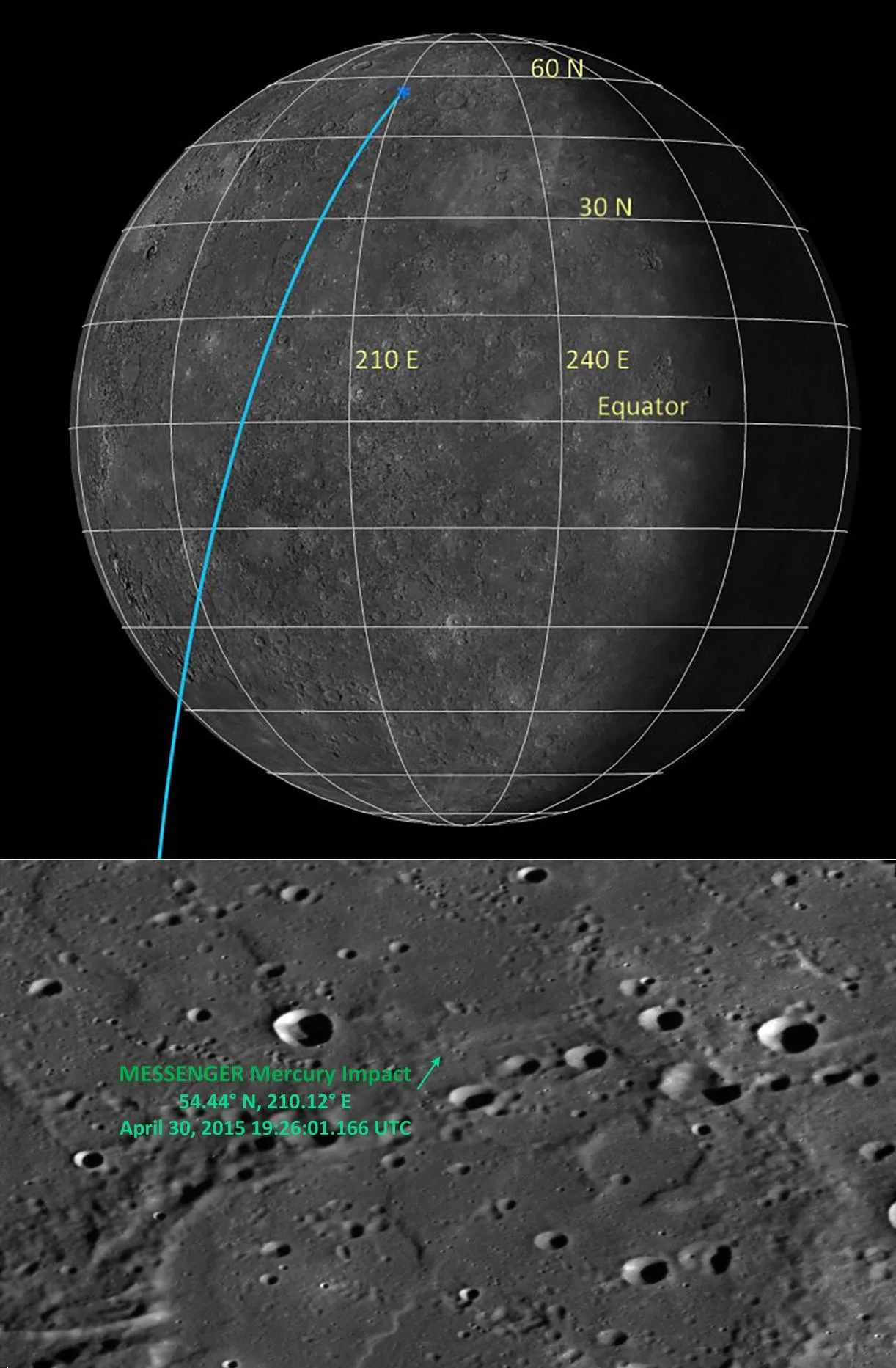
The questions waiting there are unusually deep. Mercury is denser than it has any right to be, with a metal core that takes up far more of the planet than models of its formation can comfortably explain. It hides what appears to be water ice in the permanent shadows of polar craters, on a world whose dayside reaches temperatures that would melt lead. It is, in short, a planet that breaks the rules, and only two missions have ever orbited it to ask why. The first, NASA's MESSENGER, ended in 2015. BepiColombo is the second, and the most capable, and after eight years in transit it is finally close enough to begin.
Why Three Missions, Why Now
It is tempting to treat a year like this as coincidence, three timelines that happened to converge. The reality is closer to the opposite. Flagship space-science missions take ten to twenty years from approval to results, and an agency that approves them steadily will, decades later, see them arrive in clusters. The convergence of PLATO, SMILE, and BepiColombo in 2026 is the visible surface of decisions made in the 2000s and early 2010s, when none of the scientists now waiting for data could have known which mission would slip, which would launch on time, and which would nearly fail and recover.
What the three share is a refusal to settle for inference where measurement is possible. For decades, astronomers argued about how common Earth-like planets might be; PLATO is built to count them. For half a century, physicists modeled Earth's magnetosphere from scattered point measurements; SMILE photographs it whole. For two hundred years, Mercury has been the planet we could see but never quite explain; BepiColombo goes to stand over it and look. Each replaces a long-running argument with an instrument.
The Stakes Beyond the Science
There is a second story running underneath the first, and it is about who builds the instruments. All three missions are European-led, and two of them are explicitly international: BepiColombo binds Europe to Japan, and SMILE binds Europe to China in a full scientific partnership of a kind that has grown rare. At a moment when space is increasingly framed as a contest between national programs, a year defined by shared hardware and pooled expertise is its own quiet statement about how the most ambitious science still tends to get done.
For the public, the payoff is more direct than it may first appear. The space-weather forecasting that SMILE advances protects the satellites that carry communications, navigation, and weather data. The planetary science that BepiColombo gathers refines the story of how rocky worlds, including the one beneath your feet, came to be. And the worlds PLATO is built to find will shape, for a generation, how seriously we can ask whether Earth is ordinary or rare. A banner year for missions is not really about the missions. It is about the questions they are finally close enough to answer.
There are years when spaceflight inches forward, and years when a decade of patience arrives all at once. For Europe, 2026 is the second kind, three instruments reaching three frontiers, each trading a long argument for a measurement.
Frequently Asked Questions
When does PLATO launch and where does it go?
PLATO is built to launch toward the close of 2026 aboard an Ariane 6 rocket from Europe's spaceport in French Guiana. Its destination is the second Sun-Earth Lagrange point, L2, about 1.5 million kilometers from Earth, the same region used by the James Webb and Gaia spacecraft. The launch date has shifted before and some ESA documentation carries it into early 2027, so the precise window may still move.
Why does PLATO have 26 cameras instead of one big telescope?
A single large mirror gives a deep view of a small patch of sky. PLATO's goal is the opposite: to watch more than 200,000 stars at once for years, looking for the tiny brightness dips that reveal Earth-sized planets. The 26 cameras together create a very wide field of view that no single telescope of comparable cost could match.
Has SMILE already launched?
Yes. SMILE lifted off on 19 May 2026 aboard a Vega-C rocket from French Guiana. After commissioning its instruments, it began routine science observations in the second half of 2026, with a planned three-year mission.
What is SMILE actually photographing?
SMILE images Earth's magnetosphere, the magnetic bubble that shields the planet from the solar wind. Its soft X-ray camera detects the faint glow produced when solar-wind ions collide with gas at the edge of the magnetosphere, tracing the boundary where the shield meets the Sun's outflow. It is the first attempt to capture the whole structure in a single image rather than measuring it one point at a time.
Why is BepiColombo arriving at Mercury so late?
BepiColombo launched in October 2018 and was originally meant to enter Mercury orbit at the end of 2025. A power-system fault in 2024 reduced the thrust available from its electric propulsion. Engineers redesigned the final approach to draw more on Mercury's gravity, pushing arrival to November 2026 while keeping the science program essentially intact.
What makes Mercury worth a dedicated mission?
Mercury is denser than formation models predict, with an oversized metal core, and it carries a magnetic field that a planet its size should not still have. It also appears to hold water ice in permanently shadowed polar craters despite scorching dayside temperatures. Only two spacecraft have ever orbited it, and BepiColombo is the most capable, sent to investigate exactly these puzzles.
Sources
- ESA (2026). "PLATO mission overview." link.
- ESA (2026). "ESA's highlights for 2026." link.
- DLR (2025). "PLATO mission to launch in late 2026 onboard Ariane 6." link.
- ESA (2026). "Smile lifts off on quest to reveal Earth's invisible shield against the solar wind." link.
- ESA (2026). "BepiColombo to swing by Mercury for the sixth time." link.
- ISAS/JAXA (2025). "Change in arrival time for the international Mercury exploration mission, BepiColombo." link.